Lifeng Liao is a storyteller. With a background in both costume design and textiles, her work marries a theatrical sensibility with deep knowledge of material processes. She says:
‘When I first came to London, I was studying fashion. During the course, one of the tutors told me she could see strong dramatic elements within my work. Her suggestion broadened my perspective.’
Liao then began researching the field, which she then became fascinated by: ‘Costume design is about building worlds and creating clothing for specific characters — both of which aligned perfectly with my interests.’ Much like the dyes that seep into her fine fabrics, history and narrative are carried within each garment, inseparable from their composition.
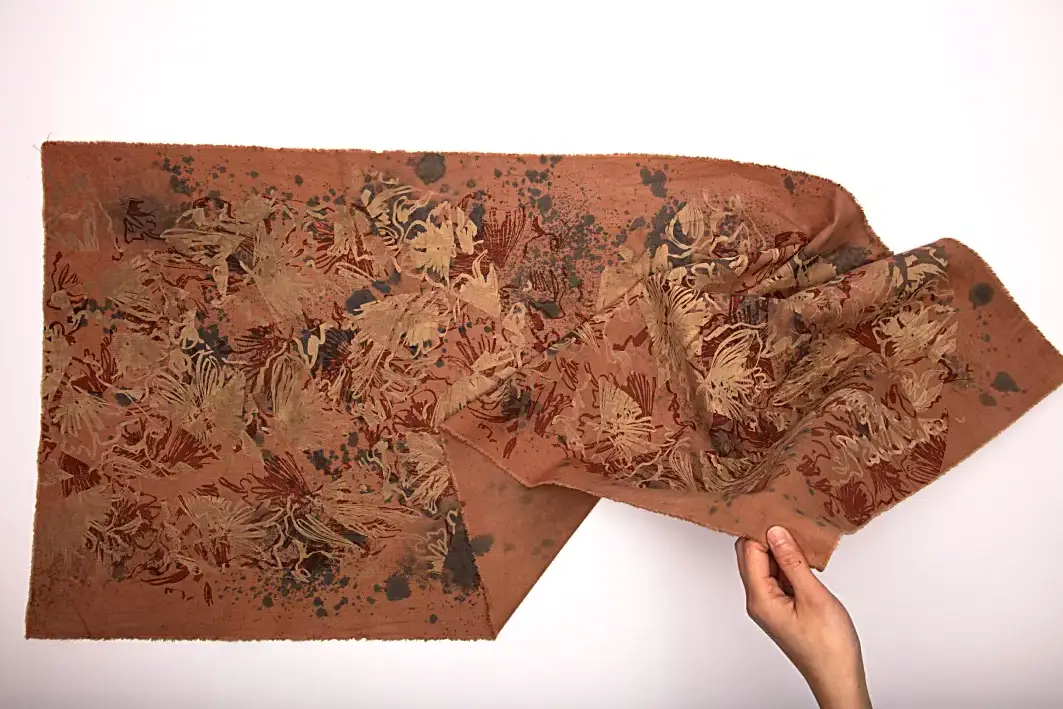
In her designs for Oscar Wilde’s tragedy, Salomé, Liao departs from the purely dazzling, bejewelled brasserie costumes by Leon Bakst for the Ballet Russes. Her vision incorporates the decapitation of Saint John the Baptist, whose head is requested by the Princess in exchange for an erotic dance. Both violence and opulence are embedded within Liao’s textiles for Salomé’s ‘Dance of the Seven Veils’. Raised flame feather motifs traverse against a backdrop of deep, red lightweight silk. The red connotes the duality of lust with foreboding, as the designs turn sinister: blood from the head literally begins to stain a delicate white veil. The heaviness of these smears is stark compared to the weightless appearance of the material in space. It’s an almost painterly rendition of Wilde’s play, where the aesthetic probes the ethical questions posed by its protagonist.
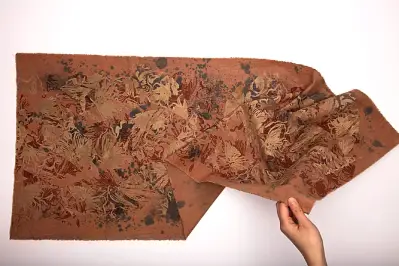
A wardrobe professional at the Royal Ballet and Opera, Liao brings inspiration from the stage even when not strictly working within costume. Her wider textiles practice is often concerned with themes of nature, decay and imperfection. In one layered piece, a tableau of second-hand fabrics from hemp to leather, Liao scratches the surface of the fabric with the unlikeliest of tools — a brush used for Ballet pointe shoes. The fabric itself — rust, ochre and charcoal coloured — resembles tree bark, weathered brickwork, or perhaps stained parchment. In fact, the textile bears the fruit of multiple experiments, something of a testbed. A rusted iron wok, placed on the wet fabric, achieved its aged and eroded effects, as well as burning other natural fibres attached to the piece. Liao’s methods bear careful intention, but they also assert the material’s agency, allowing for sometimes unpredictable reactions. The artificially aged and eroded appearance of Liao’s Decay collection possesses the same imaginative spirit of Salomé, only this time through innovative working processes. Even something as commonly found as Sharpie ink is used by Liao to patch-dye, dispersed with water to create organic patterns. What emerges in both her costume and textile work is a discovery of beauty in disintegration, whether this be the emotional textures of Salomé or physical weathering. Memory and the traces of the individual imprint is of paramount concern. One historical source of inspiration includes Boro, traditional Japanese kimonos that were worn, repaired and mended over many years. The constant maintenance of these garments resulted in rich layering and textures, becoming unique and irreproducible works of art. They convey both the histories of artisans and of the wearers. ‘Boro is rooted in frugality and resourcefulness, standing in stark contrast to the fast fashion and consumerism of today. I find it deeply intriguing, and it relates closely to my ongoing exploration of the beauty of decay’, says Liao. In a landscape of mass-production, Liao’s appreciation for hand-dyed, hand-printed and second-hand materials is a necessary return to singular craft.
Liao is currently preparing for her solo exhibition, scheduled to take place from 16 to 18 August 2026 at 67 York Street Gallery.
Word by Anna Moss: https://www.anna-moss.com/about
Publication date:August 11 2026