A Conversation with Yaxuan Li on Gardens, Perception, and Memory
Interview by Yutong Ye, Curator
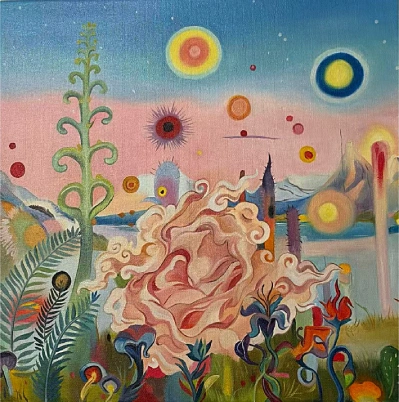
Certain natural forms recur throughout: flowers and foliage, bodies of water, distant mountains, and coloured circles suspended in the sky. They are recognisable, yet difficult to locate within any particular landscape. Plants shift in scale, spatial registers overlap, and colour departs from naturalistic representation. The garden gradually becomes less a physical site than a space constructed through perception, memory, and imagination.
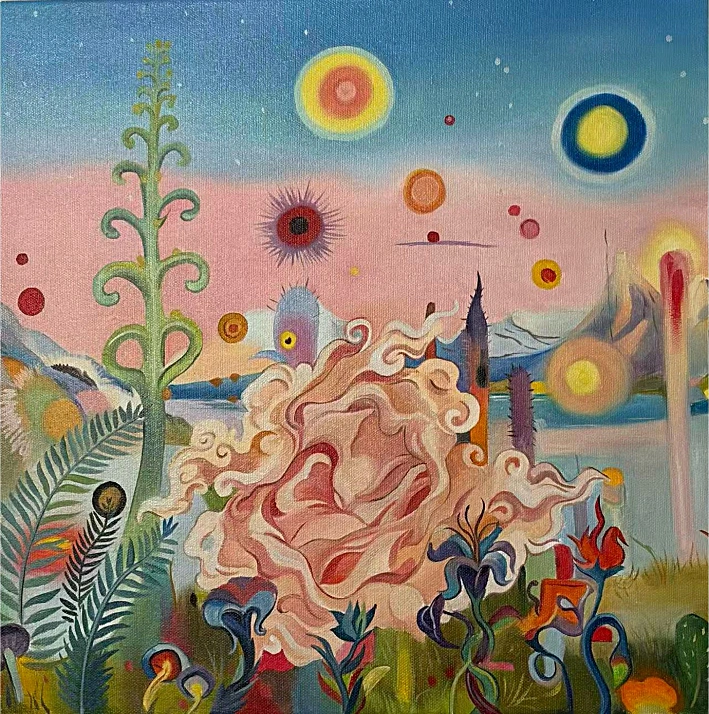
In recent works including Where the Sun Learns to Bloom, Somewhere Beyond the Flowers, and A Memory of a Garden, the flower has emerged as a recurring motif. Yet Li is less interested in faithfully representing botanical species than in what happens to a plant once it enters memory: what remains, what disappears, and what is reconstructed through painting. Our conversation began with flowers, but soon moved towards questions of scale, colour, spatial uncertainty, and the unreliability of memory.
Ye: Flowers and plants appear repeatedly in your recent paintings. How did they become such a persistent motif?
Li: I never consciously decided to make a series “about flowers.” I tend to notice plants in everyday life and often photograph them, but when I begin painting, I rarely work directly from those photographs. I realised that if I returned to a flower after some time, I wouldn’t remember its complete form. What remained might be its colour, the way a petal curled, or simply the feeling of seeing it in a particular place.
Ye: So rather than depicting a flower, is it a reconstruction of your memory?
Li: Yes, remembering a flower involves gaps. I might be certain that it was pink but have no idea what the leaves looked like. I might remember it as enormous because it occupied a significant place in that memory.
That is why scale shifts so much in the paintings. A flower can dominate the foreground while mountains, water, or architecture become very small. Different things simply occupy different amounts of space in memory. For example, the “a” in A Memory of a Garden is important for that reason. It is not the garden, as though there were one original place the painting could recover. It is one possible memory of a garden.
When we remember somewhere, I don’t think we necessarily retain a complete image of it. Perhaps we remember a tall plant near the entrance, water in the distance. After some time, the relationships between those fragments become uncertain. Painting allows me to keep that uncertainty rather than resolving everything into a coherent space.
Ye: I can also see the tension between recognition and uncertainty appear in your work Where the Sun Learns to Bloom. The circle in the sky could be the sun, a planet, or simply a field of light. Even the title gives “blooming,” an action we associate with plants, to the sun.
Li: The circles initially came from the sun, but eventually I didn’t think they needed to remain suns. Once everything is clearly named, the space becomes fixed very quickly: this is the sun, this is the sky, this is the ground. I prefer the circle to remain more open.
With Where the Sun Learns to Bloom, I noticed that the flower was opening outwards, but the circle above it seemed to have a similar sense of expansion. “Blooming” no longer seemed to belong exclusively to the flower. A sun cannot literally bloom, but language can momentarily loosen the categories through which we understand familiar things. The painting does something similar: its elements are recognisable, but their usual relationships have shifted.
I was very conscious of how the viewer might enter that painting. The foreground is dense and colourful, but I didn’t want the eye to stop there. There is a passage through the plants towards the water and mountains.
This also resembles the way a memory can be triggered. You begin with something very specific, but it takes you somewhere else. Seeing a particular flower might bring back a place you once lived, a person, or a moment that did not seem particularly significant at the time. In that sense, the flower becomes an entry point. It is a concrete object, but what it opens onto can be much larger than itself.
Ye: During the recent London Design Festival, your workshop A Garden of Memories extends these questions into a participatory process. You ask participants to draw a flower from memory without looking at a reference image. Why is that absence important?
Li: With a reference image, it is very easy to start judging whether the drawing looks correct. I’m more interested in what remains when there is nothing to rely on.
I don’t necessarily experience memory as faded. Sometimes the opposite happens: as time passes, one part of a memory becomes more intense. It may not become more factually accurate, but subjectively it becomes stronger.
Participants recall a flower connected to a person, place, or experience and draw it from memory. Someone might remember the colour but not the shape; someone else might enlarge one part considerably.
We often treat forgetting as a failure of memory, but in the workshop, forgetting, displacement, and exaggeration can reveal what has actually been retained. A participant may discover that what they remember is not the appearance of the flower at all, but who they were with or how a particular place felt.
In Li’s paintings, the flower is therefore less an object waiting to be identified than a perceptual trigger: a form specific enough to be recognised, yet open enough to accommodate individual experience. Her gardens occupy a similarly ambiguous space. We recognise flowers, water, mountains, and sky, but cannot determine where they collectively belong.
Memory here is not a static archive of the past but an ongoing act of reconstruction. A Garden of Memories transfers this process from the artist’s canvas to the participants’ hands: when a flower must be reconstructed through memory, forgetting, distortion, and imagination become part of how the image is made.
Perhaps this is why Li’s gardens do not ask to be located. The more pertinent question is what happens when a familiar form appears before us again—and where, through memory, it might take us.
Written by:Megan Hartley
14 October 2026