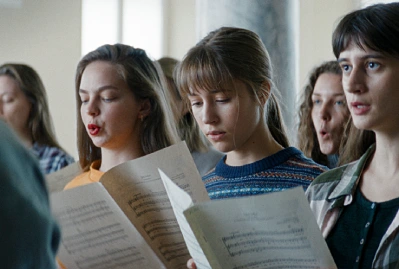
Little Trouble Girls is the debut feature from Slovenian director Urška Djukić, a succinct coming of age story of a sixteen-year-old chorister set over a single weekend in the Italian countryside. What Djukić presents to us is a meditation, bristling with playful curiosity, on religion, sexuality and self-identity, wherein music is used to give force to the female voice.
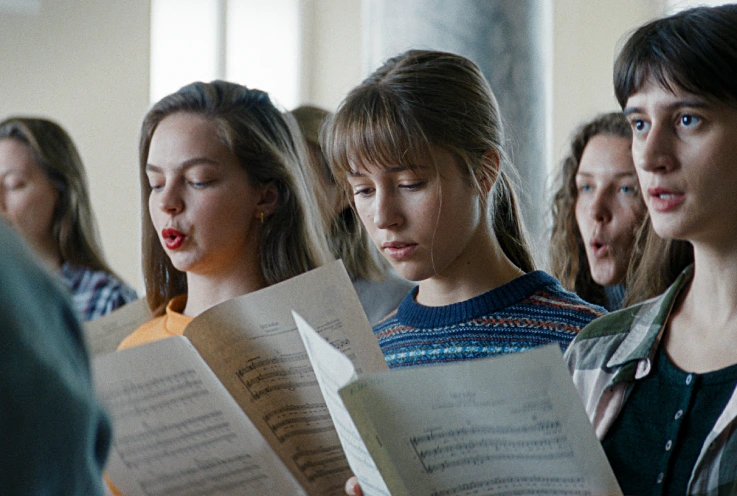
Lucija (Jara Sofija Ostan) struggles to fit in. Growing up in a conservative Catholic family who repress any mention of sex, she finds herself at odds with her instincts and her faith during a sunny weekend of rehearsals in a rural convent. As her relationship with the popular and more mature Ana-Maria (Mina Švajger) blossoms, she begins to question her world, an existential conflict that turns the choir and her conductor (Saša Tabaković) against her. Cut adrift from the music that is her passion and devotion, what will she find in the absence of all she’s ever known?
This film marks Djukić’s first foray into feature length cinema, her previous projects having been short films, the most recent of which, Granny’s Sexual Life, having picked up over 50 awards, including the European Film Academy Award for best short film in 2022 and the 2023 Cesar Award for best animated short film. Yet, she hits the ground running here, establishing the primary character focus and their world from the opening scene. The easily distracted Lucija is thrust into the social sphere of Ana-Maria and a small group of girls during a rehearsal, their camaraderie evident as they swap make-up and gossip. As Lucija watches transfixed by her fellow Alto’s red lips, Lucija’s desire, her repression and her ostracization intersect, and we can only cringe as she’s whisked away by a mollycoddling mother just as she begins to gain acceptance.
The Ljubljana born writer/director seems blessed with that rare gift of both vision and boldness. A minutes-long camera shot of a 14th century illustration of Christ’s wound, which just so happens to resemble a vulva, overlaid with the sound of heavy breathing, opens the film. It’s moments like these Djukić commands total control of the audience’s sensory perspective, with music serving as a powerful transitory motif through Lucija’s awakening. Djukić speaks candidly about how attending a performance by a Slovenian girls’ choir inspired her to want to recapture ‘the power of their voices, teetering on the edge of awakening their Womanhood.’ The recurring scenes of the choir in cloistered rehearsal convey just that, but also work in interrupting the languorousness the film initially feels at risk of falling into.
Metaphor is ever at the forefront of ‘Little Trouble Girls’. The imagery of faith, and nature as sexual awakening, is sometimes straight forward, but nevertheless effective in its immediacy. The characters interact playfully with these symbols as they test the limits of their secular world, and their friendship. During one tender scene between Lucija and Ana-Maria, they eat sour, unripe grapes to atone for their sins, a theme poignantly revisited in the final shot of the film as the credits roll. Metaphor eventually gives way to something more explicit, however, as they encounter a group of male restoration workers on the convent grounds. Their games then take a more serious turn, their friendship with Lucija tested as she becomes mired in confusion, torn between her attraction to a handsome stranger and her deepening affection for Ana-Maria. The tension ratchets up significantly in the final act as the conductor carries out a personal and humiliating excision of Lucija in front of the whole choir. She takes refuge in a cave where a group of nuns perform the rites to a ceremony, and a cascade of imagery signals Lucija’s ultimate transcendence. It’s a worthwhile payoff in a story that never loses sight of its protagonist’s unconventional journey.
Little Trouble Girls, named after the Sonic Youth song that plays over a symbolic final shot of Lucija, is bound to turn heads and garner attention. Regardless, Urška Djukić has achieved no small feat in producing art out of thought provoking paradoxes related to religion and womanhood. We could use a little more of that.
Little Trouble Girls is released in cinemas on 29 August and on BFI Player from 13 October
words Jake Munn