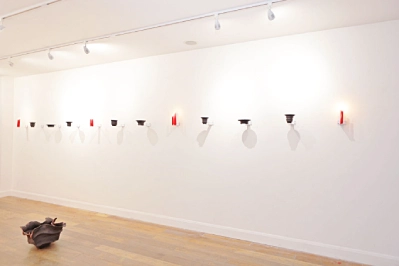
Shavonne Yang’s exhibition ‘Out of Specification’, presented at Fitzrovia Gallery, is structured around a clear and deliberate framework. The gallery is positioned as a testing site, operating under the logic of quality control.
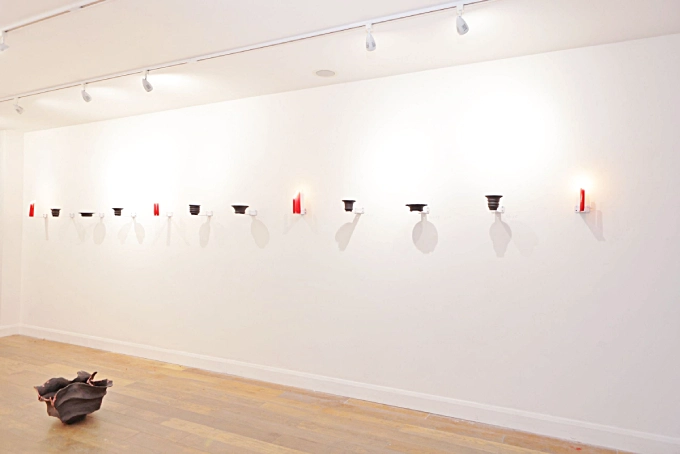
At its centre is AnKang Bio™, a fictional biotech company producing body implants designed to construct a socially compliant female body. Within this system, the exhibition is divided into two bodies of work. The Perfect Female presents the “ideal” output, objects that appear controlled, refined, and resolved. Wrong Vessels, by contrast, occupy the position of failed or rejected specimens, forms that fall outside acceptable limits. The relationship between the two is central. One defines the standard, the other exposes the cost of maintaining it.
The works in The Perfect Female hold a surface of control. Forms appear upright, contained, and stabilised, as if they have successfully met the conditions imposed upon them. Their openings are regulated, their structures held in place. They read as finished objects, but that sense of completion feels imposed rather than natural. What is being presented is not neutrality, but compliance. That sense of control breaks down in Wrong Vessels. These are not containers or functional objects, but vessels that refuse to resolve into stable forms. Their surfaces split, warp, and pull out of alignment. Edges collapse inward or stretch outward under pressure. In several works, the structure appears to have shifted during firing, as if the material has resisted the process that attempted to fix it in place. One vessel sits slightly off balance, its base uneven, forcing the entire form into a subtle lean. The surface is marked by a fracture running vertically from the opening down toward the base, not cleanly broken but stretched, as though the clay has been pulled apart rather than cut. The opening itself is irregular, neither circular nor contained, widening on one side while tightening on the other. It holds together, but only just.
In another piece, the body of the vessel folds inward along one edge, creating a compressed, almost collapsed section that disrupts its symmetry. The surface bears the trace of heat and pressure, with slight distortions where the clay has shifted during firing. These are not decorative effects. They are the result of a material process that refuses complete control. Yang’s use of clay is critical here. The material does not simply respond to intention. During firing, it can crack, warp, or shift unpredictably. Forms that appear stable in their initial construction may alter under heat, resisting the final shape imposed upon them. This behaviour is not corrected or concealed. It is carried through into the finished work. What emerges is a direct parallel between material and body. Just as the clay resists the conditions placed upon it, the body resists the systems that attempt to regulate and define it. The “out of specification” label becomes more than a technical term. It marks a refusal, a failure to conform to imposed standards.
Within this framework, the exhibition moves beyond description and into critique. The Perfect Female represents a constructed ideal, produced through control, discipline, and adjustment. Wrong Vessels expose the instability of that ideal, revealing what happens when material and body do not comply. The work does not present resistance as dramatic or symbolic. It is embedded in the structure of the objects themselves, in the way they hold, shift, and fail to resolve. The forms remain intact, but they do not behave as expected. They carry the evidence of pressure, and in doing so, they refuse the conditions that produced it.
words Alexa Wang
4th June 2026