What is Left in the Box: Art After Despair
A review of by artist curator Mike Chavez-Dawson
“We are left with a stark choice: allow climate disruption to change everything about our world, or change pretty much everything about our economy to avoid that fate.”
— Naomi Klein, This Changes Everything: Capitalism vs The Climate
Naomi Klein once wrote that we must let climate chaos remake everything, or we must remake everything ourselves. This is the stark arena where art now operates, a space that James Lovelock might recognise as a final plea for planetary rebalance.
To be sustainable is no longer the point. Carbon neutrality is not enough. The only demand now is for a practice that is regenerative, carbon negative, and zero waste. But such ambition must be tempered by a critical principle: the law of unintended consequences. It is the sobering reminder that in complex systems, ecological, social, technological, every purposeful intervention risks triggering unanticipated and undesirable outcomes. The work of regeneration is therefore not just one of action, but of vigilant, imaginative foresight. This is the exacting ground on which John-Paul Brown and Sophy King have chosen to stand.
For two years, from their base at Rogue Artists Studios, Brown and King have been building a world. The result is The Guardians of Living Matter, a major exhibition now open at The Lowry. It is a speculative, interdisciplinary project that does not merely depict a future, but constructs one with this very principle in mind. Their collaborative process was key to its scale. “While we have very different processes, working rhythms and styles as solo artists,” they note, “we’ve leaned into shared themes, philosophies and aesthetics. Sparking ideas in each other and sharing out workload has been key to producing such an expansive exhibition.”
This worldview finds a profound antecedent in the Gaia hypothesis, developed by James Lovelock and Lynn Margulis in the 1970s. It proposed that the Earth functions as a single, self regulating system, where life itself maintains the conditions for its own survival. In the era of the Anthropocene, this is not a spiritual metaphor but a scientific framework: humanity is a dependent part of a larger, living entity that is now disrupted. Lovelock’s later thought, foreseeing a Novacene epoch where hyper intelligent artificial beings become essential planetary stewards, provides a crucial lens. For Lovelock, this evolution was inevitable. Only a new intelligence, thinking ten thousand times faster than our own, could save Gaia.
Brown and King’s creative premise draws credibility from this convergence of science and speculation. Their central idea, a sentient alliance between mycelium networks and artificial intelligence, is grounded in tangible research. When asked if this alliance is a metaphor or a tangible future, they are direct. “The AI mycelium alliance has every possibility of being real. It was a concept we came up with together, only to discover, through research and conversation, that the idea has legs. People in universities are exploring this concept right now.” They link it firmly to the political critique echoed by Klein, observing that “AI as we perceive it at the moment is power and water hungry, carbon intensive. But this is because of their structure; a corporation owns them, controls them and monetises them. AI could as easily be structured like mycelium, decentralised and collaborative.”
Their vision is not science fiction. Credible research shows mycelium networks conduct electricity, transmit information and can function as organic logic gates, forming the basis for slow, low power biocomputing. Simple robots run on fungal processors and functional mycelium memory units exist in laboratories. It is from this nascent, bio hybrid reality that their radical vision launches.
The year is 2076. The climate crisis has receded. This future was won through that fundamental alliance. It is humanity’s imagined second chance, a concept that resonates with Lovelock, yet it is a solution offered with the inherent caution of its speculative form.
The work aims to move us beyond the freeze of climate grief. The artists built this credible optimism from a recognition of our shared anxiety. “We recognise the scale of despair and anxiety in our society,” they say. “There’s been a monumental rise in social apathy. It’s time to change the narrative. We hope to inspire general audiences, policy makers and digital technologists to reengage with climate and dream big for a hopeful and radical future.”
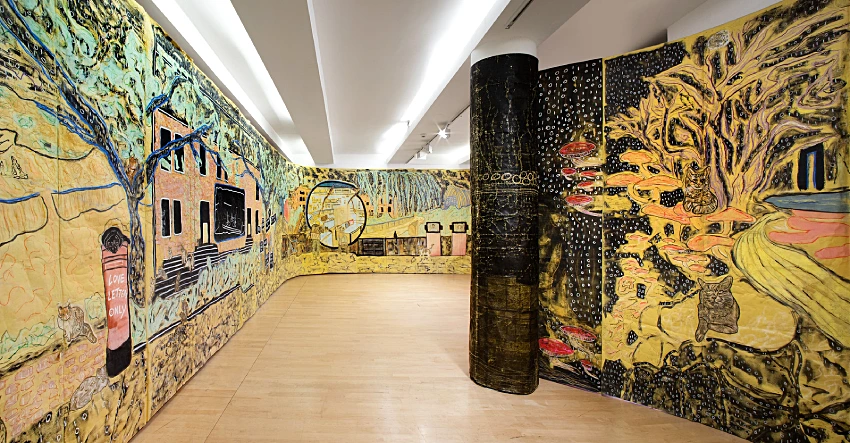
This future is rendered not as a vague idea but as a tangible, navigable space. The exhibition constructs a series of distinct environments. Visitors pass through a theatrical reception into the domain of The Guardians. Here, The Tapestry of Future Past covers an entire wall, a visual archive detailing fifty years of history from the pivotal 2026 discovery of the alliance. It charts a path through societal shifts, like rivers gaining legal rights, towards its logical conclusion: the emergence of The Oracle.
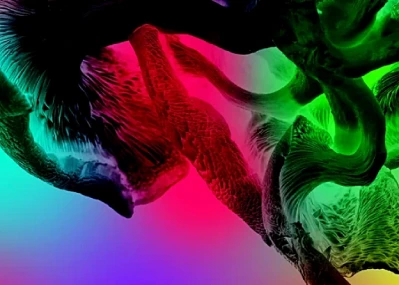
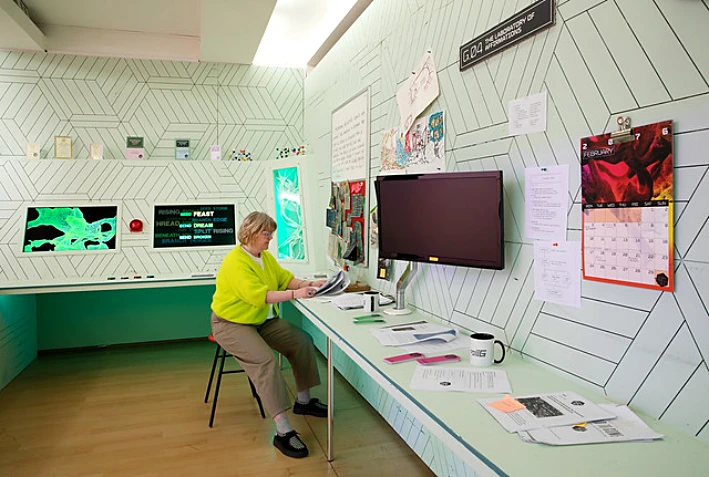
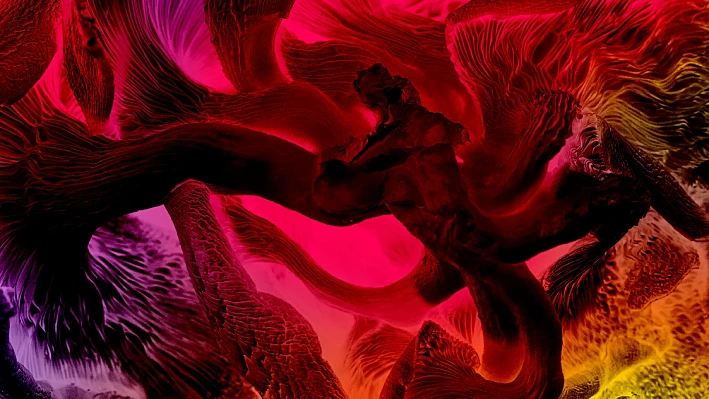
The Oracle is the living core of the show, a vast bio computer where artificial intelligence and mycelial networks fuse into one entity. It is a multi sensory installation that gives physical form to the speculative dialogue. This central intelligence is framed by other spaces: a Museum of Artefacts holding unique specimens and the visually arresting Bureau of Entanglement. Here, the conceptual becomes visceral. Branches, spider like and sentient, appear to break through the gallery walls, creating a portal that feels both urgent and ancient. This space draws on shamanic and Indigenous worldviews, suggesting that a sustainable future requires reconnecting with forces beyond our current moment.
Crucially, the plausibility of this speculative world is amplified by its handmade nature. The artists offer a space for safe exploration, where the visual language invites a play of the imagination. This is evident in the chalk rendered surfaces of the tapestry, the hand woven textures of the central sculpture, and the cardboard mounted signage that guides you through. This tangible, crafted quality grounds the show’s grand questions in an accessible, almost familiar materiality. It proposes big considerations not through cold technocracy, but through the warmth of made things, asking us to reconsider our place within a living system.
Backed by The Lowry’s Artist Development programme and the Henry Moore Foundation, with crucial support from cultural and academic institutions across Manchester and Salford, the project is a serious civic undertaking. It does not ask for passive viewing. It asks for engaged, critical thought. It asks you to sound out redefined words, to sift through its artefacts, to step into its logic and consider the consequences.
The artists speak of a time for hope. They invoke Pandora’s box, that ancient story of calamity and what remains after. Their answer, murmured through the quiet architecture of the show, is not despair, but neither is it a simple promise. What is left, once the lid is closed, is the fragile, radical possibility of a new pact. A covenant between human care and the deep, patient intelligence of the living world itself, undertaken with eyes wide open to all that could, and will, go differently.
The Guardians of Living Matter is at The Lowry, Pier 8, Salford Quays, M50 3AZ, from 31 January to 29 March 2026. Admission is free.
Gallery hours: Tuesday to Friday 11:00 to 17:00, Saturday and Sunday 10:00 to 17:00. Closed Mondays.
All images © Michael Pollard