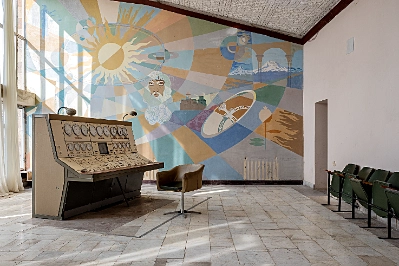
The laboratories remain long after the ideology that built them disappeared. Across the former Soviet republics, vast scientific institutes—radar arrays, observatories, research centres and control rooms. They continue to stand in varying states of decay and operation, monuments to a system that once treated science as both political instrument and utopian ideal.
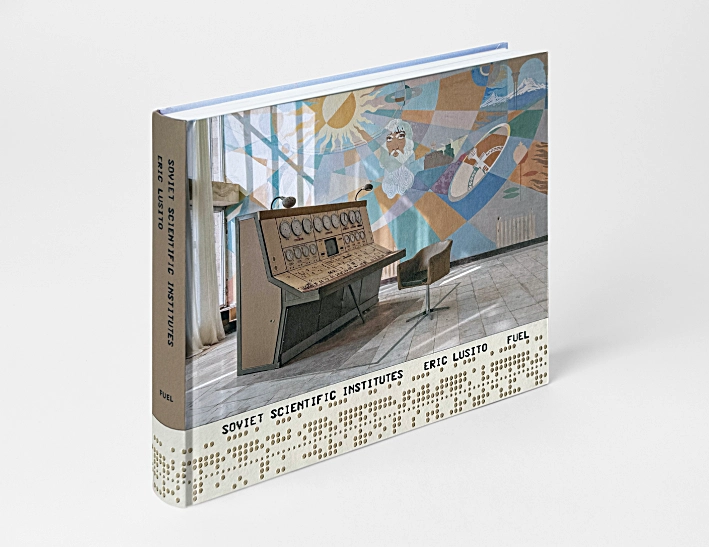
In Soviet Scientific Institutes, photographer Eric Lusito documents these strange, often inaccessible spaces with a restrained eye for their scale, theatricality and lingering sense of purpose.
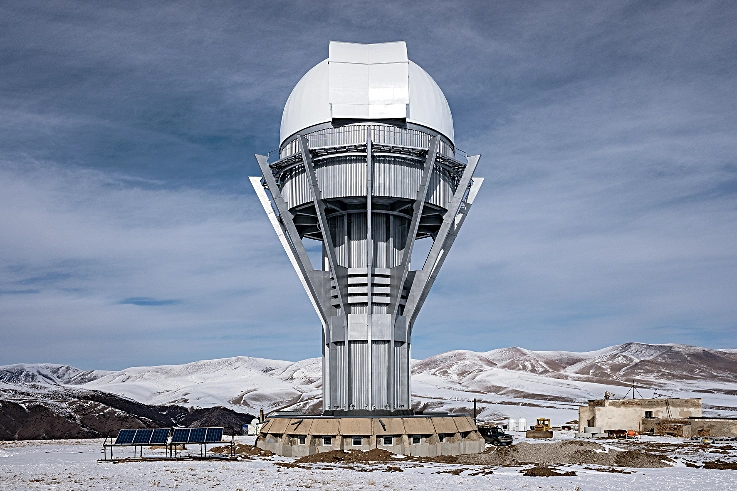
Lusito’s photographs move through a landscape of analogue machinery and monumental architecture: cavernous halls filled with blinking consoles, telescopes pointed toward distant galaxies, and mysterious experimental devices that seem drawn from the speculative worlds of Jules Verne or H. G. Wells. Yet these are not imagined futures, but the remains of an enormous state-sponsored scientific infrastructure developed during the Cold War, when the Soviet Union positioned scientific achievement at the centre of its national identity.
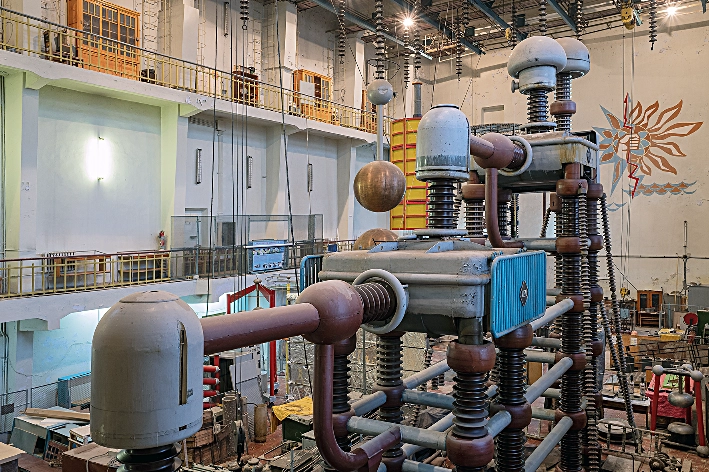
Many of these institutes collapsed into neglect after the fall of the U.S.S.R., their funding withdrawn and their technologies rendered obsolete almost overnight. Lusito’s images capture the melancholy grandeur of these abandoned ambitions, but the book is equally interested in survival. Some facilities continue to operate despite political upheaval and chronic underfunding, maintained by researchers who adapted to the post-Soviet world rather than abandoning their work entirely.
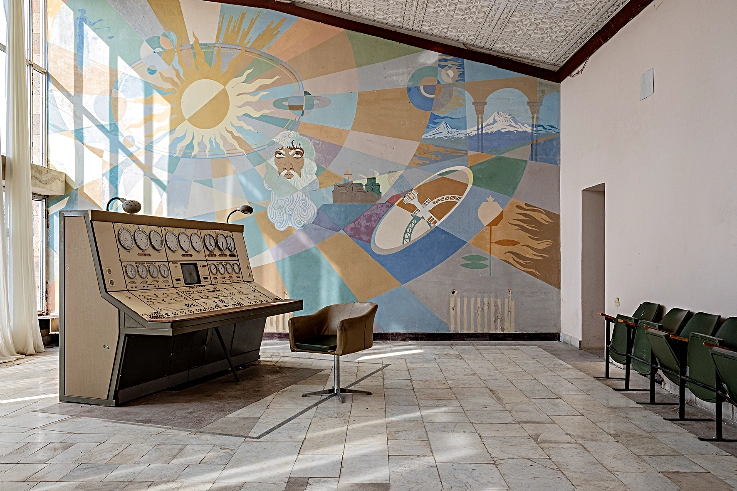
Among the sites Lusito visits are a cosmic ray research centre high in the Armenian mountains and one of the world’s largest radar arrays in Ukraine, a structure so immense that locals reportedly believe it to be a climate-altering weapon. The photographs are accompanied by an introduction from historian Paul Josephson, who places the institutes within the broader history of Soviet technological ambition and its distinctive visual culture of oversized machinery, austere modernism and heroic industrial scale.
What emerges is not simply a study of decay, but a portrait of a vanished worldview still embedded in physical form. Soviet Scientific Institutes records the afterlife of Soviet futurism: a world of machines built to engineer the future, now suspended somewhere between obsolescence and endurance.
Soviet Scientific Institutes, by Eric Lusito, FUEL Publishing
words Al Woods