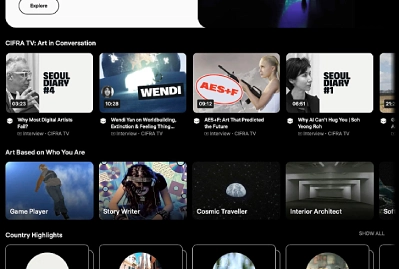
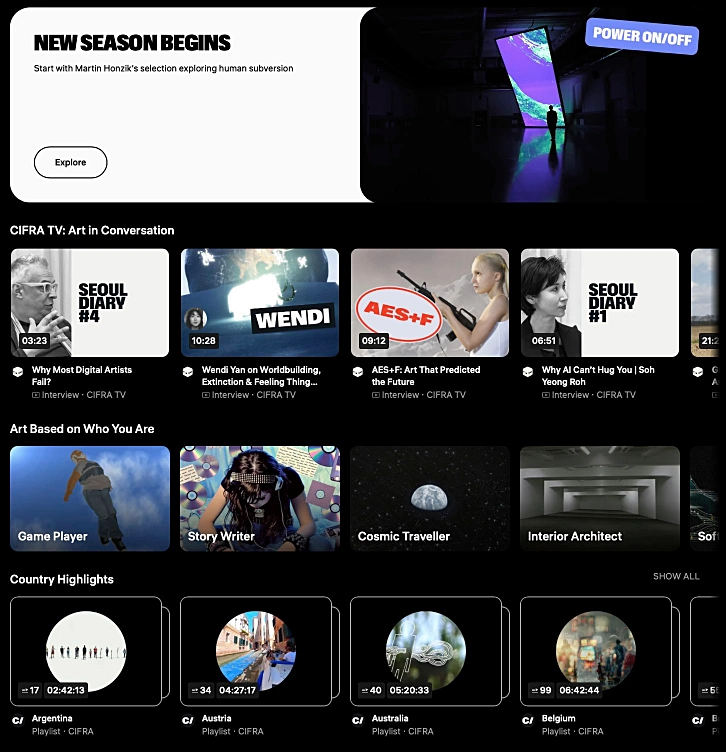
UAE-based media art platform CIFRA has officially launched its new 2026 curatorial season POWER ON / OFF.
The concept of power has always relied on images. Even long before the emergence of algorithms and AI, societies used visual culture in the construction of religions, empires, political ideologies, and even collective identities.
Today, however, images no longer merely represent power, they are being often integrated into its production. Circulating through algorithmic infrastructures, platform economies, and automated systems of classification, they are starting to determine how exactly reality is perceived, organised, and contested.
This visible shift forms the key idea of POWER ON / OFF curatorial season. Rather than approaching power exclusively through politics or institutional structures, the six-month programme investigates its contemporary manifestations across digital technologies, memory, embodiment, and collective imagination. Instead of suggesting a single narrative, POWER ON / OFF is bringing together internationally recognised artists and curators who will explore how contemporary technologies influence the production, distribution and perception of power.
Moreover, it is important to highlight that the new season includes not only exhibitions, curated online selections, educational programming, online meetups, but also new episodes of Uncover with Art, and the next edition of the CIFRA Award.
This season also introduces a new curatorial model experienced by CIFRA. Switching from an exhibition-centred narrative, the principal theme will be explored through several independent levels, creating multilayered research in the new media. Every chapter is designed to provide a deeper insight on the different dimensions of power and how it is experienced in art.
Slow, Wrong, Unfit by Tega Brain and Sam Lavigne
The project Slow, Wrong, Unfit, presents artworks by artists Tega Brain and Sam Lavigne, two artists whose collaborative and individual practices have consistently examined the political consequences of digital infrastructures.
Rather than typically accepting efficiency, optimisation, and seamless automation as indicators of technological progress, the exhibition turns towards slowness, error, friction, and deliberate malfunction. Browser extensions, software interventions, participatory projects, and speculative interfaces become the project’s main heroes – tools for exposing the values encoded within computational systems.
Among the featured artworks, there are both solo and collaborative projects that are dedicated to the examination of the social and political logics embedded in digital technologies. For example, Slop Evader (2025) imagines how the internet might look without the overwhelming presence of generative AI, while Slow LLM (2026) delays its responses, challenging the expectation that AI should always prioritise speed and efficiency. In Zoom Escaper (2021), a browser extension automatically produces convincing reasons to exit online meetings, exposing existing routines of remote work. Slow Hot Computer (2016) reworks conventional ideas of productivity with a computer concept. Looking through Enron’s internal corporate archive, The Good Life (2016–17) recreated one of the corporate scandals of the early twenty-first century through the company’s own records. Unfit Bits (2015) offers a guide to deceiving fitness trackers, questioning the limitations of self-tracking technologies, while Synthetic Messenger (2021) researches the role of digital advertising infrastructures in shaping the process of online news circulation.
This online exhibition belongs to a layer of critical media art that questions the ideology of technological solutionism, the belief that increasingly complex social problems can be solved primarily through computational efficiency. Rather than proposing alternative technologies, Brain and Lavigne expose the cultural assumptions upon which existing systems depend.
human sub:version: Disrupting System-Generated Realities
One more curatorial chapter dedicated to the research of power phenomenon is featuring human sub:version – curated selection by Martin Honzik, former Chief Curatorial Officer of Ars Electronica.
The curated art playlist addresses one of the defining questions of the algorithmic age: what forms of human agency remain possible when computational systems are already organising perception, decision-making, and knowledge production?
Bringing together internationally recognised artists such as: Tega Brain, Quadrature, Vladan Joler, Dorotea Dolinšek, Špela Petrič, Simon Weckert, and VTOL, the exhibition creates a deeply insightful narrative about technological progress. Despite differences in methodology and medium, the participating artists share an interest in revealing technologies as cultural and political constructions that becomes a key game changer, creating multi layered art research.Though their artworks investigate algorithmic infrastructures, digital autonomy, Ai, surveillance, biological systems, and alternative futures.
“Subversion is not mere provocation. It is a specifically human capacity — the ability to question existing systems, imagine alternatives, and make change possible in the first place,” observes Martin Honzik, while speaking about the project. “Art develops new images, narratives, and forms of understanding that do not simply comment on societal transformation, but create the conditions for it to become imaginable, discussable, and ultimately shapeable.”
Across its various chapters, POWER ON / OFF proposes an unconventional regard on the existing concept of power through the lens of media art, tracing its historical relationship with image-making, politics, religion, and collective memory. From the visual cultures that sustained religious belief and political authority to today’s algorithmic systems that shape perception and public discourse, the curatorial season argues with the idea that images have never merely reflected power. In this context, new media art is presented not only as a medium, but as a critical practice that examines infrastructures so often defining contemporary society.
By Sofiia Barysheva