A photograph might tell you where a bunker sits. It cannot tell you how large it became in your mind before a difficult shot. That is the territory Li Xiaojian paints: golf courses stretched and tilted by the experience of playing them.
Over nearly two decades, the Chinese artist has made fairways, bunkers and greens the subject of a sustained painting practice. His solo exhibition, Landscape of Play, brought recent oils and watercolours to London’s Fitzrovia Gallery this summer. These are landscapes with something at stake. A sweep of pale sand can attract the eye while spelling trouble for the player.
Wentworth Club in Surrey has become a recent source of inspiration. In 2025, Reignwood Group, with which he has a close relationship, invited him to visit the club. Known for hosting the BMW PGA Championship, Wentworth gave him fresh ground to explore beyond its familiar tournament image.
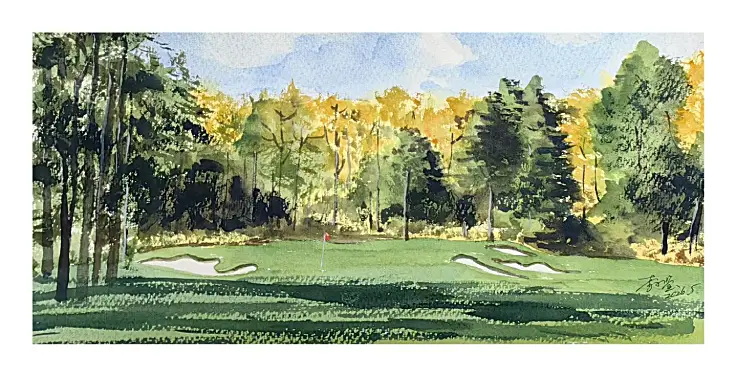
In a watercolour developed following the visit, a dark footbridge crosses the foreground beneath a large tree. Beyond it, water opens towards a green marked by a small red flag. Yellow foliage glows among deeper greens. The flag offers a destination, but the water and overhanging branches make reaching it feel less straightforward.
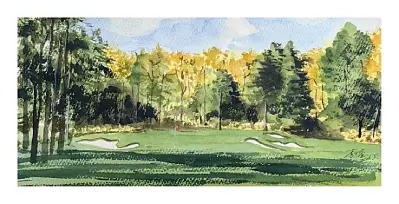
Another painting takes a wider view, stretching a pale bunker across the foreground beneath an open green. The sand catches the eye before the flag does. Across both pictures, the features that make the landscape beautiful also complicate the player’s next move.
That double reading has attracted attention from golf’s specialist press. Golf Monthly Korea devoted an August column and a September interview to his work, with publisher and editor-in-chief Cho Seong-su exploring how he brings the game’s psychological pressures into painting.
His account of why he began gets to the heart of that ambition. He initially asked painter friends to depict golf courses, but their pictures failed to capture what he felt while playing. He eventually picked up the brush himself.
A player sees more than grass, water and trees. Each feature carries a consequence: a promising line, a risky shortcut, somewhere a ball might disappear. Li’s process starts with those possibilities. He prefers to play a new course first, then walk it again, recording the places that stay with him.
Back in the studio, memory can upset the geography. The magazine’s August column describes how a difficult bunker experience in Hainan informed his enlarged depictions of bunkers at Mission Hills. Greens tip towards the viewer and distances contract. What felt formidable during the round can claim more space in the painting.
He connects this invitation to imagine playing with Chinese landscape painting. Traditional ideals, he explains, value places suitable for wandering and dwelling. He proposes another possibility: a landscape suitable for playing golf. The addition is playful, but precise. He wants viewers to enter the picture mentally and begin considering a shot.
The putting green becomes the focus of that encounter. He describes it as the protagonist of his work, where hope, pressure, precision and disappointment meet. Slopes and hazards guide attention towards it, bringing the drama of an entire hole down to a small patch of ground.
As that focus developed, human figures gradually disappeared. He found that empty courses created a stronger connection with the viewer. Their solitude echoes his understanding of golf: each player must choose how to approach the next shot and live with the result. With nobody pictured taking it, the decision hangs in the air.
Watercolour gives these scenes lightness and shifting atmosphere; oil lends the terrain greater weight through colour and surface. His choice is also practical. He generally uses oil when time permits, particularly for larger works, and turns to watercolour when time is limited.
Britain’s courses continue to feed his imagination. Alongside Wentworth, Li Xiaojian singles out St Andrews Old Course as the place that has impressed him most, valuing its relationship with the surrounding environment and local residents as much as its history.
His paintings bring that attention back to the scale of a personal encounter. The fairway opens ahead, a bunker interrupts the view, and the flag waits in the distance. Before long, the viewer is weighing a route of their own.
Landscape of Play was held at Fitzrovia Gallery from 28 July to 2 August 2026.
Written by:Nick Banning
Publication date:22 September 2026