

There was a time when buying drum gear meant a Saturday pilgrimage: you’d walk into a local shop, tap a few snares, squint at cymbal lathing under fluorescent lights, and leave with something you felt in your chest, not just read on a spec sheet.
Now, most of that browsing happens with a trackpad and a mug of coffee between meetings, after rehearsals, or during the quiet hours when you’re trying to upgrade your rig without derailing your week.
Online buying isn’t the problem. The problem is that professional-grade drum gear is high-value, high-precision, and surprisingly fragile. A kit isn’t a book you can toss into a cart and forget about. It’s shells, edges, hoops, finishes, stands, pedals, electronics, warranties, and logistics; all bundled into one decision.
The best online drum retailers understand this and build an experience that protects you before, during, and after checkout. Here’s how to spot the real ones.
1) Look for real drum people, not scripted customer service
A top-tier retailer doesn’t treat drums like generic inventory. They treat them like instruments. That usually starts with staff who speak the drummer; not just “order support.”
Before you buy, test them:
- Do they offer help choosing between shell materials based on the sound you want (not just the price)?
- Can they explain why a 14×6.5 snare might sit differently in a mix than a 14×5.5?
- Do they understand hardware compatibility; rack clamps, pedal feel, hi-hat stands with double-braced legs, beater angles, and stage durability?
- For electronic kits: can they talk honestly about pad feel, triggering, hi-hat realism, and module workflow?
If a site has a “drum specialist,” “gear expert,” or dedicated drum department (even a phone line that actually gets answered by someone who plays), that’s a huge green flag.
This is especially important for buyers looking to buy electric drum sets for adults online, where pad feel, triggering accuracy, and long-term module support matter as much as specs on a screen.
Retailers such as Drum Center of Portsmouth stand out precisely because their staff understand these nuances firsthand, helping players make informed decisions that go far beyond bullet points and product descriptions.
2) Demand high-quality media: not just photos, but proof
“Stock photo retail” is fine for cables but risky for instruments. The best retailers reduce uncertainty with high-resolution, accurate product media, especially for:
- Natural wood finishes (grain varies)
- Hand-hammered cymbals (no two are identical)
- B-stock or open-box items (condition matters)
- High-end snares (bearing edges, throw-offs, hoops)
What great looks like:
- Multiple angles, close-ups, and detail shots
- Clear views of finish, hardware, and any cosmetic variations
- “Actual item photos” for premium cymbals or unique finishes
- Video walkarounds for kits or flagship electronic sets
- Audio samples (when relevant), ideally unprocessed
A retailer that invests in better media is telling you something: they expect informed buyers, and they’re confident in what they sell.
3) Scrutinize shipping like you’re touring next week
Pro gear has to arrive ready, not “hopefully fine.”
Shipping is where great retailers separate from “warehouse with a checkout button.” A professional drum retailer should be transparent about how they pack and protect gear, because drums are awkward: big boxes, delicate edges, heavy hardware, cymbals that can flex or crack if mishandled.
What to look for:
- Clear packing standards (double-boxing, padding, edge protection)
- Shipping insurance details (what’s covered, what’s not)
- Signature-required options for high-value orders
- Tracking that updates properly
- Honest timelines for backordered items
If the site has vague shipping language, or if reviews repeatedly mention damage, delays, or “support vanished after shipping,” treat that like a warning label.
4) Make returns and exchanges part of your buying decision
Professional-grade gear is personal. The “right” cymbal or snare on paper can feel wrong in your hands. So returns aren’t a perk, they’re part of the safety net. A quality retailer makes this easy to understand upfront:
- Return window length (30 days? 45 days?)
- Whether returns require original packaging
- Condition rules (especially for cymbals, heads, and electronics)
- Return shipping costs and restocking fees
- How exchanges are handled (fast swap vs. slow refund cycle)
A pro-friendly retailer doesn’t punish you for being discerning. They design policies that respect the fact that feel and sound are subjective.
Learn how proper packaging and shipping insurance protects high-value shipments.
5) Confirm warranty support and aftercare
A purchase isn’t the end. It’s the start of ownership, and ownership is where electronics glitch, pedals squeak, hardware loosens, and modules need updates. The best retailers are built for the “what if” moment:
- Do they help coordinate warranty claims?
- Is there tech support for electronic kits (modules, triggers, firmware)?
- Do they offer manufacturer-authorized service pathways?
- Do they provide real troubleshooting, or just a link to a PDF manual?
For electronic drum buyers, this matters even more. A module issue shouldn’t turn into a month-long email chain. Great retailers move quickly, speak clearly, and solve problems without drama.
6) Check inventory depth
A serious drum retailer should carry more than what’s trending on social media. Pros (and serious students) need choice:
- Multiple cymbal weights and sizes
- Alternate snare depths and materials
- Pro-level hardware lines (not only entry bundles)
- Replacement parts and accessories
- Upgrades for e-kits (pads, kick towers, hi-hats, racks)
Also look for honesty around availability:
- Do they show real-time stock status?
- Are backorders clearly labeled?
- Do they provide estimated restock dates or vague “ships soon” language?
If the site feels like it’s guessing, your timeline will pay the price. Pros need more than one size, more than one accessory, and strong retailers understand essential gear needs (from stands and tuners to tech tools).
See Flux’s gear essentials list for instruments.
7) Evaluate pricing like a professional
Pro buyers aren’t just hunting discounts; they’re hunting value. Great retailers tend to be clear about:
- What’s included in a kit (shell pack vs full hardware vs cymbals)
- Bundle details (and whether you actually save money)
- Price matching policies (if any)
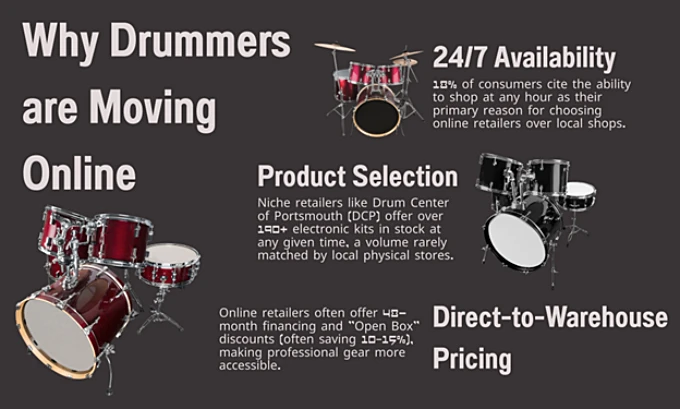
- Financing options (if offered) with readable terms
Be cautious of “too good to be true” pricing from unknown sellers, especially for premium cymbals, flagship e-kits, or high-demand snares. Counterfeit and grey-market gear exists, and it’s rarely worth the risk.
Pro buyers aren’t just hunting discounts; they’re hunting value, and smart budgeting matters when investing in pro gear (see how to save money when buying musical instruments).
8) Look for education and community
The best drum retailers support drummers. That shows up in content and community. Trust signals include:
- Tuning guides written by drummers (not SEO filler)
- Comparisons that explain why something matters (not just specs)
- Video demos that feel honest, not overly produced sales clips
- Artist features, webinars, or clinic-style learning resources
A retailer that teaches tends to care. And a retailer that cares tends to do the basics; packing, support, authenticity properly.
9) Read reviews like a detective (and avoid review theatre)
Reviews matter but only when you know what you’re looking at. Prioritize:
- Verified purchase reviews
- Details about shipping condition
- Notes about customer service response times
- Specific experiences with returns or warranty support
Be wary of:
- Pages with only glowing five-star reviews
- Repetitive phrasing (can signal filtering or fakery)
- No mention of packaging quality (odd for drum buyers)
Also check what drummers say outside the retailer’s own site; forums, groups, and community spaces tend to surface patterns quickly.
10) Do a two-minute “legitimacy check” before you spend big
This is the unglamorous part; but it prevents regret. Before you buy:
- Confirm business address and contact details
- Look for secure checkout indicators and recognizable payment options
- Check privacy policies (especially if you’re creating an account)
- Confirm clear tax/VAT/duties info if buying internationally
- Search the retailer name + “returns” or “damage claim” to see patterns
Professional-grade gear purchases should feel confident, not anxious.
Conclusion
A great online drum retailer doesn’t just move boxes. They reduce risk, provide expertise, and stand behind your purchase with logistics and support that respect the realities of real musicianship practice schedules, studio deadlines, gigs, tours, and the simple truth that drums are personal.
If you find a retailer with drum-savvy staff, honest media, robust shipping practices, fair returns, credible warranties, and an actual relationship to the drumming community; you’re not just buying gear.
You’re buying peace of mind, delivered.