There’s something slightly funny about trying to measure a walk.
Not distance. That part is easy. But the feeling of walking. The way a street tilts your mood, how a corner shop can make a neighbourhood feel like it’s holding you, how one underpass can turn “a quick stroll” into a small act of nerve.
And yet we’ve tried. We’ve built numbers for it. Scores, heat maps, “amenity density”. As if the city is a spreadsheet and our bodies are just the cursor moving through it.
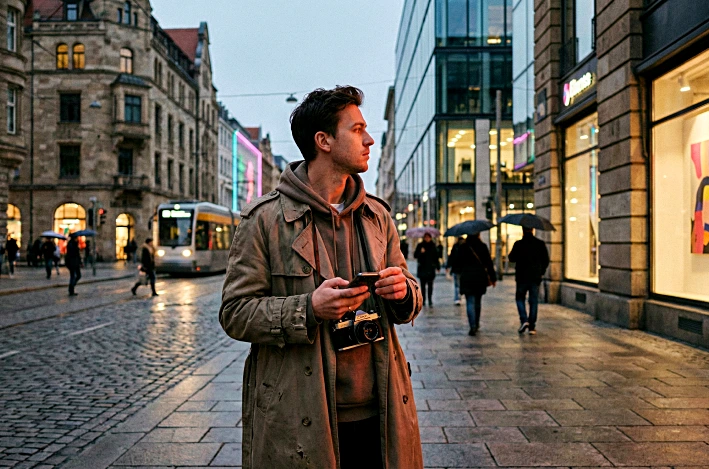
From an urban studies perspective, this isn’t surprising. Cities have long been managed through abstraction. Zoning maps, traffic models, land-use ratios. Walkability metrics sit neatly in that lineage, translating lived experience into something legible to planners, developers, and investors.
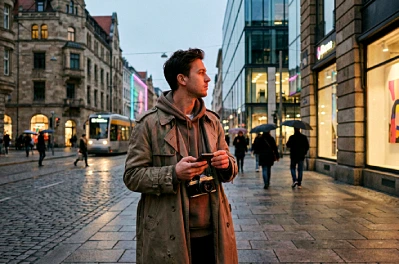
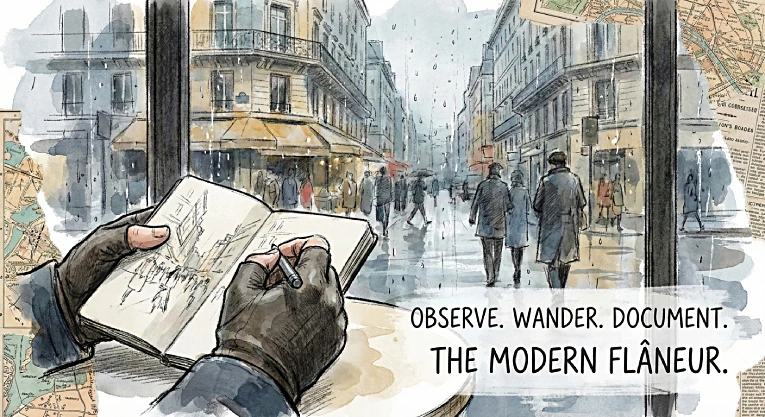
The modern flâneur, that old figure of drifting attention and purposeful aimlessness, now moves through this quantified city. Still wandering, but increasingly surrounded by invisible frameworks that shape where wandering feels possible.
But the flâneur was never only about movement. It was about perception.
The flâneur isn’t lost. They’re listening.
The classic idea of the flâneur, Parisian, poetic, slightly smug, always carried a kind of romance. The lone walker absorbing the city as a living text. The shop windows. The faces. The half-heard conversations. The strange little theatres of everyday life.
Urban theorists might describe this as “reading the street”, an attentiveness to how space communicates through rhythm, repetition, and interruption. What feels welcoming. What feels hurried. What invites pause.
That sensitivity is echoed in art that resists a single, stable point of view. Work that distorts perspective not to confuse, but to reveal how seeing is always conditional. An exhibition examining how André Kertész and M. C. Escher bend reality in different mediums offers a useful parallel, placing perception itself at the centre of experience rather than treating it as neutral or fixed.
Like the flâneur, these artists linger. They observe how order and chaos coexist, how structure never fully contains lived reality.
Walkability is not convenience. It’s a kind of trust.
A high Walk Score, or any similar metric, mostly tells you this: you can access a lot of things without a car.
Useful. Practical. True.
But urban life is rarely decided by access alone. It’s shaped by how space feels over time, how predictable or forgiving it is, how much cognitive effort it demands. Whether walking becomes a default behaviour or something you only do when conditions are perfect.
Real walkability is psychological. It’s the sense that the street is on your side.
Two areas with similar amenities can produce very different walking cultures. One might feel efficient but brittle, all exposure and speed. Another might feel slower, greener, more legible, even if it offers fewer destinations. From an urban studies lens, this comes down to scale, enclosure, continuity, and social presence.
That distinction is explored in this guide to walkable neighbourhoods for Toronto, which looks beyond headline scores to the elements people consistently respond to on the ground: tree cover, lighting, block length, park access, and the everyday rituals that make streets feel usable rather than merely passable.
The city here becomes less a network of points and more a series of lived routes.
Attention is the new urban currency
There’s a particular kind of walking that feels less like getting somewhere and more like entering a state.
You stop checking the time.
Your thoughts loosen.
Your senses sharpen.
Urbanists often talk about this as a form of low-stakes engagement with space, a way cities support mental restoration simply through movement and exposure. But the contemporary city increasingly competes for attention rather than releasing it.
Screens in stations. Ads on buses. Cafés designed for visibility rather than comfort. Even neighbourhoods marketed as “walkable” are often curated for consumption first and dwelling second.
That tension helps explain the rise of structured exploration. Tours, themed routes, curated experiences. They provide orientation and narrative in environments that might otherwise feel fragmented. A broad overview of the different ways people explore New York illustrates how walking is often framed as something to be guided, explained, or optimised.
The flâneur sits slightly outside this logic. Their walk isn’t about mastery or coverage. It’s about encounter.
Safety isn’t the absence of danger. It’s the presence of life.
Much of what makes a street walkable has little to do with infrastructure alone. It has to do with social signals.
Do other people linger here. Do they move at different speeds. Are there reasons to pause.
Urban studies has long recognised this as informal surveillance, not policing, but the quiet reassurance that comes from shared use. Streets where life unfolds in layers tend to feel safer than those designed purely for throughput.
When streets empty, the mind fills in the gaps. When shopfronts go dark, walking speeds up. When there’s nowhere to sit, no windows to look into, no small invitations to stay, the body reads it as a warning.
The flâneur responds instinctively to these cues. They interpret space the way people interpret tone or body language. Quickly. Intuitively. Often before conscious thought catches up.
The best walks have a plot
A good walk isn’t only a route. It’s a narrative.
There’s a beginning: the decision to leave the house.
There’s texture: the shift from quiet side street to busier strip, the way a park recalibrates your breathing, the subtle sensory edits a city makes as you move through it.
And there’s an ending that isn’t really an ending, because a walk leaves traces. A mood. A sense of orientation. A slightly altered relationship with the place you’ve just passed through.
This is what metrics struggle to capture. Walking is not only a means of transport. It’s a form of everyday urban participation.
The flâneur doesn’t just access amenities. They absorb patterns. They notice how a city holds them, or doesn’t.
And perhaps that’s why walking still matters so much.
In a culture that prizes efficiency, walking remains one of the few ordinary acts that allows space for reflection without demanding productivity. It reminds us that cities are not only systems to be optimised.
They are environments we learn, slowly, to inhabit.