By Clara Whitmore – January 7th 2026
In Breath (2022), Liu Daheng presents a restrained yet uncompromising performance that addresses suffocation as both a bodily experience and a social condition. Realised as a public performance and video work, Breath treats respiration not as a neutral biological function, but as something shaped, restricted, and controlled by the spaces we move through. The work forms part of Liu’s ongoing professional practice, which examines queer embodiment, endurance, and the pressures exerted on the body within public environments.
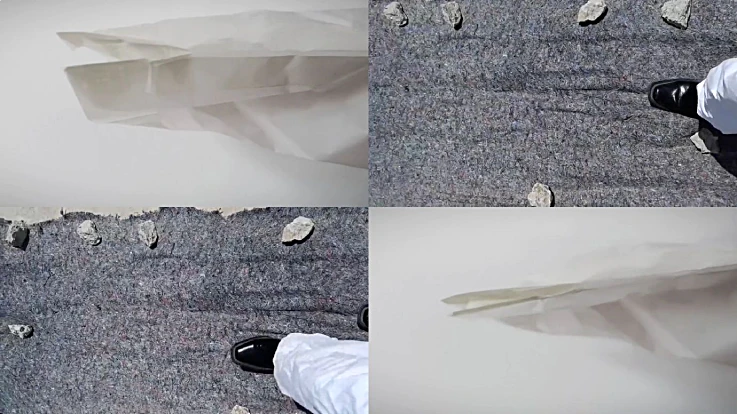
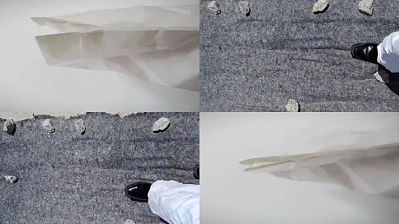
The performance is deceptively simple. Liu walks through urban spaces with a paper bag sealed over the mouth, forcing breathing to become rapid, shallow, and visibly strained. As the lungs work, the bag expands and collapses, turning breath into something fragile and unstable. Movement continues, but never comfortably. What unfolds is a careful balance between control and collapse, where forward motion is possible only at the cost of physical discomfort.
Rather than relying on overt drama, Breath insists on duration. The work unfolds slowly, through repetition and persistence. Dizziness, imbalance, and staggered steps are not exaggerated but allowed to accumulate. In this way, the performance reflects the continual negotiations required of queer bodies within patriarchal and heteronormative public space. Suffocation here is not symbolic alone. It is enacted through rhythm, limitation, and endurance.
The paper bag plays a crucial role. It functions less as a prop than as an interface between the body and its surroundings. Air is filtered and restricted. Breathing must be managed. The bag becomes a temporary structure for survival, mediating between vulnerability and external pressure. Through this simple device, Breath reveals how social norms extend their reach into the most basic act of living.
Set within non-specific urban locations, the performance gains a heightened sense of alienation. Concrete surfaces and anonymous public zones offer no shelter or grounding. Even when no one appears to be watching, the body remains under constraint. Movement becomes a form of negotiation rather than freedom. Each step forward feels provisional, marked by exhaustion as much as intention.
Formally, Breath is disciplined and precise. The pacing of the video documentation, the grain of the image, the sound of breathing, and the pauses between movements are carefully held in balance. Liu avoids explanation and narrative framing, allowing repetition and discomfort to carry the work’s emotional weight. The result is a quiet intensity that builds over time.
One of the work’s most compelling gestures is its treatment of breathing itself. Usually invisible and unnoticed, breath here becomes audible, visible, and political. It is no longer background activity but exertion. Breath asks what it means when survival must be consciously negotiated, when even breathing becomes an act shaped by social limits.
Breath sits within a broader lineage of body-centred and endurance-based performance, yet it avoids grand statements or spectacle. Its strength lies in restraint. By combining minimal action with sustained physical pressure, Liu offers a clear and affecting account of queer survival as an ongoing, embodied process.
Ultimately, Breath is not a performance about symbolism or metaphor, but about lived pressure. It makes visible the forces that restrict movement, expression, and presence. In doing so, Liu Daheng presents survival not as triumph, but as persistence, measured in steps taken, balance maintained, and breath continually reclaimed.