Little Trouble Girls, a sensual and thought provoking coming of age tale, is a debut brimming with poetic imagery that is sure to satisfy many. This is by no means Slovenian writer/director Urška Djukić’s first project, however. In 2021, Djukić and co-director Emilie Pigeard found success with Granny’s Sexual Life.
It collects the testimonials of anonymous Slovenian women from Milena Miklavčič’s book, Don’t Play with Fire, Ass and Snakes, and explores how different sexual relationships used to be in the first half of the 20th century, women’s lack of agency in this era and the mistreatment they endured at the hands of their husbands. It won the European Film Award for Best Short Film in 2022, and in 2023, continued its streak by picking up the Cesar Award for Best Short Animated Film. It was a meteoric accomplishment for a 2D animated film that is, in contrast to Little Trouble Girls, bitesize in scale.
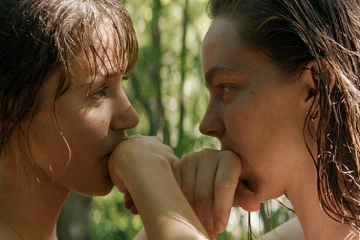
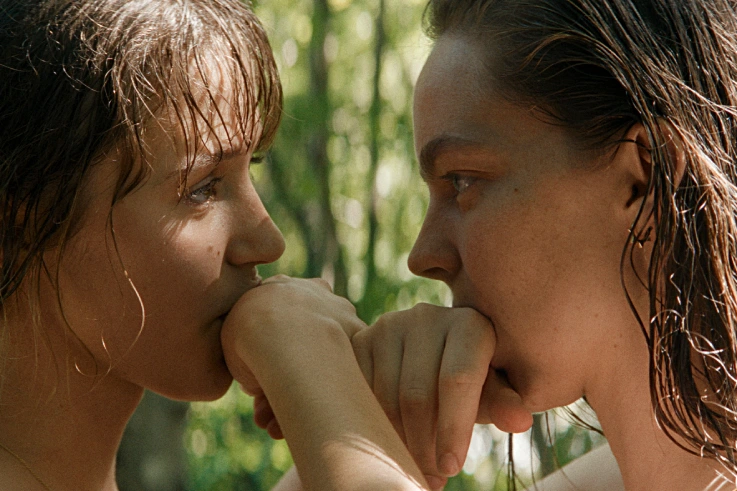
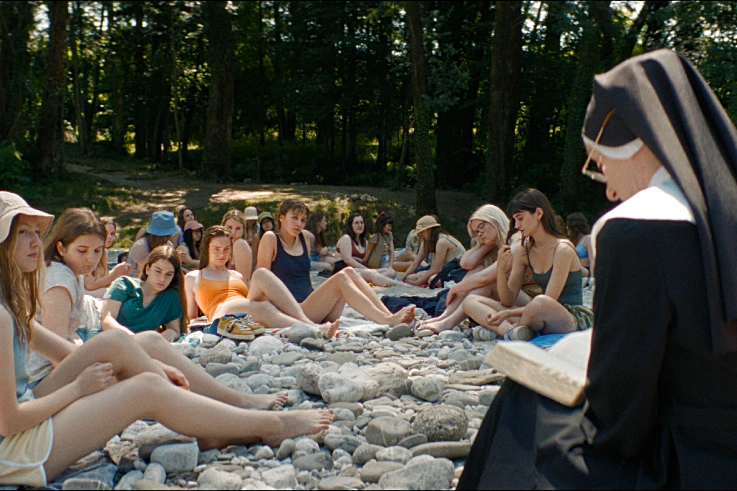
The religious repression of female sexuality is also central to Little Trouble Girls. The film follows 16 year old Lucija, a shy, disconnected girl who sings alto in a Catholic choir. During a weekend retreat of rehearsals in the Italian countryside, she grows closer to her more outgoing friend, Ana-Maria; however, their growing desire for each other conflicts with Lucija’s upbringing, sex being a topic of utmost taboo within her devoutly Catholic household. To complicate matters further, she’s also tempted by a male restoration worker at the convent, and the ensuing confusion of her emerging womanhood begins to drive a wedge between her, her friends and the choir at large.
The film had been in development since 2019 during Djukić’s Cannes Cinéfondation Residency. Side by side with Granny’s Sexual Life, Little Trouble Girls, then, feels like a maturation of ideas that have been stirring Djukić creatively for some time. What Little Trouble Girls teaches us, however, is that far from being ideals of a bygone era, these deeply held societal attitudes towards religion, sex and femininity are still all too present. Through the film, we witness, literally as well as metaphorically, a voice stolen by religious constriction, and then found again.
It’s been a busy year for Urška Djukić. On top of promoting the international release of her debut, she’s raising a new-born and in the process of relocating. She graciously took time out of her busy schedule to discuss with Flux Magazine her influences, themes, and the process of working with such a talented cast of up and coming stars.

Which directors inspired you growing up and did these influence Little Trouble Girls?
I feel a strong connection to filmmakers who work through improvisation, such as Mike Leigh and Valeska Grisebach. Their films achieve a striking level of realism and you believe the actors completely. It feels as though everyone is truly present, genuinely engaging with the world around them, which I see as essential in cinema. One of the most significant influences on my work has been Lucrecia Martel, particularly her film The Holy Girl. It explores adolescent female sexuality in a subtle yet subversive way, and her approach has influenced my own perspective on Little Trouble Girls.
There are a number of complex themes running through the film that work so harmoniously together. Were these pre-established or did you discover them during production?
For me, the creative process is intuitive and exploratory. I’m drawn to themes that resonate personally and have broader social relevance. I rely on inner guidance and intuition, often uncovering the core of a film during its development rather than at the outset. My journey began with an exploration of the female voice, long silenced and suppressed throughout history. I sensed that, even today, vocal expression remains a struggle for many women. This focus on voice naturally led me to the body. Gradually, my attention shifted to the experiences of a young girl navigating the tension between her physical awakening and the societal expectations that seek to contain it. I began to ask: How can one come to understand the world through the body? How do we learn to trust our senses? The body holds an innate, instinctive intelligence, one that can guide us if we learn to truly listen. Those who are deeply attuned to their bodies are often less naive, as they tend to follow their internal compass rather than external pressures.
The scene in which the conductor berates Lucija on her performance towards the end was difficult to watch. It’s a compelling performance from both Jara Sofija Ostan and Saša Tabaković. How did you approach directing such a tense moment and handling those performances?
We started working with the actors very early and held numerous rehearsals. Together with actress Nataša Burger who supported me as an acting coach with her extensive knowledge of improvisation, we developed a series of exploratory exercises. These began as abstract tasks and gradually transitioned into concrete scenes from the script. This process allowed us to deeply examine even the smallest gestures and motivations of each actor, in order to achieve a sense of authenticity and realism on screen. We created this scene, filmed in a single take, using the same approach. We thoroughly explored the psychological layers of the moment. We shaped the conductor as a man who isn’t fully in touch with himself and therefore seeks to control his environment. When someone crosses a line, his carefully constructed persona begins to fall apart, and he reacts in an exaggerated and inappropriate way, out of either fear or frustration. Jara’s performance was truly coming from the discomfort of the body, as a reaction to this agression. All of this remains largely in the subtext, but it doesn’t take much for the viewer to understand what’s happening beneath the surface.
There’s a wonderful chemistry between Ana-Maria and Lucija. How did you build that relationship between the girls, and the choir as a whole, behind the scenes?
I believe type casting is essential for creating authenticity in film. Jara Sofia Ostan, who plays Lucija, immediately stood out among 60 audition tapes. There was something magical about her, like an old soul in a young girl’s body. Mina Švajger, cast as Ana-Marija, brought a fearless energy and wild blue eyes that perfectly contrasted Lucija’s quiet sensitivity. Together, they embodied a kind of yin and yang—two opposing yet complementary forces.
Neither of them had much singing experience prior to the film, so we brought in a vocal coach and organized regular singing lessons alongside intensive improvisation rehearsals. Spending so much time together helped them build a genuine bond, which was crucial. In the end, the most important element is the chemistry between actors, that intuitive connection where they truly feel each other and offer mutual support. Without that, it’s better to cast someone else.
What interested me most was the idea of attraction. What is it that truly draws us to someone, or something? It’s not always about sexual desire. Sometimes, we’re drawn to a quality someone else has; something we feel we’re missing, but deeply long for. That, too, is a kind of sexual energy. The relationship between Lucija and Ana-Marija is rooted in this idea. Lucija is pulled toward something she doesn’t yet understand that both unsettles and awakens her. It’s a force she instinctively senses is essential to her personal growth.
Was it difficult deciding which songs to use in the film where music is such an important part of the narrative?
The search for the film’s music began during the screenplay writing process and was a truly enriching experience, as I explored a vast range of music. I was particularly drawn to Slovenian folk songs, whose themes and atmosphere perfectly complemented the mood of certain scenes. Towards the end of the film, we feature a very old Italian prayer suggested by our collaborator, vocal artist Irena Tomažin. Together with Jasna Žitnik and a group of selected singers, she adapted and performed the prayer in the scenes where the sisters sing in the cave and beneath the waterfall. The song’s powerful vibration deeply moved everyone on set. While filming, we all felt the profound strength of this ancient prayer, which speaks of cleansing and renewal.
The film closes with the well-known song “Little Trouble Girl” by Sonic Youth, which also inspired the film’s title. The track beautifully encapsulates the story and themes of the film.
How long did the choir rehearse for before production began?
We formed our own project choir about six months before filming began. After organizing an audition for female singers, we selected 30 girls and later included four of our actresses, who at the time had little to no singing experience. That’s when the real work began.
The choir was led by conductor Jasna Žitnik, and actor Saša Tabaković who plays the conductor in the film, had the opportunity to learn from her throughout the process, gaining insight into both conducting and leading a choir.
Little Trouble Girls is released in cinemas on 29 August and on BFI Player from 13 October
words Jake Munn