There are concerts where individual moments stand out, and then there are evenings where the atmosphere itself lingers long after the music ends.
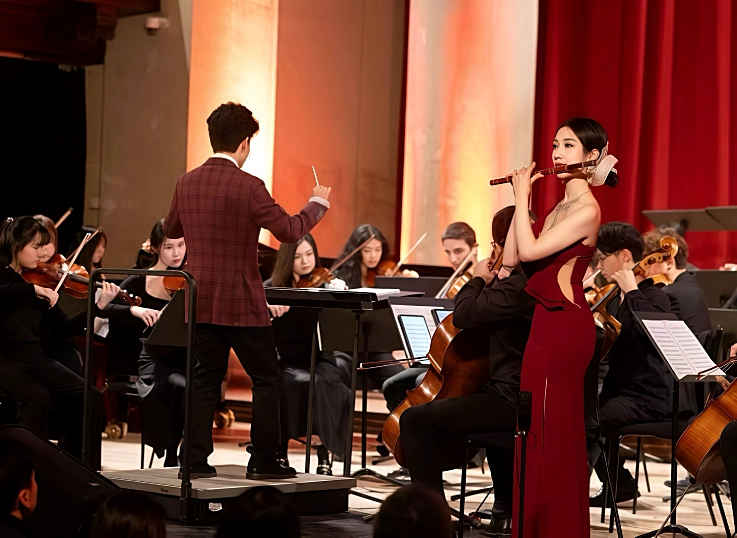
The Golden Horse Soars · 2026 Heritage in Harmony New Year Concert, held on 14 February at Sinfonia Smith Square in central London, felt very much like the latter. Set inside the warm acoustics of the Grade I listed hall, the programme moved between orchestra, traditional Chinese instruments, voice and chamber music, balancing celebration with something quieter and more reflective underneath.
Among the evening’s most memorable moments were two very different appearances by Dizi and Xiao soloist Zongpu Lu. What made them striking was not simply contrast, but the way they seemed to reveal two sides of the same musical instinct.
The first arrived with force.
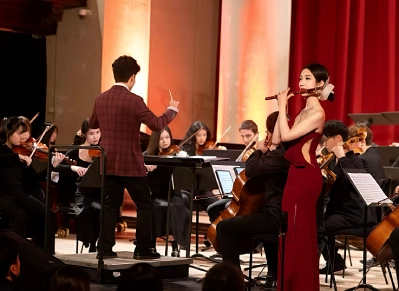
Rising Momentum | Galloping Horses, arranged by Chang Ge, expanded the familiar spirit of traditional repertoire into a larger orchestral landscape. From the opening phrases, the music carried a sense of forward motion that rarely relaxed. Strings pushed rhythmically underneath the solo line while the Dizi moved rapidly through the texture, at times bright and piercing, at others almost disappearing back into the orchestra before re-emerging again.
What stood out most was the sense of control inside that movement. Fast passages never felt rushed for the sake of display. Even in the densest sections, there was still shape, direction, and space inside the phrasing. The articulation remained remarkably clean, but more importantly, the playing carried momentum without becoming mechanical.
There was also something unexpectedly physical about the performance. Certain rhythmic figures suggested the energy of galloping horses, though never in an obvious or overly literal way. Instead, the motion seemed embedded in the breath itself, in the push and release of phrases, the elasticity of timing, the constant feeling of propulsion through the hall.
Then, later in the evening, the atmosphere shifted almost completely.
Performing Meihua Sannong alongside Professor Cheng Yu, Lu exchanged the brightness of the Dizi for the darker, more inward sound of the Xiao. The transition altered not only the colour of the music, but the emotional temperature of the room.
One could feel the audience listening differently.
Meihua Sannong is among the most enduring works in the Chinese qin tradition, associated for centuries with the image of the plum blossom, restraint, resilience, quiet endurance. Yet the performance never felt historical in a distant sense. Instead, it unfolded with an intimacy that made the piece feel strangely immediate.
The Xiao does not project in the same way as the Dizi. Its sound sits closer to silence, relying less on brilliance than on presence. Here, breath became the centre of the performance. Long phrases emerged gradually, suspended in the hall with an almost fragile stillness before dissolving again.
What was most compelling was the refusal to over-shape the music. Nothing felt exaggerated. Small changes in tone and timing carried emotional weight precisely because they were restrained. In several moments, the hall became so quiet that even the space between phrases seemed part of the performance itself.
Cheng Yu, renowned Pipa and Guqin performer, Professor at SOAS University of London, brought a grounding presence to the collaboration. Her playing carried deep historical awareness without ever making the music feel academically distant. Together, the two musicians approached the piece less as reconstruction than as living conversation.
Perhaps that was what stayed with the audience most strongly throughout the evening: not simply technique, or even repertoire, but contrast. One performance moved outward with brightness and velocity; the other folded inward, quieter yet somehow heavier in emotional resonance.
And yet they belonged naturally together.
In a musical landscape where traditional instruments are increasingly placed into new contexts, it can be tempting to speak in terms of “fusion” or “cross-cultural dialogue.” But the evening suggested something more organic than that. These instruments no longer feel confined to heritage presentation alone. In the right hands, they move comfortably between worlds, orchestral and intimate, historical and contemporary, structured and deeply personal.
By the end of the concert, what remained was not a sense of novelty, but of continuity: movement and stillness existing side by side, each giving shape to the other.
By Clara Whitmore
24th April 2026