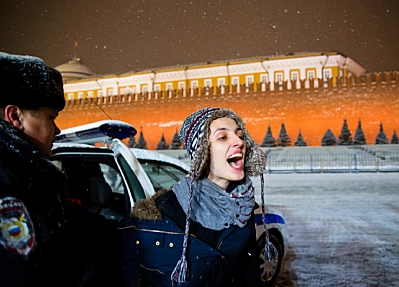
Russian-American filmmaker Julia Loktev’s documentary My Undesirable Friends: Part I – Last Air in Moscow underwent a dramatic shift because of geopolitical events. What began as an exploration of the realities facing Russian independent journalists living and working under Vladimir Putin’s regime, took a turn when Russia invaded Ukraine on 24 February 2022.
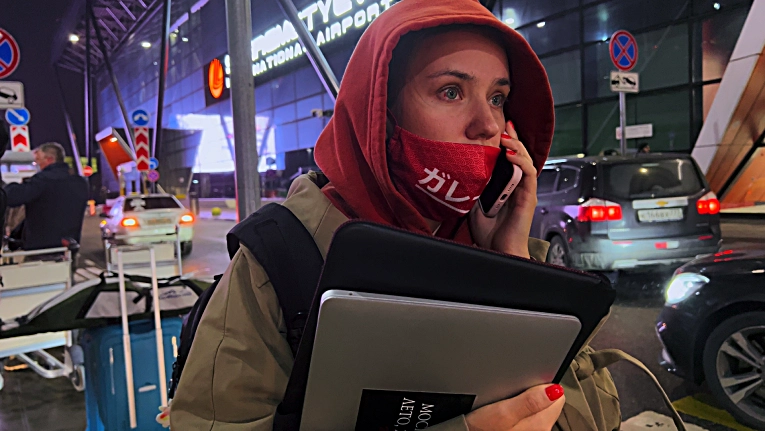
The persecution of journalists escalated, and it became impossible to oppose the war or hold the regime to account. Any journalists that didn’t conform to the status quo were labelled by the state as foreign agents. Intimidated, arrested and incarcerated, Putin’s authoritarian regime forced journalists to go into exile.
In My Undesirable Friends: Part II – Exile, to be released in 2026, Loktev and her protagonist and co-director Anna Nemzer, follow the journalists into exile, where they continue the important work of speaking the truth and holding Putin’s regime to account.
Loktev made her directorial feature debut with the 1998 documentary Moment of Impact, about a man who, in 1989, after being hit by a car, was left fighting for his life. Nearly a decade later, his daughter looks back on the incident and its lasting impact on her family of Russian immigrants living in Western America. In 2006, Loktev directed the narrative thriller Day Night Day Night, that centres on a 19-year-old woman who has decided to detonate a suicide bomb in New York’s Times Square. This was followed by The Loneliest Planet, another narrative feature in 2011, about a couple whose relationship shifts during a backpacking trip in the Caucasus Mountains.
In conversation with Flux, Loktev discussed her interest in life’s contradictions, which she documents through the tonal juxtapositions that emerge from the day-to-day experiences of her protagonists. She also spoke about her appreciation for inappropriate humour, being allergic to heroics, and how political and world events have transformed the way audiences are connecting with the film.
The following has been edited for clarity.
ARE THERE ANY WORDS THAT YOU FEEL ENCAPSULATE THE FILM?
It’s funny, because this reminds me of when a friend defended her dissertation, and they asked her, “If your dissertation was a bumper sticker, what would it say?” So, if I could say what the film was in a few words, I probably would not have made it.
I always hope to make films that resonate in people’s minds. I want them to reverberate and bounce off in different ways, so that people think about it differently.
Obviously, truth and resilience are in there, but I could also pull love, community, and humour out of a hat too. Hopefully, there are a lot of different things you can say about it, and it might vary from person to person, or differ day-to-day because we think about different things.
What has been most rewarding is when people tell me they’re talking about it months later, or they constantly remember scenes. That’s the best I can hope for as a filmmaker.
MY UNDESIRABLE FRIENDS IS FILLED WITH A TENSION AND DREAD THAT IS OFFSET BY THE WARMTH OF HUMAN CONNECTION. AT A TIME WHEN WE’RE LOSING OUR GRIP ON NUANCE, THE FILM HOLDS ONTO IT. INSTEAD OF A SIMPLISTIC BLACK AND WHITE WORLD VIEW, YOU DIG DOWN INTO THE NITTY-GRITTY OF A REALITY DEFINED BY CONTRASTS.
I’m not a journalist; I don’t come from the documentary discipline. I come from fiction and am interested in life, character and all the contradictions. I’m interested in the way the most dramatic events are, on the one hand, made up of the texture of daily life and, on the other hand, there are those things that work in a counterintuitive way, like humour. Inappropriate jokes are my catnip [laughs]. Anything that breaks the on-the nose mood is something I’m attracted to.
My co-editor [Michael Taylor] and I have worked together for twenty years now, and we are both attracted to the same things. He knows I’ll like somebody jumping up and down and making a strange noise, because all these things exist in parallel. There’s a scene where Anya is driving and she actually talks about this. She says, “On the one hand, everything is wonderful. I’m surrounded by friends. I work with these amazing people. Everything’s great, but I’m constantly living in fear that they may shut down the media I work for.”
As a journalist, there’s a sense that your life can come crashing down. And in fact, that is what happens in the film. Their lives do come crashing down, although they do not lose their sense of humour in the midst of it. But as Anya’s talking about this, in the back of her car is her daughter, who is coming back from theatre class. She is doing some weird breathing exercises and trying to say an odd tongue twister with a wine cork in her mouth. I think that’s utterly familiar to most of us in how we live our lives.
THE FUTURE IS SUPPOSED TO BE UNPREDICTABLE, AND YET, WE SEE CYCLICAL PATTERNS THROUGHOUT HISTORY THAT MAKES THE FUTURE PREDICTABLE.
In some ways it’s predictable; in some ways it’s unpredictable, right? You see the writing on the wall and isn’t that what hope is made for? You try to imagine that things can go a different way than the way they’re heading. There has to be some crack, where if the future is predictable, that becomes a kind of fatalism.
What did it mean for these people to be living under an increasingly authoritarian regime? Obviously, things were very clear in Russia, but it happens slowly, and then it happens very fast. So, Russia had been shutting down independent media for a long time, and yet it was still possible to exist, and it was still possible to work, until it wasn’t. And that’s what this film captures.
It was an incredibly fast turning point between when it was still possible for the opposition to live and work under the regime, and when this became unimaginable. The world the film shows does not exist today. You cannot work in the open in Russia if you’re in the opposition. It changed so drastically, and yet at the same time it was changing slowly.
How do you know when that moment has passed? I remember this is something I thought about a lot when we were filming during those first few months. The film takes place in the months before Russia started the full-scale war [in Ukraine], when nobody knew a war was coming. But journalists were feeling a rapid and increasing crackdown. Russia was naming media and young journalists as foreign agents, a lot of whom were incredibly young, and everybody was trying to figure out, what does this mean? How are they going to use this? I mean, yes, there’s going to be a fine, possibly jail. It becomes a mechanism of control. But what this was leading to nobody quite understood, but everyone was thinking, ‘Okay, I’ll put this foreign agent disclaimer on my work to allow me to continue reporting the truth.’
Everyone was in the same position where they were expecting a knock at the door any time. Some of them had been searched and their offices bugged. They’re expecting things to happen any moment now, and so, they’re all in this state of, can we keep working another day? How do we know when it’s time to leave? Is the time to leave tomorrow or was the time to leave yesterday? How do you know when it’s too late? And there were larger questions.
In retrospect, a million people left when the answer became clear. It was when Putin started a full-scale war, which you couldn’t openly oppose in Russia without being arrested. This was particularly important for journalists, of course, for whom it was important to continue to speak openly about the war, and to describe Russian war crimes. So, to do this, they had to flee into exile.
It’s not an easy decision, but yes, when the choice is a blunt one of going to jail or going into exile, they make the decision easy for you. But up until that moment, it was not an easy decision, because if you’re working under a government that you oppose, is it better to stay within the country? Or are you somehow complicit by being in the country? A lot of Americans would say, “I’m going to leave the country” because of Trump. But is leaving the country a benefit? In the case of journalists, that was, of course, the only way they could continue to report, and they do all still work as journalists. So, there was a clear benefit to leaving the country.
I REMEMBER SOMEONE ONCE SAYING THAT IT SEEMS APPEALING TO BE THE CYNIC, BUT IT’S BETTER TO BE THE PERSON THAT GOES WITH THE FLOW. THE FIRST PART COULD BE TRUE OF OUTSIDERS OR THOSE THAT CHALLENGE THE SYSTEM. YOUR FILM LOOKS TO THE REAL-LIFE STAKES AND DOESN’T PANDER TO ROMANTICISED IDEAS OF THE HEROIC. MY UNDESIRABLE FRIENDS OFFERS AN HONEST VIEW OF WHAT CHOOSING TO CHALLENGE INSTITUTIONAL POWER MEANS.
Absolutely, and everyone was very aware of the risks and what was at stake. They lived in constant fear of being arrested. The youngest journalist, Ksyusha, when she was 22, her fiancé, who was also a journalist, was arrested. He’s now serving a 22-year term for supposed treason for doing journalistic work. So, the stakes are huge, but what’s at stake for not doing something? What’s at stake is letting your country slide to hell. And then you still do it, and it still slides to hell. But at least you’ve done what you could.
I’m constantly aware that the people I filmed have sacrificed so much. And the thing that is really important to say, is when we talk about sacrifice, they will be the first to tell you, “We don’t have problems compared to the Ukrainians, who our country is bombing.” They constantly remind themselves that their country is the aggressor that started this war.
We can put things on a scale and say losing or having to flee your home is not as horrible as having your home and family bombed, but sorrow doesn’t work that way, otherwise we’d never cry about breakups because, in the global scheme of things, they are really small [laughs]. We can always say, somewhere else it’s worse.
All of them have lost their homes. What does it mean to lose your home? It means you can’t go back to see a parent when they’re dying because you’ll be arrested. This is something that you expect to do in your life. You expect to be there with your father or mother when they’re dying, and they can’t do that.
Many of them have criminal cases against them. They’ve been charged and sentenced, and they’ve had their parent’s home searched. There’s a lot at stake in all of it, and yet the texture of it, around all those stakes, comes back to Anya and her daughter with the cork in her mouth. It’s about having to feed your family that night and literally figure out what you’re going to cook. So, it’s also about the love and connection between people.
I’m allergic to heroism. None of these people consider themselves heroes, and I really am allergic to people running around doing their heroic exploits, because it’s not about a single person, it’s a community of people doing the best they can, and knowing their best may not be good enough to overthrow the system. And yet, you do it anyway, because that’s what you do, as well as having dinner, laughing and loving all those other things that make up life.
CINEMA DOESN’T EXIST IN A VACUUM, AND THE CURRENT TRAJECTORY THE U.S. IS ON IS INFLUENCING THE WAY NOT ONLY AMERICAN BUT INTERNATIONAL AUDIENCES ARE EXPERIENCING THE FILM. DEMOCRACIES ACROSS THE WORLD ARE UNDER SIEGE. MY UNDESIRABLE FRIENDS IS ENGAGING IN A BROADER CONVERSATION THAN MAY HAVE BEEN THE CASE A SHORT TIME AGO.
It has changed so much. When I was making this film, it was a film about Russia. It was somewhere far away, and nothing to do with us over here — we’re safe. It’s over there where bad things happen in a bad place.
How it has been perceived has changed so much since Trump 2.0. And it’s even changing these last few weeks with the war [in Iran], or as Trump, echoing Putin, calls it “special combat operations.” And the crazy thing is the Republicans are now not using the word “war.” I’m thinking, can you echo this anymore, because Russia would call it a “special military operation.” It’s insane.
What’s interesting is that I suspect, as you said, it will keep changing, and in a year’s time, it will become more relevant somewhere else. This is a film about what it’s like to fight for your country — to fight for it and to lose it, which sadly, becomes more relevant for so many people.
When I was initially making it, we would have these screening clubs watch each chapter. I have friends who are from Iran and who grew up under the dictatorships in Argentina and China, and they were saying, “This is so relatable. This is what it’s like to live under an authoritarian regime.” Then, of course, in the past year, all the American critics have been writing, “This is really a film about us.” I don’t want to wish this on other parts of the world, but I am afraid other parts of the world will increasingly be saying, “It’s a film about us.”
People are used to seeing films about a Russia that feels exotic and different from them. All of these characters watch Emily in Paris, and they have the same pop culture references you do. They love Harry Potter, which they refer to constantly, or Bridgerton and God knows what else. I feel like they all know more American and British pop culture than I do. They are very familiar characters, and yet they live in this society, and under a government that up to a point felt very unfamiliar. And sadly, that too, has become familiar for so many of us.
There are scenes in the film that would not have resonated with Americans when I filmed them. For example, a university dean being arrested, a comedy show being canceled, the president saying, “We only want to talk about the pleasant things in our history, not the unpleasant things.” None of those things seemed particularly relevant to Americans when I was filming it. But, oh, my God, they’ve become so relevant. And so, it’s a much larger story than just being about Russia. It’s about something much bigger, and something that’s increasingly happening.
As I mentioned, we had these screening clubs, and the first chapter is where people are randomly named foreign agents. They didn’t start with the most important journalists. It was like, do they have one of those spinning lotto things that they pull things out of? How are they choosing people? It was unclear. Well, half the room had grown up in other places, like Iran or Argentina, and then there were the others who had spent their entire lives in the States. They said, “We need it to be more clearly explained. Why exactly were these particular people named foreign agents? How does it work?” At which point, the other half of the room pretty much started yelling at them, “That’s how it works. It has to be random. You have to feel like it could happen to you.” If you understand how it works, then it doesn’t work — that is how authoritarianism functions.
I don’t think we’ll be having this conversation in the States in 2026 because everyone understands the randomness of it. Whether you’re looking at ICE arrests or the targeting of universities, you know there isn’t necessarily a logic. What makes it feel possible, what makes it potent, is its unpredictable nature.
My Undesirable Friends: Part 1 – Last Air in Moscow is now streaming on MUBI.
Interview by Paul Risker