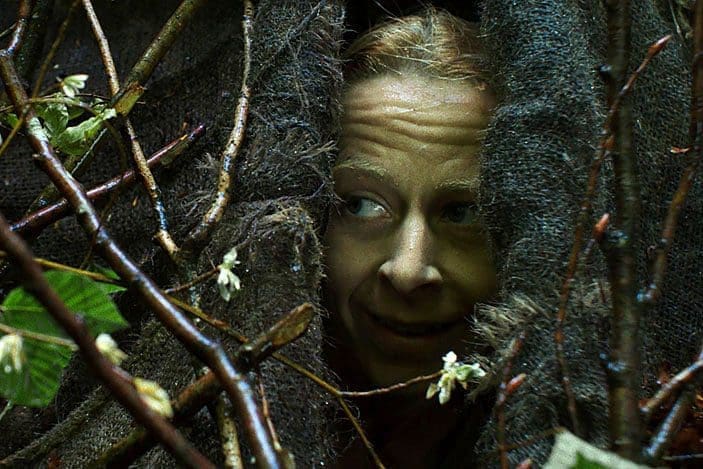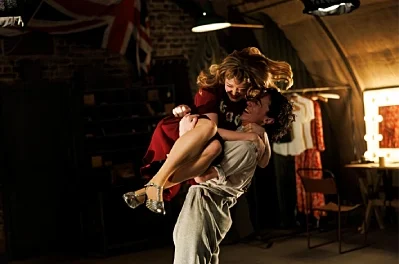
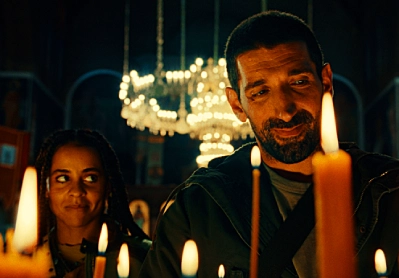
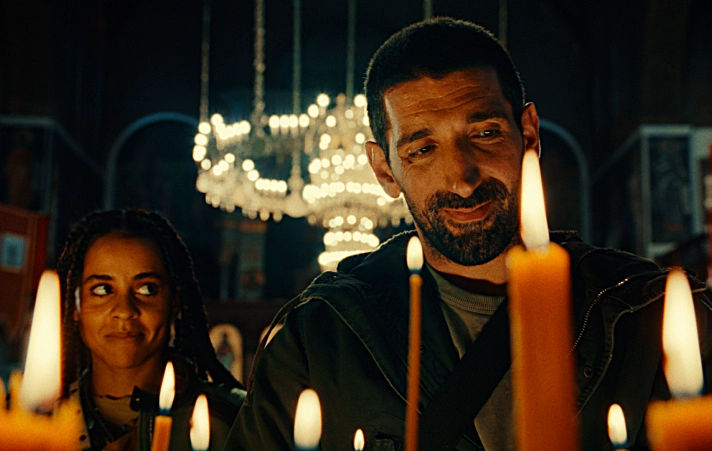
Director Thea Gajić’s feature directorial debut, Surviving Earth, is a film deeply rooted in the personal. Based on her own father’s story, Surviving Earth follows a character named Vlad (Slavko Sobin), who fled the war in Yugoslavia in the 1990s and has made a home for himself and his daughter, Maria (Olive Gray) in the UK.
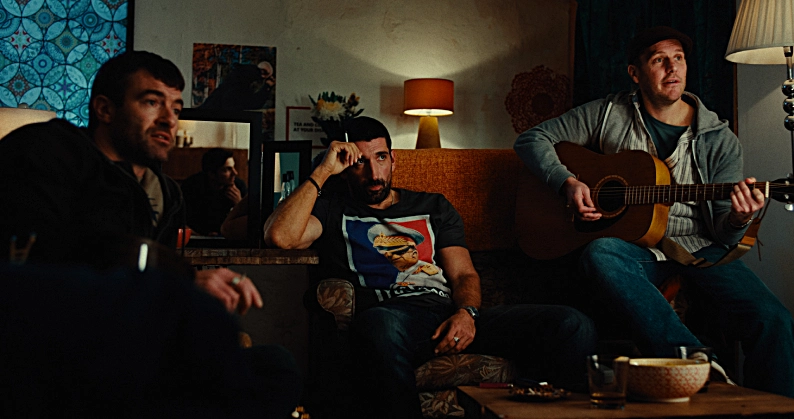
A talented harmonica player, Vlad forms a band with his work colleagues. However, the traumatic ghosts of his past haunt him, and Maria can only watch her father’s world fall apart under the weight of these memories.
Gajić has directed the short films, Run, that explores the male and female dynamic, with a particular focus on feminine strength, and The Importance of Skin, rooted in Gajić’s own personal experiences. It looks at the relationship between happiness and tragedy, and how we impact the lives of those around us. Gajić has also directed the short films Eli, Ajar, and a segment of London Calling: Brit Shorts.
In conversation with Flux Magazine, Gajić discussed her creative journey, the decision to share a deeply personal story, and discovering a conflict between drama and reality. She also spoke about happy endings, poetry, hope, and reframing resiliency as something more delicate.
The following has been edited for clarity.
WHAT MOTIVATED YOUR INTEREST IN FILMMAKING?
I fell into the directing side of things, but I had a huge passion for acting, which I’d been doing since I was little. I acted in school plays, studied drama, and then I did a lot of theatre work with the Old Vic. And with all the part-time drama classes, I just threw myself into it.
Acting was where my intentions were initially. Although, having said that, when I was a teenager, I would help my friends come up with stories for their music videos, and later I wanted to create material for myself and my peers to use for showreels. So, there was a preconscious awareness of something more, but I was only consciously aware of it after doing a couple of short films. It was then that filmmaking and acting began to morph as I realised I wanted to delve into this side of filmmaking.
AS A FILMMAKER, ARE YOU ABLE TO DRAW FROM YOUR EXPERIENCES ACTING AND WORKING IN THEATRE?
Absolutely, and once I put that cap on, I very quickly saw how everything else fed into directing. My confidence grew from that, because, at first, it can feel like you actually don’t know anything about this side of the craft, but you do. You’ve learned about it subconsciously through your love for other parts of the craft.
I did a work experience placement in the assistant director’s department on the first series of Peaky Blinders, where I learned so much about a real set. But when I was doing that work experience, I only wanted to act. I wasn’t necessarily thinking about being a filmmaker, but that experience definitely influenced my desire to direct.
WHAT WAS THE GENESIS OF SURVIVING EARTH, AND WHY DID YOU CHOOSE THIS FOR YOUR FEATURE DEBUT?
It’s a personal story; it’s about my dad. I would speak about him whenever people would ask about my family, and they were all really intrigued by his story. And the more I spoke to people about it and saw him through their eyes, the more I realised it was a story that I was used to. For me, that was just my dad. And so, the more other people reacted to it, the more I realised how much bigger than me this story could be. That’s what encouraged me to explore it as a feature.
WAS THERE A THERAPEUTIC ASPECT TO SHARING THIS STORY?
Definitely, and as artists, we are always processing emotions through art in some shape or form, even if no one ever sees it. You might write a poem or make something and never release it, but it’s how you process things. So, yes, this was part of processing my grief, even if I wasn’t intentionally doing it for that reason.
It has been a beautiful thing, because it has meant that I’ve been able to talk about it and I haven’t locked myself behind a door and succumbed to a deep sadness. Instead, I’ve been able to be more active in my grief. I’ve allowed myself to feel sad and just do whatever I need to do while moving towards a bigger goal or a more important piece of work that will hopefully help other people.
JUST BECAUSE SOMEONE IS DEPRESSED, IT DOESN’T MEAN THEY CANNOT SMILE OR LAUGH. IT’S HUMAN NATURE TO SIMPLIFY THE COMPLICATED, WHICH IS WHY WE GET TRAPPED IN THESE BLACK AND WHITE THINKING PATTERNS. THIS FEELS RELEVANT TO SURVIVING EARTH, ESPECIALLY WITH REGARD TO WHAT IT SAYS ABOUT HOPE. IT’S A FILM ABOUT HOW WE CAN FIND HOPE, JOY AND HAPPINESS IN SPITE OF THE HARSHER REALITIES OF LIFE.
I completely agree with that sentiment, and we have had a few questions along our Q&A journey where people have asked, “What are you trying to say? Where’s the hope?” Or “Where’s the silver lining?” I tell them the silver lining is life. It’s exactly what you said. People that are depressed aren’t depressed 24/7, every second of every day. And the trauma that we’ve been through, the life that we’ve lived and the decisions that we may regret, there are definitely seasons when they feel really heavy and then there are seasons when they don’t. Or maybe there’s a day when they don’t, or an hour when they don’t. What we experience day-to-day is a constant back and forth. For me, the film is about what we leave behind, and the hope that you can still have this colourful life despite your circumstances. And yes, they may always come back to haunt you, but it doesn’t mean that you can’t live fully through them.
It’s always interesting when people say that to me, because we’re all going to die — none of us survive. And I don’t mean that in a weird, sad way. It’s just that’s what we know to be true. So, we should live the life that we want, which is easier said than done, I get that. But if you can look at someone like Vlad, who still had this dream and managed to live some of it, which some people never even try to do, that is the silver lining and the hope. You can still have really beautiful, meaningful relationships even though you will mess up. But you will also get things right. That’s just the tapestry of life.
People are used to films that have a happy ending, which is why they sometimes struggle with it in these Q&As. But the reality is that death is sudden, and sometimes the rug can be pulled out from under you.
WE’VE BEEN PROGRAMMED TO WANT A HAPPY ENDING. FILMS LIKE SURVIVING EARTH INSTEAD CHOOSE TO NOT DISAVOW LIFE’S DIFFICULTIES, NOR ARE THEY SO CYNICAL THAT THEY DISAVOW HOPE.
It’s interesting because the ending that was originally written was more of a happy ending. The character still met his fate, but there was a memorial at the end celebrating his life. I wrote that because that’s what happened in real life. There was this beautiful memorial that we all had together and people from all corners of my father’s life came to celebrate him.
We shot it and when I saw it in the edit, it just didn’t sit right with me. There was never going to be enough time on screen to grieve somebody, or to even justify that grief and the celebration of a life. I needed another hour or two to actually explore what my grief felt like, which is why the scene undercut it. So, we crafted that new ending out of what we already had, and that’s why, to some people, it does feel abrupt, because it is. And making a new ending out of what we had shot, meant it wasn’t perfectly written.
I’m happier with this ending than I would have been with the original one. And I think most people still get hope from the film, which I’m pleased about.
REAL LIFE AND NARRATIVE FICTION ARE NOT NECESSARILY IN SYNCH, WHICH MEANS WRITING A SCENE AS IT HAPPENED WILL NOT ALWAYS WORK.
That’s a massive lesson I learned during the writing process. The only thing we shot that I felt didn’t work was that memorial scene. Obviously, other scenes got cut, but it wasn’t necessarily because they didn’t work narratively. In the early days of writing the script, so many ideas that I thought would translate well on screen got cut because you have to fit something into 90 minutes and the way it happened in real life didn’t work. For example, there was a series of events that happened one day after the other. I remember writing it, and everyone said it was this repeated beat. I said, “Yes, exactly. He did the same thing again and again, one day after the next.” But they told me that in the film world that was not going to work.
THE FILM’S TITLE IS AN INTERESTING CHOICE. I EXPECT THERE’S A STORY BEHIND IT.
I used to write poetry more than I do now. So, I was writing a poem about grief after I lost a friend in 2018, which was three years after my dad died. I wrote this line in the poem: “How to survive earth when the hands that spun you have returned to clay.” That line always stuck with me, and so, I took “survive Earth” and created the film’s title from it.
At first, it was a working title, but it just kind of stuck. When you’ve lived with a film for so long, it’s hard to change the characters’ names, and it’s also hard to change the title.
We were challenged on the title by an outside producer who said that it sounded like sci-fi. I said, “I can see why you think that, but I know what the title means to me.” And I still like the title.
THE STORY IS AN EXPLORATION OF RESILIENCY AND ATTEMPTS TO FRAME THAT IT’S NOT MERELY ABOUT HAVING STRENGTH AND SELF-PRESERVATION. THERE’S A LOT OF NUANCE AND OBSERVATIONS ABOUT HUMAN NATURE IN THE FILM, THAT CHALLENGES THE AUDIENCE TO LISTEN TO AND GENUINELY SEE THE CHARACTERS FOR WHO THEY ARE.
I had a side project called Conversations with Friends, which is this social media thing where I would record these conversations. One of the conversations I had with my best friend was about resilience, and how everyone sees it as being tough and hard and how you have to be resilient through these different seasons of your life. But we spoke about it as being soft and how you have to be vulnerable to change. To move through these different seasons, you need to be squishy. And this is something people don’t often consider when they talk about resilience — it is about those soft moments.
Vlad is a very tender, soft person. He’s easily moved, right? And that is because he’s resilient. He has survived for so long in spite of his circumstances, because of his resilience and his softness, and sometimes that gets missed.
So, when anyone asks me where’s the silver lining, I immediately know how that person views the world emotionally, because they’ve missed the nuance. I guess a lot of people choose to see the world that way, because it’s easier and less painful. It’s just how some people are wired and I get it. But there is so much nuance in this film and in Slavko’s performance that if you’re not looking and listening properly, you could miss it.
Surviving Earth is released in cinemas from April 24th.
words Paul Risker