An alligator with a pink bow, a mysterious snake charmer and a forgotten corner of British showbusiness.
Artist Tim Ridley revisits the extraordinary life of Daisy, the 1950s film star whose story turns out to be about rather more than reptilian celebrity.
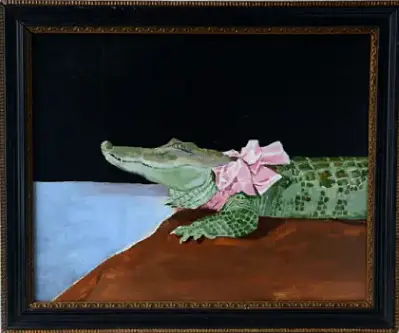
There are plenty of ways to become famous, but few involve an alligator, a pink bow and a supporting role alongside Diana Dors and Margaret Rutherford. Daisy, however, managed all three. The unlikely star of the 1955 film An Alligator Called Daisy enjoyed a brief moment in the cinematic spotlight before retiring to Cornwall, where she became a local attraction, wandering around a garden and occasionally posing for photographs with a pipe.
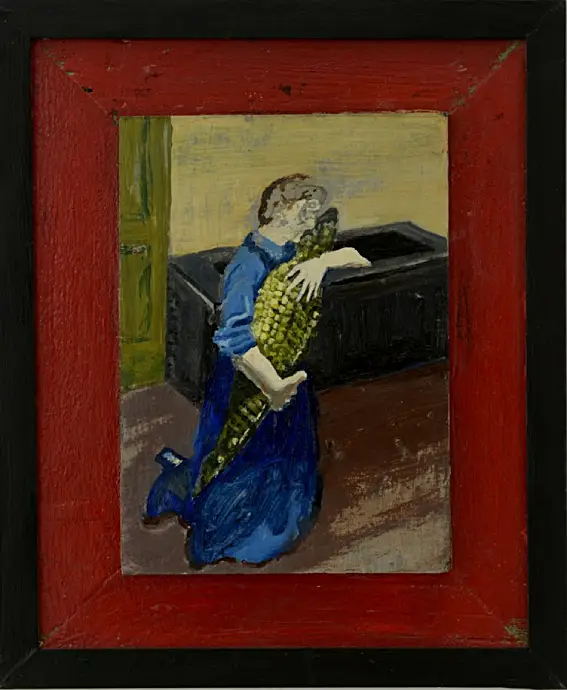
It’s an extraordinary story, and one that artist Tim Ridley has taken as the starting point for Daisy, his new exhibition at Fitzrovia Gallery, London, from 8–13 December 2026. But beneath the eccentricity of Daisy’s life lies a more complicated subject: the uneasy relationship between humans and animals, and the ways in which we turn the natural world into entertainment, property and spectacle.
Before her film career, Daisy had already appeared in nine productions, trained by her owner, a mysterious circus performer and snake charmer known as Koringa. Claiming to have been raised by fakirs — Muslim holy men or mystics who renounce worldly possessions and demonstrate extraordinary feats of endurance — Koringa described herself as “the only female fakir in the world”. The reality was rather less exotic. Born in Bordeaux, she was a French woman of Indonesian ancestry who most likely never visited India.
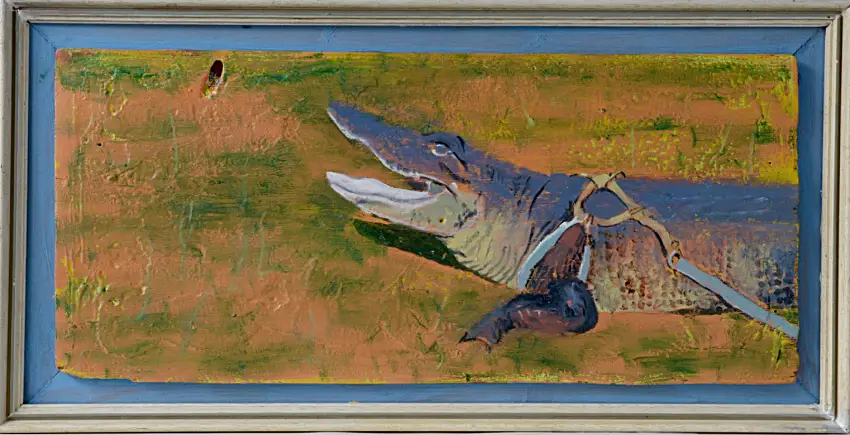
Koringa trained snakes, crocodiles and alligators to “act” in films, but her career as an animal trainer ended abruptly when another alligator attacked her at Pinewood Studios, causing serious injuries. Forced to give up the business, she sold most of her animals, Daisy among them.
In 1956, Daisy was purchased for £2 by Katrina ‘Gwen’ Roberts, who promptly insured her for £3000 and began taking her to football matches and carnivals as a special guest. By the late 1960s, the pair had settled in St Keverne, on Cornwall’s Lizard Peninsula, where visitors could pay to see the increasingly substantial reptile and her trademark pink bow.
Daisy had grown from six feet and 44lbs to nine feet and more than 250lbs. She reportedly wandered freely around Roberts’ house and garden, while local children claimed to have ridden on her back. Photographs show her smoking a pipe and balancing objects on her snout. The pink bow, it seems, was a permanent fixture. Beyond these glimpses, little is known about her later life, leaving Daisy suspended somewhere between documented history and local folklore.
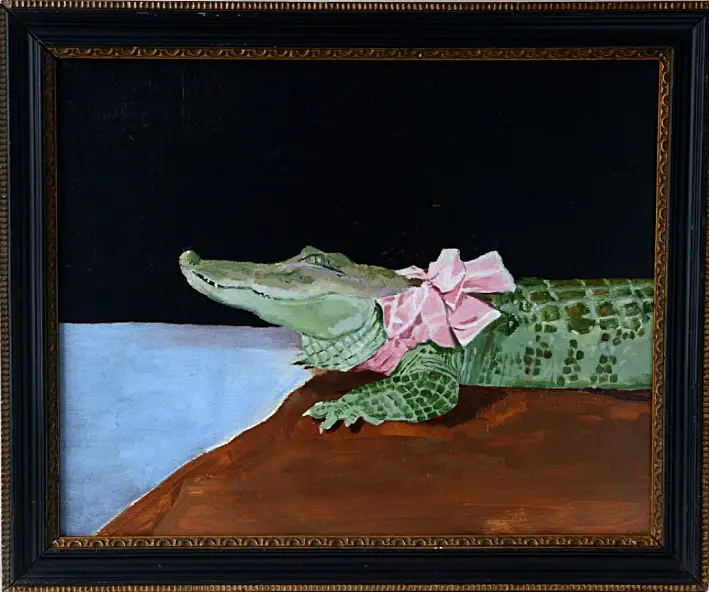
It’s precisely this curious territory that interests Ridley. His paintings use Daisy’s story to explore the uneasy power dynamic between humans and the biosphere. Alongside the alligator are other creatures caught up in a human world that isn’t of their making. Initially humorous, the images reveal a more troubling undercurrent: animals displaced, domesticated or transformed into objects of fascination.
As Ridley explains: “I use oil paint, graphite and found images to question the uneven power relationship between humans and the biosphere. My work is often small in scale, partly because I have a small studio, but also to minimise my impact on the environment. Anything I make is undertaken with the utmost respect towards the environment… I am not looking for answers, so much as opening up a space in which future solutions to species extinction, and habitat loss can be found.”
There is something particularly compelling about the contrast between Daisy’s absurd celebrity and the more serious questions her story raises. She was, after all, an animal whose identity was largely constructed by the people around her: trained, exhibited, insured and photographed. The bow and the pipe make for amusing images, but also suggest how readily we impose our own ideas of personality and entertainment on other species.
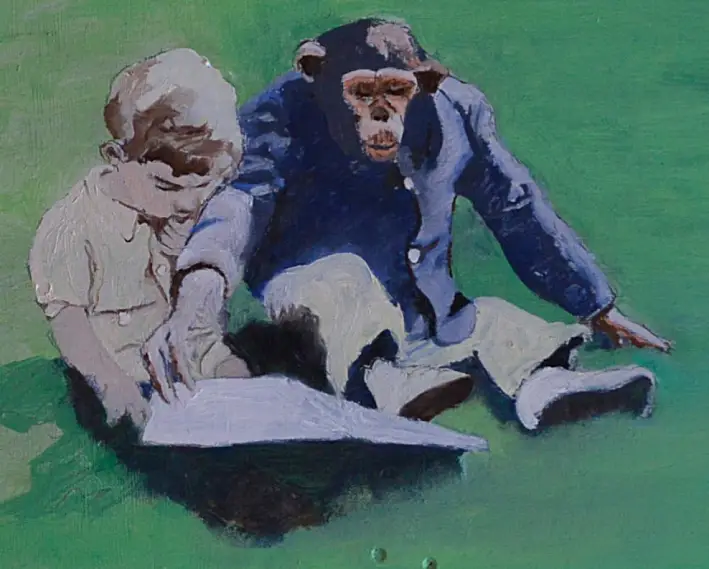
Curator Dr Matt Retallick sees the paintings as something distinct from more familiar interpretations of Cornish art.
“The Daisy paintings sit apart from familiar ideas of art made in Cornwall. They are distinctive and quietly assured, their significance extending far beyond their immediate visual presence. Through one extraordinary animal, Tim brings together questions of captivity, performance, memory and care without forcing them into a simple conclusion.”
Ridley isn’t offering a straightforward moral lesson. Instead, he uses an unlikely piece of British cultural history to open up questions about captivity, care, memory and our responsibility towards the natural world. Daisy may have been the star, but the real subject is the audience: our appetite for spectacle, our fascination with animals and our curious assumption that the world exists primarily for our amusement.
A pink bow, it turns out, can carry quite a lot of baggage.
Daisy is presented in association with curator Dr Matt Retallick and Daisy Laing, the creative curatorial platform founded by Kate Jones, which champions emerging and established artists.
TIM RIDLEY: DAISY 8–13 December 2026 – Fitzrovia Gallery, 139 Whitfield Street, London W1T 5EN
written by Charly Wells