The trail to Gokyo follows part of the well-known Everest route before turning north beyond Namche Bazaar into a quieter corner of the Khumbu.
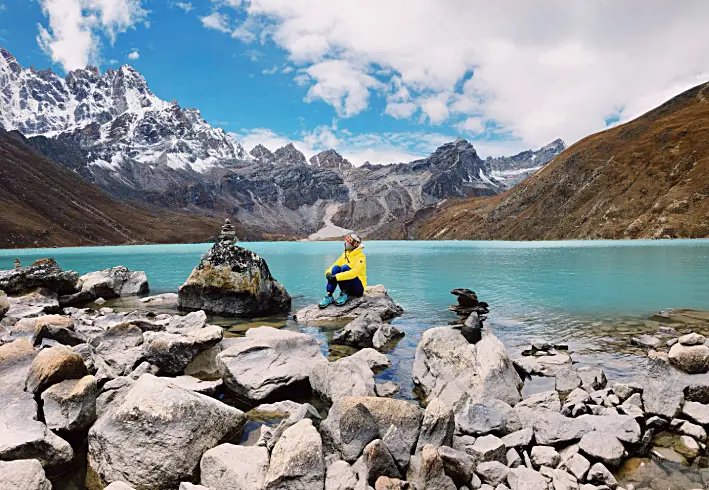
Here, a chain of turquoise glacial lakes sits beneath towering Himalayan peaks, with the vast Ngozumpa Glacier and views towards Cho Oyu adding to the scale of the landscape. For travellers seeking the Everest region beyond its best-known trail, Gokyo offers a different perspective on the Himalayas, combining high mountain scenery with Sherpa villages and traditional teahouse stays.
The standard Gokyo Valley trek does not require technical climbing, although it is a demanding high-altitude journey. The route involves long walking days, steep ascents and several nights above 4,000 metres, so good preparation and gradual acclimatisation are essential. For travellers prepared for the physical challenge, the reward is access to glacial lakes, remote mountain scenery and one of the region’s most impressive viewpoints.
Wandering Namche Bazaar’s Markets in the Khumbu, Nepal
Namche Bazaar curves around a steep natural amphitheatre at approximately 3,440 metres, with stone buildings rising in tiers above the Dudh Koshi valley. Its shops, bakeries and trekking lodges make it the main commercial centre of the Khumbu. A weekly Saturday market brings traders and residents together to buy fresh produce, clothing and household goods, although visitors arriving on other days will find a quieter market area.
An extra day in Namche also allows trekkers to acclimatise before heading higher into the valley. Short walks towards nearby viewpoints offer glimpses of peaks such as Kongde Ri and Thamserku, while time in town provides an opportunity to browse local shops, enjoy a bakery stop and prepare for the next stage. For anyone curious about a Nepal trekking tour, Namche offers a useful introduction to the landscape and communities that shape the journey ahead.
Visiting Tengboche Monastery in the Shadow of Everest, Nepal
Tengboche Monastery stands on a ridge surrounded by rhododendron forest, with clear-day views towards Ama Dablam, Everest and Lhotse. Inside, painted murals and Buddhist statues reflect the monastery’s importance to Sherpa communities across the Khumbu. Visitors may hear monks chanting during prayer sessions, but access and timings depend on the monastery’s daily activities. Visitors should remove their shoes before entering, respect photography restrictions and keep their voices low.
Tengboche is not on the direct route from Namche Bazaar to Gokyo, but it can be included in a longer itinerary connecting different parts of the Khumbu. For those who make the detour, the monastery adds a cultural dimension to the journey, offering insight into the Buddhist traditions that remain central to Sherpa communities. Set against a backdrop of Himalayan peaks, it provides a different kind of highlight from the lakes, glaciers and mountain viewpoints further along the trail.
Tracing Turquoise Lakes Beside the Ngozumpa Glacier in Gokyo, Nepal
The trail into Gokyo passes a chain of high-altitude glacial lakes set against the rocky slopes and moraine of the Ngozumpa Glacier. Their colours shift with the light, from pale blue to vivid turquoise and deeper shades of glacial green. The lakes also have religious significance for Hindus and Buddhists, while their waters provide refuge for migratory birds, including ruddy shelducks. Together, these features make the valley much more than a scenic stop along the Everest trekking network.
Gokyo village sits beside Dudh Pokhari, the third lake, at approximately 4,790 metres. Its teahouses offer a place to eat, rest and take in the surrounding peaks, with the lake and glacier providing a striking backdrop to village life. Further up the valley, additional lakes offer opportunities to explore more of this remarkable high-altitude landscape. From the village, the ascent of Gokyo Ri provides a wider perspective on the lakes, glacier and mountains beyond.
Climbing Gokyo Ri for Views of 4 Peaks in Nepal
The climb to the 5,357-metre summit of Gokyo Ri is one of the defining experiences of the trek. A steep trail winds above the village, gaining elevation towards a viewpoint that brings four of the world’s highest mountains into view: Everest, Lhotse, Makalu and Cho Oyu. The ascent is demanding because of the altitude, but it does not involve technical mountaineering. Allowing sufficient time to acclimatise is essential before attempting the climb.
From the summit, the turquoise Gokyo Lakes lie far below, while the vast, moraine-covered Ngozumpa Glacier stretches through the valley. Prayer flags flutter beside the rocky summit, adding a familiar Himalayan detail to the panorama. Clear weather reveals the surrounding peaks in remarkable detail, making the climb a memorable opportunity to appreciate the scale of the Khumbu and the varied landscapes that distinguish the Gokyo route.
Crossing Cho La Pass at 5,330 Metres in Nepal
Cho La Pass provides a challenging link between the Gokyo Valley and the wider Everest trekking network, allowing travellers to combine the glacial lakes with other parts of the Khumbu. The route climbs through a rugged mountain landscape of rocky slopes and boulder fields before reaching a high section where snow and ice can affect the crossing. It is a demanding day that requires careful preparation, appropriate equipment and suitable conditions.
Beyond the pass, the route descends towards Dzongla, opening up a different perspective on the surrounding Himalayan valleys. For trekkers following a longer itinerary, Cho La adds another dimension to the journey, linking the quieter Gokyo landscape with the wider Everest Base Camp trail. The crossing is more demanding than the standard Gokyo route and requires appropriate experience, acclimatisation and guidance, but it can form a memorable part of a carefully planned trek.
Ready for Nepal’s quieter Everest trail?
The Gokyo Valley offers a different way to experience Nepal’s Everest region, bringing together turquoise glacial lakes, the vast Ngozumpa Glacier, Sherpa villages and sweeping views of some of the world’s highest mountains. From the streets of Namche Bazaar to the panorama from Gokyo Ri, the journey reveals a side of the Khumbu that extends well beyond the familiar route to Everest Base Camp.
Reaching Gokyo requires fitness, gradual acclimatisation and several demanding days on foot, but technical climbing is not required on the standard route. Longer itineraries can incorporate Tengboche Monastery or cross Cho La Pass to connect with the Everest Base Camp trail, offering further ways to explore the region. With the right itinerary and enough time to adjust to the altitude, Gokyo provides a rewarding Himalayan adventure built around extraordinary scenery, local culture and the experience of travelling deep into the mountains.
written by Alexa Wang