Yun Wen is a London based visual artist, working across film and moving image. Her most recent photographic project, No Longer What We Were (https://www.wenwyun.com/nolongerwhatwewere) was selected as a finalist by Ten Moir gallery for the Blu Sky Artist award.

No Longer What We Were (2026) takes Franz Kafka’s Metamorphosis as its point of departure. Kafka’s story follows the protagonist, Gregor Samsa, who wakes up one morning into a ‘monstrous verminous bug’. Yun’s series of photographs offer an expansive interpretation of the narrative, starting with the more legible and moving toward the illegible. Yun’s subject looms over us, arms outstretched, face strained in fear. But something looms over him: duplicated shadows, one in the background and one on the ceiling. It is through shadowplay that Wen’s compositions become alive. Suddenly, the permanence of film photography — the seemingly solid contours of black and white subjects — become dynamic. An outstretched hand touches Gregor’s neck – either gently tapping or choking, creeps down the wall like a vine or an insect. In this way, Wen’s tricks of the light function as a kind of library of gestures. A trio of photographs centre around Gregor at his desk. In Kafka’s original version, Gregor’s furniture is paramount to his sense of identity. The desk in particular contains memories from every stage of his development: as a child, business student and adult. Upon his transition into an insect, the Samsa family consider removing his furniture so that he can move around the room freely: not just up and down the walls. The question of whether or not to go forward with this goes far beyond logistics. It is a philosophic problem that Kafka makes concrete, concerning the past and present selves.
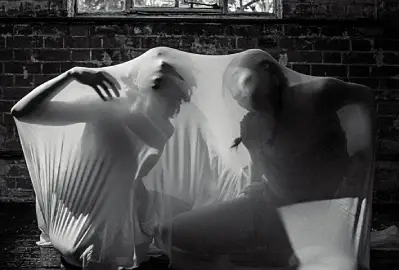
Similarly concerned with this notion of the self as something unstable, Wen captures the shifting condition of the self through her lens. Her images waver between monochromatic, still and in colour and out of focus. Towards the end of the body of work, we see a move towards abstraction. We no longer see a familiar subject alongside outstretched hands. Limbs, hands, materials dominate. The costume design for the sequence was carefully executed by collaborator ZhiLin, whose practice touches on themes of distorted space and psychological tension. This tension is mirrored in the literal contortions taking place within the images. The strained relationship between ghostly limbs and material vaguely resemble ectoplasm, an idea that was present in 19th century spiritualism, where a spiritual substance (often in the form of cloth) exuded from a medium during a seance. Other photographs make two bodies visible, however where one begins and the other ends is ambiguous. The ripples of fabric appear like wrinkles or skin in the human body. The inclusion of multiple figures under the surface is further rich in suggestion. Wen’s thematic concern with transformation and identity draws upon Lacanian thought. In his psychoanalytic theory, Jacques Lacan outlined three registers of the psyche: the Imaginary, the Symbolic and the Real. These distinguish between the self we imagine to be, our social and cultural existence and what cannot be expressed. In Wen’s work, there is also push-pull between registers. In No Longer What We Were in particular, we see the recognisable self (the man at the desk), the amorphous body, the world of objects and the elusive world of shadows.
Even in photography, Wen’s practice draws strongly from her academic background in film. Her images are undoubtedly cinematic in their sensitivity to framing, movement, light and atmosphere. One particular influence on her visual style is the Twentieth Century Ukrainian filmmaker Maya Deren. In her 1943 avant garde short film Meshes of the Afternoon, Deren sought to transfigure a ‘simple and casual incident into a critical emotional experience.’ There are notable parallels between Deren’s sequence and Wen’s photographs. In Deren’s film, we also see the motif of repeated hands, multiple selves and a deep sense of foreboding. But these parallels are rooted in an appreciation of dream logic, rather than direct inspiration.
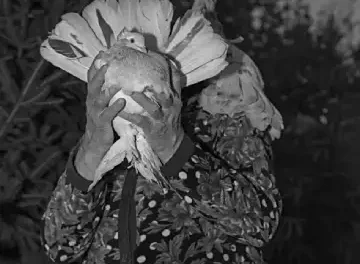
Wen’s own moving image piece, Light that Candle (2023) is a poetic meditation that follows the female body through phases of reproduction, adolescence and maturation. What is immediately striking about the piece is Wen’s use of non-diegetic sound. Amidst montages of cracking eggs, sticky fluid and playing with feathers, we hear a track of breathlessness, laughter and cat-call whistling. The artist’s storytelling is therefore highly associative, mediated in fragmentary visual or sonic moments. The mis-en-scéne of the piece takes place within a small, canopied structure. In light of the piece’s journey between gestation and maturation, it evokes a womb-like interior. Inside this space, Wen creates tableaus with timeless, symbolic imagery: eggs, apples, wine, glasses, strands of beads, feathers. Though it precedes No Longer What We Were, we see the same preoccupation transformation, memory and the body. As with Gregor Samsa’s desk, a whole life is contained within narrow parameters. Everyday objects unravel the passage of time and internal experience.
Words by Anna Moss
10/09/2026