


Your frames may be falling apart, but your lenses are still crystal clear.
It happens all the time. You’re going about your day when you hear that dreaded crack. Your glasses frames have finally given up, split at the bridge or snapped at the hinge. But here’s the thing: your prescription lenses are still flawless. Not a scratch. Perfect vision. You’ve been wearing these glasses for maybe six months, a year. Nowhere near the end of their useful life.
Most people assume they must replace everything when frames wear out. The entire pair goes in the trash, and they’re back at the optical shop dropping $300-500 on completely new glasses. But this “replace everything” approach wastes your investment in those perfectly good prescription lenses. The smarter approach? Exploring replacement frames for glasses while keeping your valuable lenses or attempting strategic repairs that can extend your eyewear’s life significantly.
The right strategy can save your lenses, protect your budget, and extend the life of your eyewear investment. Sometimes a simple five-minute repair can add months to your frames’ life. Other times, transferring your existing lenses into new frames offers better value than buying entirely new prescription glasses, often saving $200-400 in the process.
Understanding Your Broken Frame and When Lenses Are Worth Saving
Before you grab super glue or start shopping for new frames, assess what type of damage you’re dealing with and whether your lenses are worth the effort to save.
- Bridge breaksare the most common and most difficult to repair permanently. The bridge bears constant stress from lens weight and nose pressure. When plastic frames crack here, they often break completely in half.
- Temple arm breakstypically happen at the hinge where the arm connects to the frame, or mid-arm where repeated folding creates stress fractures. Hinge breaks can sometimes be fixed with simple screw replacement.
- Nose pad attachment failuresare more common with metal frames. The small screws that hold nose pads can loosen or break. These are usually the easiest repairs, often just requiring a tiny screwdriver.
Frame Materials and Repair Considerations
- Plastic and acetate framesare heat responsive. They can be carefully melted and fused back together using heat welding techniques. However, they’re more brittle than metal, especially cheaper plastic frames, meaning breaks happen suddenly and completely.
- Metal framesoffer more repair options. They can be soldered, welded, or mechanically fastened with screws or wire. Metal frames tend to bend rather than break, giving you warning signs before catastrophic failure.
- Titanium framesare incredibly strong but difficult to repair at home. Titanium requires specialized welding equipment. If your titanium frames break, professional repair or frame replacement are typically your only options.
When Your Lenses Are Worth Saving
Your lenses represent the real investment in your eyewear. A pair of quality prescription lenses, especially progressive lenses or those with premium coatings, can easily cost $150-400 alone. They’re worth saving when:
- The lenses are scratch-free.Surface scratches can’t be polished out and will compromise your vision. Clear, unmarked lenses are prime candidates for saving.
- Your prescription is still current.If your vision has changed since you got these glasses, even perfect lenses won’t help you see clearly. But if you’re within a year of your prescription, those lenses are still valuable.
- The lens coatings are intact.Anti-reflective and other coatings eventually wear out or peel. If your coatings are failing (hazing, peeling at edges, or rainbow effects), it might be time for new lenses.
- They’re specialty or high-index lenses.If you paid extra for high-index lenses, progressive lenses, or polarized prescription sunglasses, you have more incentive to save them. These can cost $200-500 to replace.
Don’t try to save lenses that are more than two years old with outdated prescriptions, scratched or damaged, or poorly positioned due to severe frame warping.
Five Proven Methods to Fix Broken Glasses Frames
Choose your repair method based on your frame material and break type.
Method 1: Super Glue for Plastic Frame Cracks
Best for: Small cracks in plastic or acetate frames that haven’t completely separated, minor temple arm cracks.
Materials needed: Cyanoacrylate gel super glue, rubbing alcohol, cotton swabs, rubber bands.
Steps:
- Clean both surfaces thoroughly with rubbing alcohol
- Apply minimal glue to one surface only
- Press and hold for 60 seconds, aligning pieces precisely
- Secure with rubber bands and let cure for 24 hours
Reality check: Super glue works best for non-load-bearing cracks. Bridge breaks repaired with only super glue rarely last more than a few weeks. For temple arms, expect repairs to last several months with gentle handling.
Method 2: Screw Tightening and Replacement
Best for: Loose hinges, missing screws, wobbly temple arms on metal or plastic frames with metal hinges.
Materials needed: Eyeglass repair kit with tiny screwdrivers and assorted screws, clear nail polish.
Steps:
- Identify the correct screw size
- Align the hinge properly before inserting the screw
- Insert carefully, turning clockwise with minimal pressure
- Tighten just enough so the temple arm moves smoothly but doesn’t wobble
- Apply a tiny drop of clear nail polish on the screw head to prevent loosening
Pro tip: Work over a white towel to catch dropped screws.
Method 3: Heat Welding for Plastic Frames
Best for: Clean breaks in plastic or acetate temple arms where glue alone won’t provide enough strength.
Materials needed: Heat gun or lighter, flat tool for pressing, damp cloth, clamps.
Safety note: Work in a well-ventilated area, away from flammable materials.
Steps:
- Clean and align the broken edges
- Heat one edge carefully for 2-3 seconds until tacky, not dripping
- Immediately press pieces together for 20-30 seconds
- Cool with a damp cloth
- Clamp and let set for 4-6 hours
Heat welding creates a surprisingly strong bond, often 70-80% of original strength when done correctly.
Method 4: Two-Part Epoxy for Load-Bearing Repairs
Best for: Bridge breaks in plastic frames, breaks that need maximum strength, repairs supporting lens weight.
Materials needed: Two-part epoxy adhesive, mixing surface, toothpick for application, clamps.
Why epoxy beats super glue: Epoxy creates a stronger, more flexible bond that handles stress better. For breaks that bear weight, epoxy is superior.
Steps:
- Mix equal parts of both epoxy components
- Apply to both surfaces of the break
- Align precisely and clamp firmly
- Let cure for the full 24 hours before wearing
Method 5: Wire Splints for Emergency Repairs
Best for: Emergency temporary fixes when you need your glasses immediately.
Materials needed: Thin wire (24-26 gauge), wire cutters, needle-nose pliers.
Steps:
- Align the broken pieces
- Wrap wire tightly around the break, starting 1/4 inch before and continuing 1/4 inch past the break
- Twist ends together, trim excess, and fold flat
- Add tape over the wire for comfort
Reality check: This is temporary only. Wire splints are bulky and uncomfortable. Plan on a proper repair or replacement within a few days.
When Repair Isn’t Worth It: The Case for New Frames
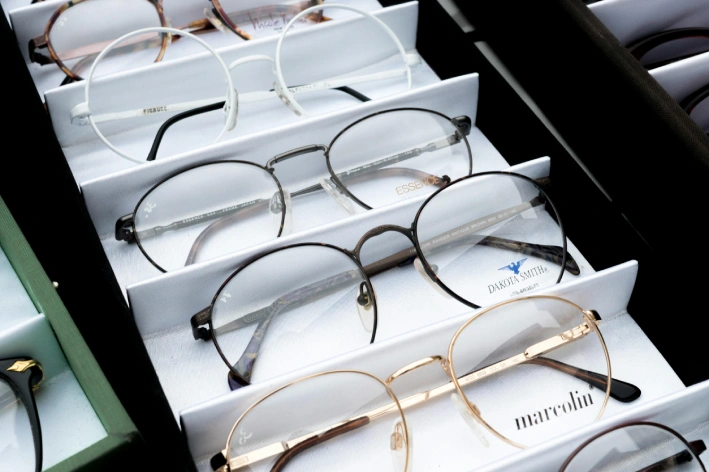
Sometimes the smartest move is replacement. But you probably don’t need to replace your lenses, just the frames.
Signs Your Frames Aren’t Worth Repairing
- Multiple breaks or previous failed repairs. If this is your second or third break, the frames have reached their end of life.
- Severe frame warping. When frames get bent out of shape, they can’t properly hold your lenses in the correct position relative to your pupils.
- Cheap frames that cost more to repair than they’re worth. If you paid $50-100 for complete glasses, professional repair at $30-60 doesn’t make financial sense.
- Breaks that compromise structural integrity. Multiple cracks radiating from one-point, complete bridge separation on heavy frames, or breaks through the lens rim can’t be reliably repaired.
The Smart Alternative: Keep Your Lenses, Get New Frames
Here’s what the optical industry doesn’t advertise: your prescription lenses are the expensive part. The frames? Relatively inexpensive by comparison.
Cost breakdown reality: A complete pair of quality prescription glasses might run $300-500. But here’s how that breaks down:
- Prescription lenses (especially progressives or with coatings): $150-400
- Frames: $50-150
- Markup and retail overhead: $100-200
Your lenses represent 50-70% of the total cost. If they’re still perfect, you’ve already made the major investment.
Lens replacement services offer serious savings. Instead of buying entirely new prescription glasses, you can have your existing lenses professionally removed and installed in new frames. The cost? Typically, $55-120 depending on lens complexity. A fraction of the $300-500 you’d spend starting from scratch.
You get a style upgrade while keeping your prescription investment. Lens replacement lets you keep the prescription you know works while upgrading to frames you love.
How to Choose Compatible Replacement Frames
Not every frame will work with your existing lenses, but compatibility requirements are less strict than you might think.
- Eye size (lens width):Your new frames should match your current frames within 2-3mm. This measurement is stamped on the inside of the temple arm (like “52-18-140”).
- Bridge width:Match this within 1-2mm for proper fit on your nose.
- Lens shape considerations:New frames with similar shapes to your old frames work best. Drastically different shapes may require new lenses.
- Frame style options:Full-rim frames offer the widest compatibility. Semi-rimless and rimless frames have more specific requirements.
- Professional lens installation matters:Don’t try to pop your lenses into new frames yourself. Professional services remove, verify, and install your lenses safely with specialized tools that prevent damage to both frames and lenses.
Making the Right Choice for Your Situation
The right choice depends on your specific situation: the type of break, frame material, lens value, and whether you’re attached to your current frames.
Choose DIY repair when:
- Your frames are high-quality
- The break is simple and clean
- You have good lenses worth preserving
- The repair method matches your skill level
Simple repairs can add months to frame life for almost zero cost.
Choose lens replacement into new frames when:
- You have expensive lenses in broken cheap frames
- Frames have multiple breaks
- You want upgraded frame quality or updated style
- The frames aren’t worth repair effort
Services like Replacement Lens Express specialize in transferring your prescription lenses into new frames starting around $55.
Start fresh with completely new glasses when:
- Your prescription has changed
- Lenses are scratched or damaged
- Both frames and lenses are outdated
The Bottom Line: Protect Your Investment
Your prescription lenses represent the biggest chunk of your eyewear investment. A $400 pair of glasses isn’t really $400 of value split evenly between frames and lenses. It’s more like $250 in lenses and $150 in frames, with the lenses doing the heavy lifting for your vision.
When frames break, you’re not losing your entire investment. You’re losing the holder, not the technology that corrects your vision. That’s why smart eyewear owners think strategically about repairs and replacements.
A quick $5 repair with epoxy can buy you months of continued use from frames you like. When repair isn’t feasible, transferring lenses into new frames for $55-120 beats spending $300-500 on completely new prescription glasses, especially when your prescription hasn’t changed.
Evaluate your broken frames honestly:
- If they’re worth repairing, choose the method that matches your frame material and break type
- If repair isn’t practical, explore lens replacement options to get upgraded frames while keeping your existing prescription investment
- If both lenses and frames have seen better days, invest in a completely fresh start
The key is making a choice that maximizes value. Your wallet will thank you, and you’ll get more life out of quality lenses that still have years of clear vision left to give.