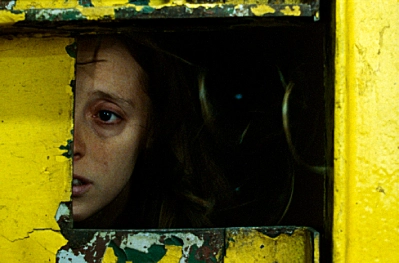
Sofía Petersen is an Argentinian-born and UK-based filmmaker, who studied film in Buenos Aires and San Sebastián. Her feature debut, Olivia, was shot with a largely non-professional cast of more than 40 people. With a crew of five and two actresses, a 45-day shoot, and years spent on the script, Olivia is a passion project.
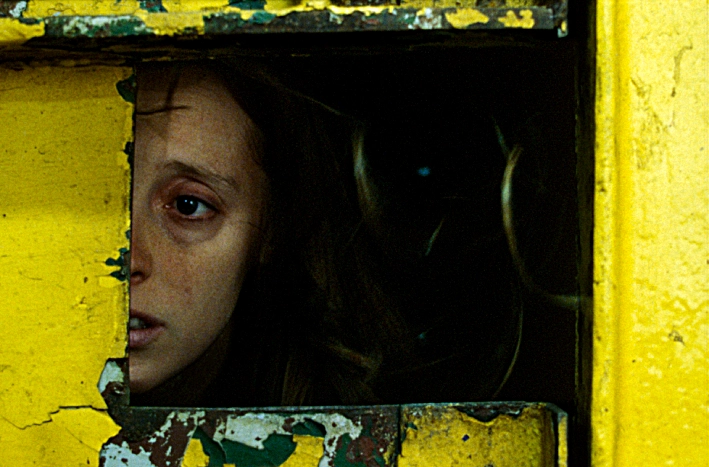
Olivia’s story is set in the South American archipelago, Tierra del Fuego, which is known as the “Land of Fire” and sitting at the southernmost tip of the continent, has earned the moniker the “End of the World.” The visually striking story revolves around Olivia (Tina Sconochini) a young woman, who goes in search of her missing father, who works in the nearby slaughterhouse.
Petersen has directed the short films, Reminiscences (2016), Fullmoon (2017), Symphony of the Being (2019), and the award-winning Passing Place (2021).
Speaking with Flux Magazine, Petersen discussed strange coincidences, taking control and giving up control, and being in a fluid state.
The following has been edited for clarity.
HOW DO YOU BEGIN PROCESSING HAVING COMPLETED YOUR FIRST FEATURE?
The process is so much day-by-day, step-by-step, word-by-word, shot-by-shot, that suddenly, now that the film is done, the past becomes a bit of a blur. Especially because it was all done with such intensity and for such a long period of time. So, the past has become unreachable — it’s now in the film, I suppose.
I often feel with these kinds of processes, that once it’s done, there’s this question of, well, how did it come about, or how did it take shape? These are questions you might get asked, and, in a way, you find yourself telling a story. I cannot really tell it for what it is. If I am to speak of it, I am putting into words something that’s really something else. This, of course, transforms it. I feel in making films, there are words involved, but there are a lot of other things too, which I personally find a lot harder to grasp or a lot harder to find the desire for.
So, it was an interesting process, especially as it’s a first feature. It’s very different doing things in a shorter form and I feel Olivia found a way of making itself in spite of us, if that makes sense. We just disposed of the time and the materials needed for it to occur, and with a certain patience, I feel you’re able to hear what it wants to be, instead of what one thinks it should be.
I suppose there were several, some of which I can trace, and many of others I cannot. Perhaps they worked through me. I think my sister’s eyes were one of the origins of it. Her name is Olivia, so I also took her name. She has these very dark eyes where you can’t really tell the pupil from the iris, and there was something about that at night. And when I met Tina, we wanted to work together without the need to make something specific — just to meet and to see what would happen. I think that was a very important place to start, and so, we started meeting twice a week, that ran into months and then years. And very slowly, a way of moving, breathing, and looking started to come through. Then the image of the fire in the water appeared, at which point I started writing.
THE SPATIAL IN THIS FILM DRAWS NOT ONLY ON IMAGINATION, BUT ON THE ACTUAL PLACE THE FILM IS SET. HOW DID THE SPATIAL SHAPE THE FILM NARRATIVELY AND VISUALLY?
It was shot in Tierra del Fuego, a place I had never been. However, Tina had been to Ushuaia, the capital of Tierra del Fuego. After reading some of the script, she called me to ask whether I had ever been there. She said it seemed as if it were written for this place. Being curious, I went there, but I didn’t really feel it. Then I started driving up north passing through smaller towns. I only had half a script, and so, it didn’t make rational sense, but there were these strange indications of places I came across, some more concrete than others.
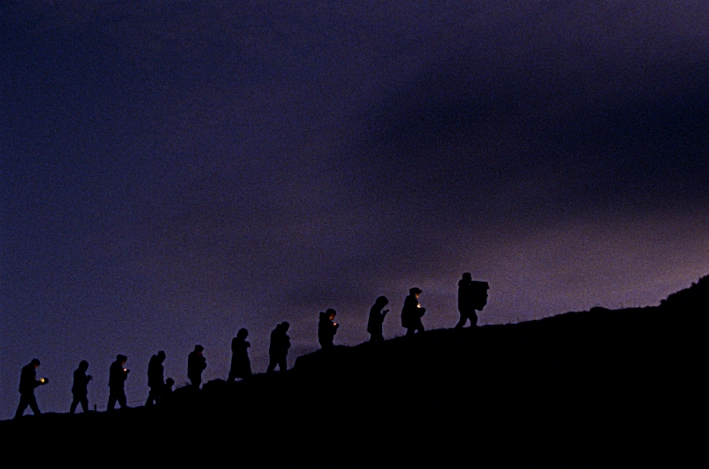
There’s only one working slaughterhouse on the whole island, which is the Rio Grande Municipal Slaughterhouse. It stands right next to this field where the old slaughterhouse, that burned down several times in its life, used to be. And the slaughterhouse being on fire was already part of the father’s dreams. That was one of many strange coincidences.
HOW MUCH OF AN ATTENTION TO DETAIL WENT INTO THE FILM?
The cabin where we shot the first part of the film, where Olivia lives with her father, we actually built. It was a very contained place where we could place every needle where we wanted, and every spoon was chosen.
WHAT DOES THE NON-PROFESSIONAL CAST BRING TO THE FILM?
It was a huge blessing for the film, because I had worked on that first half of the script for five years with a lot of detail. The other half of the script I wrote in Tierra del Fuego, where I lived for a while. And I believe the place itself, as well as a lot of the people entered the film. This is a beauty I could have never written. I’m incredibly grateful that the locals are in it and that they have shaped the film.
HOW DO YOU LOOK BACK ON THE EXPERIENCE OF MAKING OLIVIA?
I’m certainly not the same person that I was before I started filming. And I can’t imagine what person I even was before I started writing this film. And it’s not even possible to know who I am at the moment. But change is constant, especially after spending so many years of my life being occupied by this film. And sometimes I think it ends up becoming something bigger than yourself. It is not part of you; you’re a part of it.
Olivia was released in UK cinemas on Friday 24 April.
words Casper Borges