A lumen print does not settle easily. It appears through sunlight and continues to shift almost imperceptibly when it meets light again, as if something were settling without ever quite settling.
It carries a strong sense of immediacy and momentariness, but does not keep photography’s familiar promise to hold the instant still. For Xinyue Tao, this instability is both a methodological fascination and a conceptual question: when does a work that keeps changing become a “completed work”? The question does not stay where it begins, but is carried into the way Tao shapes the workshop itself.
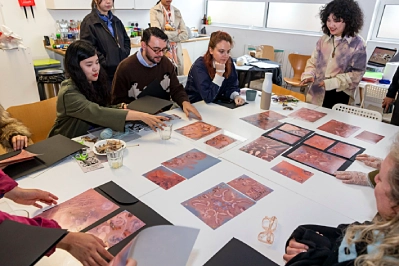
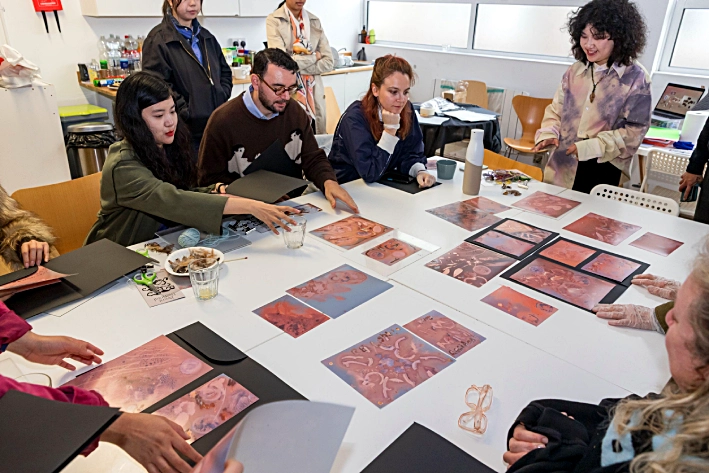
Tao’s practice has long turned around how time and space are felt rather than measured, through self, memory, and the layers beneath waking thought. Grounded in photography, hercontem use of darkroom printing and alternative processes has gradually moved towards a slower, more embodied and intuitive mode of image-making. Her early practice began with an interest in dreams, and this origin remains important to understanding her later use of lumen printing. Blurred and drifting, lumen images emerge through contact, residue, light and material reaction, following a dream-like logic resistant to clear narrative and not fully controllable. Rather than describing reality directly, they appear as material traces left by light, time and touch. For Tao, the move into the workshop is an extension within her practice. Previously, she was often the observer and the one who makes choices. She selected objects, remnants and fragments, allowing them to mark the paper unevenly. One of her lumen series Ephemeral Remains worked with food waste: peel, roots, offcuts, the parts that disappear from a kitchen without anyone noticing. The workshop carries this same attention. Everyday ingredients such as cucumber and lemon are placed onto photographic paper, pressed under acrylic, and left in the sun. When the sheet lifts, what has formed is often unexpected. Touched by light, the ordinary leaves extraordinary traces.
This extension also repositions Tao within the process of making. The image gathers through shared making, exchange, and collective presence. Tao becomes someone who sets up a field of possibility within which light, material and memory may come together. In this sense, the unfinished nature of lumen images extends from a personal methodological concern into a shared structure of making. Across different public contexts, this workshop-based structure takes on different roles. Embers of Light: Lumen Print Transfigurations, developed with Metroland Cultures, was situated within the curatorial framework of FIRE Ritual as part of Brent Biennial 2025. Here, fire became a temporary language to approach lumen printing through light, heat, transformation and impermanence. The image appears, alters and slowly fades, forming a rhythm of emergence, disappearance and renewal. What participants took away was less a finished print than a trace still in progress.
Trace of Light: Capturing the Ephemeral through Lumen Prints, presented as part of the exhibition NOW YOU SEE: Remembering/Forgetting, extended this attention to the medium’s inherent singularity while working more explicitly as an entry point into Tao’s practice. Through two rounds of making, participants could experience how variations in materials, light conditions and exposure duration shape the irreducible uniqueness of each print. This hands-on engagement with the instability of the image opened a way of approaching the artist’s methods, as making became a way of remembering.
Tao also brought this method into an educational community-based context. Exchange of Light, developed as part of the Central Saint Martins’ moving.dialogue project in collaboration with The People’s Museum Somers Town, embedded lumen printing within a structure of reciprocal exchange. Each participant was invited to bring or find a small object, an idea, or a piece of knowledge, then place it into the making process. By leaving or taking away either their own print or someone else’s offering, these contributions accumulated into a collective map tracing quiet exchanges between people, places and objects. Drawing on Raymond Williams’ conception of education as a democratic and reciprocal process, the workshop dissolved the boundary between artist and participant, allowing lumen printing to become a shared field of learning, exchange and mutual response. TearSlaly carried this method further into a longer duration and outward connection. Initiated by Xinyue Tao and textile artist Weiyi Chen, the collective developed through regular workshops, shared making and a gradual accumulation of community beyond the artists’ individual practices.
For Tao, TearSlaly also became a steady form of connection. Her work has long explored relations between self and self, self and other, and individual experience and external response. This ongoing collaborative form gave those concerns a place to unfold through repeated making. At the same time, the contrast between their mediums introduced a generative difference. Lumen printing catches fleeting changes within light and material, while textile, dyeing and stitching accumulate time through repeated bodily gestures. This formed a dialogue between two different temporalities, allowing Tao to look back at her own method from within another logic of making.This long-term collaboration eventually gathered into the duo exhibition Suspended Between at Greatorex Street, where lumen printing, textile and bodily gesture became a shared formal language. The exhibition brought the workshop method back into public space, keeping the boundary between making and viewing open.
Tao’s use of the workshop as a creative method keeps the instability of lumen printing active. The work may exist in the print, in the participant’s gesture, in the presence of the workshop, and in the changing material itself. Authorship becomes less singular, shaped by Tao’s framing as much as by the choices and responses of others. This unfinished quality is precisely what makes the workshop form so native to her practice. In opening the process to others, making becomes a way of forming relations: with material, with light, and with the people who share the same presence.
Tao’s lumen practice continually returns to what resists being fully settled: dreams, memories, remnants, objects, bodily gestures and fleeting encounters. The workshop does not resolve this instability but extends it outward, into a shared field where image-making and relation-making become the same act.
Written by Clara Whitmore
– July 19, 2026