In Minnesota, the composer and interdisciplinary artist treats culture not as something to preserve behind glass, but as a living process shaped by music, memory and encounter.
Culture rarely arrives in a new country intact.
It travels through fragments: a melody remembered from childhood, a movement learned before its history was fully understood, a holiday celebrated far from the place that gave it meaning. Once these fragments enter a different social and artistic environment, they cannot simply remain unchanged. They are performed for new audiences, placed beside unfamiliar traditions and interpreted through different expectations.
For composer, songwriter and interdisciplinary artist Cong Liu, this movement is not a problem to be solved. It is the condition from which much of his work in the United States has emerged.
Since coming to Minnesota, Liu has worked across public festivals, film, dance, theatre and community-based creative programmes. These projects vary in form, but they share a concern: how can cultural memory remain recognisable without becoming static, and how can unfamiliar traditions be made accessible without being simplified for easy consumption?
His answer is not to present culture as a finished object. Instead, he creates situations in which it can be heard, questioned and experienced in public.
Beyond “East Meets West”
The phrase “East meets West” is frequently used to describe artists working between Chinese and American contexts. It is convenient, but it often reduces cultural exchange to surface combinations: a Chinese instrument inside a Western ensemble, a traditional visual symbol placed within a contemporary production, or two musical styles made to coexist.
Liu’s work proposes something less tidy.
For him, working across cultures is not simply a matter of combining recognisable elements. It requires thinking about who is presenting a tradition, who is receiving it, what context has changed and what may be lost when cultural material is removed from the environment in which it first developed.
That understanding was shaped long before he arrived in the United States. Liu grew up around both music and movement: his mother was a guzheng performer, while his father’s work connected him to dance. Music did not appear to him as an isolated art form. It belonged to bodies, celebrations, stories and social life.
After studying composition and developing a professional practice in China, he came to the University of Minnesota for doctoral study. The move did more than place his work in another country. Distance changed the way familiar cultural material appeared.
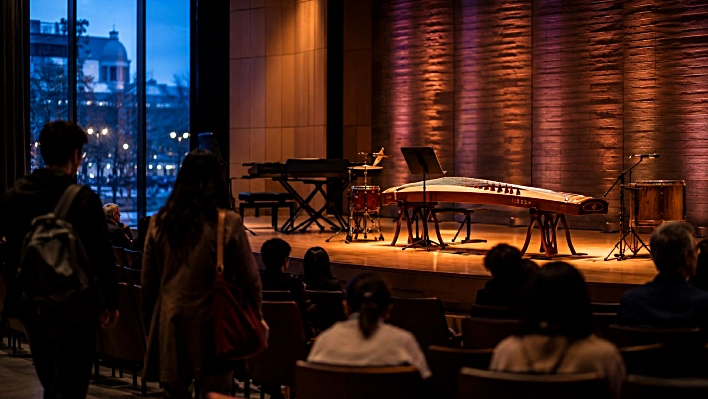
Traditions that had once existed as part of everyday experience now had to be introduced, contextualised and negotiated. An instrument such as the guzheng could no longer be assumed to carry the same associations for every listener. A festival connected to the Lunar New Year could easily become a decorative annual event rather than an opportunity for meaningful cultural exchange.
The question was no longer only how to compose music. It was how to create a context in which music could carry culture without reducing it to a symbol.
A Festival as a Public Cultural Space
That question became particularly visible in the 2023 Chinese New Year Festival at the University of Minnesota School of Music, where Liu served as Festival Director.
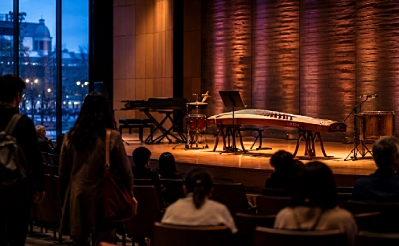
Titled Music for the Soul, Art for Life, the two-day festival was created to celebrate the growing presence of Chinese art and culture in the Twin Cities and to showcase Chinese and Chinese-American musicians and artists. Its programme included a discussion on arts and cultural diplomacy, a Chinese music concert, a public reception with live guzheng music and a panel on Chinese film and visual arts.
The structure is significant. Rather than treating Chinese New Year only as a performance occasion, the festival placed music beside diplomacy, film, visual culture and public discussion.
This allowed Chinese culture to appear not as a single, unified tradition but as an active field of ideas. A concert could celebrate musical practice, while a panel could address the political and institutional conditions of cultural exchange. A reception could provide an informal communal experience, while discussions of film and visual art connected historical forms with contemporary media.
As Festival Director, Liu shaped the event’s cultural and musical direction and coordinated the performers, participants and groups involved—work intended to build a public platform connecting Chinese and Asian cultural expression with a broader American academic and civic audience.
This kind of cultural work is easy to overlook because it does not belong entirely to composition, curation or community organising. It requires all three.
The artist is not only producing an object to be presented. He is shaping the conditions in which different people encounter one another.
Culture Cannot Be Reduced to Celebration
Public cultural festivals carry an unavoidable tension.
They can create visibility and community, particularly for people living far from the cultures with which they identify. But they can also compress complex traditions into familiar signs: food, clothing, instruments, colour and celebration.
The challenge is not to reject celebration, but to prevent it from becoming the only available representation.
The University of Minnesota festival addressed this by connecting performance to cultural diplomacy, cinema and visual history. Its public programme asked not only what Chinese culture looks and sounds like, but how artistic exchange contributes to relationships between communities and nations.
This distinction is central to Liu’s practice in the United States. He is not primarily interested in presenting Chinese culture as something exotic that American audiences can briefly observe. Nor is he interested in removing cultural specificity in order to make every work immediately familiar.
Instead, his projects create points of entry.
Accessibility, in this context, does not mean eliminating difference. It means giving the audience enough musical, historical or emotional context to remain present when something feels unfamiliar.
Memory Moves Through the Body
This approach can also be seen in Shanghailanders, a public interdisciplinary production created through Shen Pei Arts Alliance.
Combining dance, music, theatrical storytelling and Chinese cultural memory, the production addressed Shanghai, migration, war, displacement, love, resilience and historical memory. Liu served as composer, creating original music that supported its dramatic structure, choreographic pacing and emotional development.
In a work like Shanghailanders, history cannot be carried by information alone.
Migration and displacement may be described through dates, names and political events, but performance asks how those experiences remain in the body. A dancer’s pause, a repeated gesture or a change in physical weight can communicate what an explanatory text cannot. Music gives those gestures a temporal and emotional environment.
Liu’s score did not function simply as background for the choreography. It shaped transitions between scenes and helped the audience move through themes of refuge, survival and cultural identity. The music connected narrative and movement, translating historical and emotional material into a form that could be experienced without depending entirely on words.
This is cultural memory as something active rather than archival.
The past is not represented only through historically recognisable sounds. It is reconstructed through the relationship among performers, audience, movement and music in the present.
That relationship matters particularly in immigrant and diasporic contexts. Memory does not remain stable after migration. Some elements become more important because they are no longer surrounded by their original environment. Others change as they are passed to younger generations or encountered by audiences without the same cultural references.
Performance does not prevent this transformation. It makes the transformation visible.
Tradition as a Living Material
Liu’s work with early Chinese cinema offers another example.
For a Minneapolis screening of Zhang Shichuan’s 1922 silent film Laborer’s Love, he composed a new score and performed live improvised guzheng accompaniment. His preparation included research into Shanghai musical culture and the incorporation of elements associated with Yue Opera and shadow-play music.
The project did not attempt to recreate a single authentic soundtrack from 1922. Instead, it allowed historical film and traditional musical material to meet a contemporary American audience through live performance.
This is a crucial distinction in Liu’s approach to tradition.
Preservation is sometimes understood as protection from change. Yet a tradition removed from public use may remain technically intact while losing its social meaning. Musical practices survive not only because they are documented, but because artists continue to perform, adapt and interpret them.
Adaptation does not automatically mean dilution.
A traditional instrument can enter a new setting without becoming a decorative cultural marker. Historical material can be rearranged without losing its connection to place. What matters is whether the artist understands the material deeply enough to make deliberate choices about how and why it changes.
Liu’s work treats tradition as a living material: something capable of responding to new rooms, bodies and audiences.
From Cultural Identity to Shared Human Experience
Not all of Liu’s work in the United States foregrounds Chinese cultural history directly.
In the interdisciplinary musical-theatre production Shelter, he worked as Assistant Music Director, Percussion Composer and cajón performer. The production explored childhood wounds, emotional isolation and the protective structures people build around themselves. Its narrative moved through memory, addiction, unresolved sadness and the possibility of reconnecting with others.
Liu’s percussion writing and live performance supported the relationship among voice, piano, text, movement and stage action. Rhythm helped shape dramatic tension and emotional pacing rather than serving as a separate musical layer.
The production expands the meaning of cross-cultural practice.
Cultural work is not limited to presenting recognisable elements from a particular heritage. It also involves collaboration among artists whose backgrounds, performance traditions and methods of communication differ.
In Shelter, the central themes—memory, vulnerability, self-protection and human connection—were not culturally exclusive. But each collaborator entered those themes through a different artistic and personal history.
Liu’s contribution was not to add a Chinese musical sign to the production. It was to bring a way of listening shaped by his experience across composition, dance, theatre and more than one cultural environment.
This is a quieter form of cultural exchange. It does not announce itself through obvious symbolism. It occurs through rehearsal, negotiation and the way artists learn to respond to one another.
The Work of Creating Context
The most visible part of an artist’s practice is usually the finished performance. Less visible is the work required to create the context around it.
For Liu, cultural work in America has involved directing programmes, coordinating collaborators, teaching, composing, performing and helping audiences enter unfamiliar material. These activities are not secondary to artistic creation. They determine whether the work can become genuinely public.
A composition may contain cultural memory, but that memory remains private unless there is a space in which it can be shared.
A festival may present diverse artists, but its effect depends on whether the programme creates dialogue rather than placing unrelated performances beside one another.
A community workshop may introduce creative tools, but its deeper value lies in whether participants feel that their own language, history and experience belong within the process.
The same principle runs through Liu’s work with students, young creators and community-based programmes in Minnesota. He has increasingly focused not only on what he creates, but on how to establish spaces in which people can exchange ideas, respond to one another and recognise their own experience as legitimate cultural material.
In this sense, the artist becomes more than a cultural representative.
Representation implies speaking on behalf of a group. Liu’s work is often concerned with something more participatory: helping create the conditions in which more people can speak, perform and interpret culture for themselves.
Culture Grows Through Contact
Living between cultural environments is often described as a divided experience, as though the individual must continually choose which side of their identity is more authentic.
Liu’s practice resists that choice.
His work does not attempt to resolve Chinese and American experience into a single, frictionless identity. It allows them to remain distinct while creating situations in which they can affect each other.
This is why “fusion” is not quite the right term. Fusion suggests that separate elements are combined into a stable new product. Liu’s work is more interested in an ongoing process: what happens when music enters a different cultural room, when historical memory is embodied by contemporary performers, or when a tradition is understood differently because the audience has changed.
Culture, from this perspective, is not inherited once and then protected.
It is repeatedly made through listening, performance and contact.
That process can be uncomfortable. Translation always risks misunderstanding. Public presentation can simplify what it attempts to celebrate. Collaboration can expose differences that are difficult to reconcile.
But avoiding those risks would leave culture isolated from the people and environments through which it must continue to live.
Liu’s work in Minnesota suggests that cultural continuity does not depend on keeping tradition untouched. It depends on creating enough trust, knowledge and artistic structure for tradition to move without losing its depth.
The most meaningful cultural exchange does not ask one tradition to disappear into another. It allows both to remain audible—and gives them a place in which to answer each other.
words Alexa Wang