
Nothing stalls a role-play faster than a chatbot that forgets the story. One night your mystery revolves around a cursed ring; the next, the ring is missing—and the suspense with it.
The 2026 solution is to pick an AI platform that treats memory as core architecture rather than a shrinking token window. We audited official docs, scoured user reports, and ran a 100-turn continuity test across seven leading services to highlight the best AI role-play alternatives for writers who value consistency, creative freedom, and fair pricing.
Why We’re Zooming In on Memory (And One Quick Link for Context)
AI role-play isn’t a single genre. Some apps feel like writing studios, others resemble game engines, and a few act as digital companions. We judge how well each option tracks plot threads, player choices, and personal details over time.
From here on, we’ll focus on three things:
- Characters who stay consistent beyond message 50
- Memory you can view and edit
- Pricing that matches the promised recall
With that groundwork set, we can define what “better memory” means.
Quick Verdict: The Seven Best AI Role-Play Alternatives
Short on time? The table shows what each platform does best, how it handles memory, and the main compromise to expect.
| Rank | Platform | Best for | Memory approach | Main trade-off |
| 1 | DreamGen | Multi-character fiction and persistent worlds | Up to 30 000-token context plus Scenario Codex | No text-to-speech or native app |
| 2 | Kindroid | Long-term companion continuity | Layered persistent, cascaded, and retrieved memory | Top-tier memory becomes expensive |
| 3 | SillyTavern | Maximum DIY control | Backend context with lorebook and vector recall | Steepest setup curve |
| 4 | NovelAI | Prose and lore-heavy stories | Long context, Memory field, Author’s Note, Lorebook | Less of a live-companion feel |
| 5 | Nomi | Organic relationship flow | Short-, medium-, and long-term layers plus Mind Maps | Fewer granular fiction controls |
| 6 | AI Dungeon | Game-style adventures | Story and world memory with rolling summaries | Adventure first, intimacy second |
| 7 | JanitorAI | Browsing community character cards | Model-dependent memory | Inconsistent turnkey recall |
We’ll unpack each layer of “better memory” next so you can judge these services with the same criteria we used.
Character AI in 2026: The New Baseline Everyone Must Beat
Until mid-2026, Character AI struggled with short-term recall and lacked a lorebook. That changed on May 21, 2026, when the team introduced Story Memory, editable Facts, and a live memory meter. Users can pin key moments, track separate user and NPC facts, and delete mistakes before they spread. On July 24, 2026, a beta Lorebook followed, letting writers tag people, places, and rules that surface when keywords appear. Paid c.ai+ plans add larger memory quotas and early access to retrieval experiments.
We highlight these upgrades because many reviews still cite 2024 issues. The bar is higher now. Any rival must store more context, surface it more reliably, or offer finer editorial control than Character AI’s visible Facts screen. In our tests, a product lost points if it forgot a promise at turn 50 or hid its memory behind a black box, regardless of dialogue flair.
With the field reset, we can map the six memory layers that keep a chatbot’s canon intact.
What “Better Memory” Really Means
A 30 000-token context window looks big, yet raw space is only the first layer of real continuity. We track six tiers, each with a distinct role:
- Active context – the most recent dialogue the model sees; lose it and characters forget the last five minutes.
- Pinned context – immutable facts such as a hero’s name or a vault password; the best apps let you edit these on the fly.
- Rolling summary – compressed notes that free headroom without deleting history; they help only if updated at sensible checkpoints.
- Retrieval memory – an internal search that resurfaces dormant details when needed; many platforms still struggle here.
- Lore or world state – structured entries for locations, factions, and rules; Character AI’s July 2026 Lorebook, NovelAI’s Lorebook, and SillyTavern’s World Info operate at this level.
- Cross-session identity – facts that persist across chats and group rooms; a 2026 study on perspective-bounded agents found this separation cuts narrative drift (Gao et al., 2026).
Every score that follows weighs products against all six tiers, not just token count. We are judging architects, not storage lockers.
How We Ranked the Seven Platforms
We built a scoring grid and treated memory as an engineering problem, not a gut feeling. The weightings are:
- Memory architecture: 30 percent
- Creative and world-building control: 20 percent
- Model fit for fiction: 15 percent
- Multi-character competence: 10 percent
- Price and value: 10 percent
- Ease of use (web and mobile): 8 percent
- Privacy and portability: 7 percent
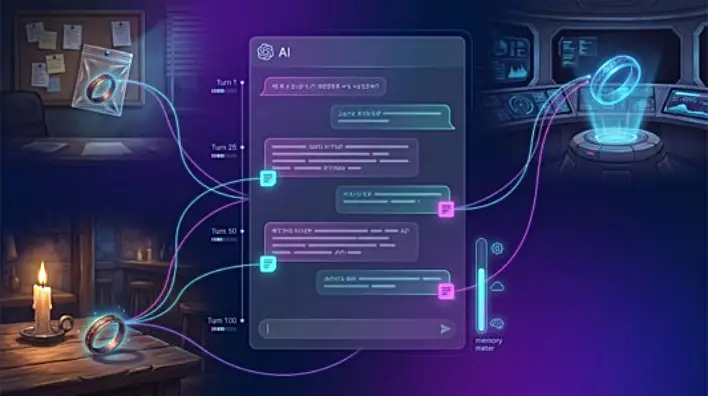
For every service we recorded the tier, model, and context limit, then ran a 100-message fantasy-mystery test. We checked recall at four points (turns 25, 50, 75, and 100), timed the setup from sign-up to first reply, and noted whether group chats kept memories apart. Missing documentation or hidden fees cost the vendor points. We will update the table whenever a product ships a major change.
1. DreamGen: Best Overall for Multi-Character Fiction
DreamGen feels like a writers’ room guided by an AI narrator. The Scenario Codex stores style, setting, and character notes, and the Pro tier unlocks a 30 000-token window plus fiction-tuned GLM 4.7 models. In our 100-turn test the hero, two side characters, and a tavern cat all stayed consistent, even after we edited the timeline. For a deeper category view, see DreamGen’s own Best AI Roleplay Chatbots In 2026 roundup.
Strengths: largest editable context and structured lore, OpenAI-compatible API.
Trade-off: no native app or text-to-speech.
2. Kindroid: Best for Persistent Companion Memory
Kindroid layers short-term, cascaded, and long-term stores. The MAX tier holds about 480 000 retrievable characters. A “Learned Context” sheet lets you edit or delete facts. Voice, images, and video add to the companion feel, though the Ultra and MAX tiers raise the monthly fee.
Kindroid companion chat UI with Learned Context memory sheet
Key points
- Platforms: web, iOS, Android
- Extras: voice notes, image sharing, live video, group-chat memory
- Price: free tier; Standard starts at about $14 per month, with higher tiers expanding memory
Trade-off: the largest memory sits behind the top subscriptions, and the settings panel can feel crowded compared with simpler companion apps.
If you want a companion that remembers months of chat and still lets you fix mistakes, Kindroid delivers both depth and editorial control.
3. SillyTavern: Best for Total Local Control
SillyTavern is an open-source frontend you run on your own machine or server. Connect a local GPU or paid API, add World Info sheets, and bolt on a vector database for retrieval. In our test a 40 000-token Qwen 3.5 model revived a prophecy from message 1 at message 80. Set aside a weekend for installation and plan for separate model costs.
Strengths: unlimited control and privacy, plus an active plug-in community.
Trade-off: steep setup curve.
4. NovelAI: Best for Prose and Lore-Heavy Stories
NovelAI’s Xialong model offers a 28 672-token active stage and an 8 192-token rollover buffer. Memory, Author’s Note, and Lorebook cards slot entries by keyword, giving novel-style control but little in-chat companionship.
Key points
- Plans: the Opus tier at $25 per month opens the full context, while lower tiers provide smaller windows
- Export: full text plus Lorebook JSON
- Platform: web only, with no native mobile app or voice features
Trade-off: multi-character banter needs careful prompt tags, and there is no built-in TTS or image chat. Pick NovelAI when polished prose and deep lore control outweigh live-companion features.
5. Nomi: Best for Organic Relationship Flow
Nomi is a companion-first app that tracks your chats across three layers:
- Short-term – the last few messages in active context
- Medium-term – a cascaded log that summarizes older turns
- Long-term – memories surfaced through a visible Mind Map (v2.0 released October 2025)
During a week-long test the bot remembered a casual cinnamon-latte joke more than 1 000 messages later without sharing the detail in other group chats. The perspective-bounded system works.
Key data
- Platforms: iOS, Android, web
- App Store rating: 4.6 / 5 from about 2 700 US reviews (August 2026)
- Price: free tier; Standard plan $15.99 per month or $99.99 per year
- Extras: voice notes, image sharing, one-tap calls, group-chat memory
Trade-off: fewer world-building controls than DreamGen or NovelAI, and character placement in crowded scenes can drift.
Choose Nomi when you want everyday rapport on mobile without Tolkien-scale lore tools.
6. AI Dungeon: Best for Game-Style Adventures
AI Dungeon tracks story summaries and world notes between turns, giving you more than a raw transcript without the full DreamGen-style codex. Multiplayer keeps separate inventories, although narrative voice can drift and the largest contexts require a paid tier.
Key data (August 2026)
- Context window: up to 4 000 tokens on the free tier; 32 000 on Mythic+ (AI Dungeon help center)
- Platforms: web, iOS, Android
- Pricing: free tier; $14.99 per month Adventure pass; $29.99 per month Mythic+ for larger context and premium models
- Multiplayer: up to 8 players with separate inventories and private actions
Memory approach
- Rolling story summaries and location notes injected between turns
- Scenario metadata stores persistent world facts across sessions
In a 100-turn dungeon crawl the engine remembered a locked-gate puzzle introduced at turn 5 and resolved it 20 minutes later, showing episode-level continuity. Dialogue can drift toward narrator exposition, and premium tiers gate the biggest contexts, but for improvisational quests AI Dungeon offers the most flexible game loop.
Pick it when you want RPG momentum and multiplayer mechanics over fine-grained character intimacy.
7. JanitorAI: Best for Community Character Cards
JanitorAI operates as a web marketplace where creators publish character cards with custom prompts, example dialogue, and a chosen model backend. As of August 2026 the catalog lists 70 000+ public personas and supports both hosted models and external keys for OpenAI, Anthropic, or local Ollama.
Memory approach
- Varies by model and how the card author defines long-term slots
- An in-chat Memory tab shows pinned facts, and authors can script extra fields
- Quality differs: a Qwen 2.5 self-host recalled a safe word perfectly, while a lighter free model forgot it after 20 lines
Key data
- Pricing: free browsing; $10 per month for JanitorAI+ adds access to larger hosted-model windows; external API fees remain separate
- Platforms: web only (mobile-friendly)
- Export: character cards use the .char format, compatible with SillyTavern and other tools
Trade-offs
- Memory consistency depends on each card and model pairing, so plan to test before a long campaign
- No built-in group-chat separation; multi-character scenes need careful prompting
Choose JanitorAI when variety outweighs reliability and you are comfortable switching engines until recall meets your standard.
Which Alternative Fits Your Workflow?
| Your priority | Recommended pick |
| Sprawling multi-character worlds | DreamGen |
| Companion that remembers months | Kindroid |
| Maximum privacy and tinkering | SillyTavern + local model |
| Fine-grained prose and lore | NovelAI |
| Mobile relationship flow | Nomi |
| Game-style quests | AI Dungeon |
| Thousands of community personas | JanitorAI |
Each platform offers a free tier or demo, so try two that match your goals, and test how their memory systems perform in practice.
Buyer’s Guide: Choosing a Role-Play Chatbot With Memory
1. The Context Window Is Only the Start
A 30 000-token buffer covers today’s dialogue, but older turns vanish unless summaries or retrieval pull them back. Always ask:
- How large is the active window?
- What rescues information once it scrolls?
2. Automatic Versus Editable Memory
Automatic capture is quick yet can store mistakes. Editable systems—DreamGen’s Scenario Codex, Kindroid’s Learned Context, Nomi’s Mind Map—let you prune errors before they spread.
3. Lorebooks and World State
Lorebooks file facts by keyword so the model inserts them only when needed. DreamGen and NovelAI lead here; Character AI added a beta Lorebook in July 2026.
4. Single-Character Chat or Multi-Character World
Group scenes need separate memories and secret knowledge. DreamGen locks NPC stacks; Kindroid and Nomi support groups; SillyTavern and AI Dungeon rely on disciplined prompts.
5. Model Quality and Fiction Tuning
Look for named creative models (GLM 4.7, Xialong) and genre controls (style sliders, phrase bias). A fiction-tuned engine usually paces dialogue better than a generic chat model.
6. The “Memory Tax”
Free tiers have limits. DreamGen provides about 2 000 Lucid Base messages per month, while Kindroid’s deepest cascade, roughly 480 000 characters, sits only on MAX. Check what you pay before the headline spec unlocks.
7. Editing, Branching, and Rewrites
DreamGen (inline edit plus branch) and SillyTavern (unlimited branches) act like version control for dialogue—vital for plots that need retroactive fixes.
8. Mobile, Voice, and Images
Kindroid and Nomi ship polished mobile apps with voice; DreamGen offers a mobile-optimised web UI and Muse/AniMuse images; SillyTavern relies on community plug-ins for TTS or sprites.
9. Privacy, APIs, and Portability
Hosted apps may analyse chats unless you opt out; SillyTavern keeps everything local. Check export formats (.json, .char) and API access if you plan to migrate data or build tools later.
Work through these nine checkpoints, and you’ll pick a service that fits both your story and your budget without discovering hidden limits mid-campaign.
FAQ
What is the best AI role-play alternative right now?
For multi-character stories the lead pick is DreamGen, whose Scenario Codex pairs a 30 000-token context (Pro tier) with editable lore. If you need the deepest long-term companion recall, choose Kindroid; the MAX tier stores roughly 480 000 retrievable characters (Kindroid docs, August 2026).
Which chatbot documents the largest memory?
Kindroid offers the biggest confirmed memory on a mainstream plan. DreamGen follows, focusing more on manual world-building than raw storage.
Does a larger context window always win?
Not by itself. A wide window helps short-term recall, but without summaries, retrieval, or a lorebook the model still forgets once the buffer scrolls. Check both window size and retrieval tools.
What is the best free option?
DreamGen provides about 2 000 Lucid Base messages each month. If you have local hardware, SillyTavern is open source; your only cost is the model or GPU.
Can any of these bots remember forever?
No. Vendors can store unlimited logs, yet retrieval stays selective. Expect months of memory with upkeep, not perfect permanence.
Which services support group chats?
DreamGen, Kindroid, Nomi, and SillyTavern keep separate memories in multi-character rooms. AI Dungeon allows up to eight players, though the narrator can drift if prompts lack focus.
How safe is my data?
Hosted apps (DreamGen, Kindroid, Nomi, JanitorAI) analyse chats for model improvement unless you opt out. SillyTavern keeps everything local unless you send text to an external API. Review each privacy page and export transcripts often.
Which platform suits writers who dislike code?
Pick NovelAI for its clean editor and Lorebook, or DreamGen for the Scenario Wizard; both hide prompt mechanics so you stay in creative flow.
Conclusion
A role-play chatbot’s memory architecture matters as much as its prose. Test two of these services on your own stories, watch how they handle recall after 100 turns, and choose the one that fits your creative cadence and budget.
words Al Woods