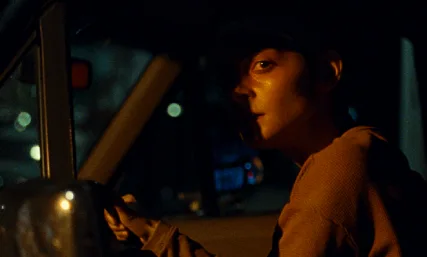
Gazer is the tense debut thriller from writer/director Ryan J. Sloan and writer/star Ariella Mastroianni, a self-funded passion project that took two and a half years of weekend shoots in New Jersey to produce.
Taking the approach of a film noir, it follows Frankie, a single mother with a cognitive disability called dyschronometria, after she witnesses a violent altercation and is framed for murder. Haunted by a traumatic past, she races to uncover the truth and clear her name whilst compromised by a fractured concept of time and reality.
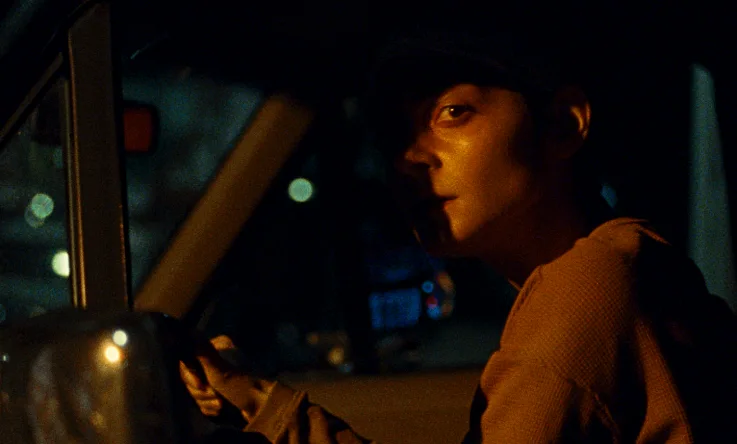
Gazer had its world premiere at Cannes Directors’ Fortnight, followed by screenings at both Glasgow and Dublin Film Festivals. It’s a satisfying debut, not least of all because the pair of collaborators were unafraid to tap into their inspirations and tell the story they wished to tell in all of its layers of psychological, even physical, horror. Balancing all of these elements was a significant undertaking, yet they shrug it off, somehow managing to revitalise classic elements of cinema through their passion for the medium.
In conversation with Flux, Ryan and Ariella discussed their influences, approach and the practicalities behind attempting something as ambitious as Gazer.
You’ve previously spoken about how this film is a love letter to those films that first inspired you. What were those films exactly and how did they influence Gazer?
Ryan: That’s a great question. Ariel and I, we’ve known each other for a long time, and we were very particular about the first film that I wanted to direct, the first film that she wanted to star in. We kept revisiting films like Coppola’s The Conversations, Scorsese’s Taxi Driver, Hitchcock’s Vertigo, Antonioni’s Blow Up, and La Ventura, De Palma’s Blow Out, trying to understand what it was we were so enamoured by. Another huge one was Lee-Chang Dong’s Burning. Ariella cracked the code that these films all shared a similar spiral structure; where every time the character hits a certain point of the spiral, they’re forced to revisit this traumatic experience they’ve been running away from.
Nobody’s doing this anymore, and these films are all male led, and none of them are set in New Jersey. So I felt like we had a great opportunity to explore this woman’s journey against the backdrop of New Jersey and this terrible healthcare system that we have, how desperate we are here to just make a living and get by. It was something that really inspired us.
We followed some of Nolan’s approach when making his first film; he shot during weekends for a year, on 16mm as well. He would shoot near windows so you didn’t have to light too much. We shot everything at night so we had to light everything, and we shot in colour, but we did follow some of his format there, I think.
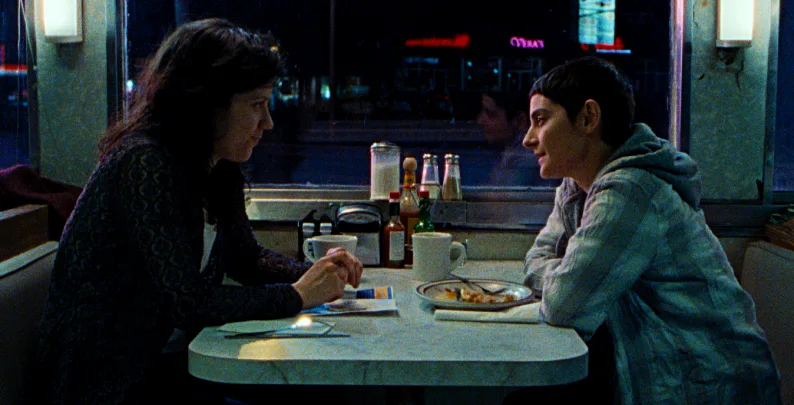
Frankie feels like a character who’s had her voice taken away in more ways than one – was this theme something you were keen to explore from the outset?
Ariella: I think the voice as a theme was something that we really paid attention to. Even just in developing the character, her voice at the beginning of the film is very small. It’s very soft. She tries very hard not to be seen. We were interested in this character in terms of voyeurism, to have a character who is living life as a ghost, keeping her head down and focussed on getting back to her daughter. She finds herself taken to this character, Paige. She really does not want to be seen, but Paige sees her. Frankie’s drawn to this idea that there is this woman who is in this predicament and Frankie sees that as a chance for redemption. We’ve always said that one thing we love about this film is that it’s a redemption story derailed by a revenge story.
Frankie has a unique cognitive disability in the film. How did you prepare for that aspect of the role and was it difficult to shut the door on the character at the end of a day’s filming? It seemed like a very challenging role to encompass!
Ariella: We shot the film on weekends in the spring and fall over two and a half years, which is really hard to maintain consistency across all departments, including performance, and I give a lot of credit to Ryan for creating an environment where we could pick up after four months and continue where we left off.
Performance wise, I don’t really have one way of approaching characters. However, because we had such a stop and start nature, one tool that was helpful for me was to really develop her physicality. Especially when you’re dealing with a quiet character, what is the thing that could tell the story without speaking? It’s a visual medium. So in the beginning of the film, she’s caved into herself, her head is down. She’s not really looking at people, she’s hardly using her voice and tries to go unseen. As she becomes more active in the investigation, she has a stronger posture, a stronger voice as she wants to figure out what’s happening.
But I’m still kind of shaking off Frankie. I wouldn’t say that I’m necessarily the kind of performer who likes to sit with it too long; it just would not be sustainable for two and a half years. She’s kind of…I don’t want to say miserable, but she’s shouldering a lot. But yeah, there was a point at which I was happy to grow my hair out a little longer!
The dream sequences in the film utilise elements of visual horror to recreate the trauma that Frankie experienced. Was there anything that specifically inspired these scenes, and was it difficult to realize them on a practical level?
Ryan: When Ariel and I were writing the nightmare sequences, originally they were flashbacks and we were showing precisely what happened. There was a point where we said to one another, this is the nightmare. It’s tragic. Ariel said, well, let’s be bold here and let’s really lean into that nightmarish element of it. As soon as that was offered, it was like the safety rails in the bowling alley were taken off. It’s a very freeing experience. We were able to explore her trauma and her haunted past by using elements of body horror, using this surreal landscape where we pop in and we pop out, we have no control over when they start and when they end. This is how a lot how my dreams work. My dreams are very surreal and very visual.
Everything you see in her dreams is what happened that night. It’s just told in a heightened way, similar to Lynch and Kubrick. In the waking world, the camerawork is handheld as we follow Frankie. In the dream, we’re on steady camera sticks. The camera doesn’t move; it doesn’t pan, doesn’t tilt, doesn’t push in. It is completely controlled. Everything is very symmetrical, very measured.
Something that I learned from studying director Sidney Lumet is to make rules for your film, and decide what those rules are doing to help tell the story. In setting the visual language, that was one of the rules that I made for the nightmare sequences I think really helped to nail that experience.
Ariella: Like Ryan said, if it feels like a nightmare to Frankie, why wouldn’t you use genre to express that? Frankie is trying to understand these feelings, and sometimes reality isn’t enough, so by presenting it in this way, it’s just more expressive.
It was fun for us to lean into that because you can capture something that’s not necessarily grounded and rooted. It’s rooted in reality, but she’s working it out in her head.
Ryan: Yeah, it was a lot of fun. One of the most fun things was how our crew were like, what are you guys making?! I just kept saying, it’s a nightmare, go with it! For audiences in the movie theatre, that’s the moment where either they’re in and they’re sticking around or they’re out. And I love that.
Gazer is in select cinemas from the 25th July from Bulldog Film Distribution.
words Jake Munn