The term “World Literature” was first coined in the 19th century by German poet Johann Wolfgang von Goethe, who was inspired by a novel translated from Chinese. Goethe remarked: “National literature is now a rather insignificant term; the epoch of world literature is at hand, and everyone must strive to hasten its approach.”
Beyond anticipating a cross-cultural, anti-monocultural literary era, Goethe implicitly positioned world literature as a conceptual counterforce to parochialism and the threat of monolingual cultural dominance.
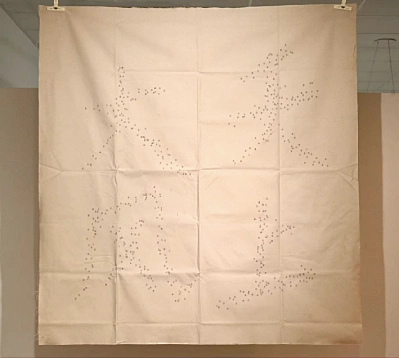
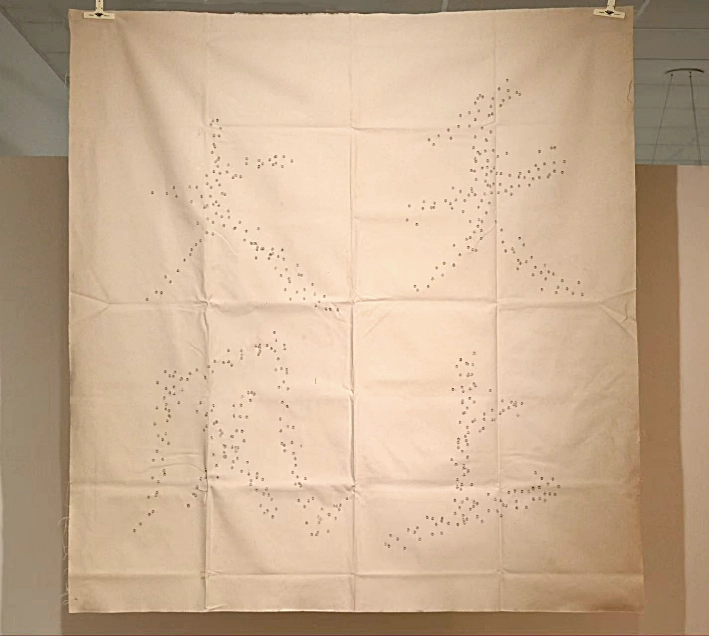
In contemporary times, amid the expansive rise of capitalist markets and global industrialization, the boundaries between cultures have been increasingly eroded by the forces of translation and commodification. Concepts such as “locality” and “nationality” have lost their primacy in cultural discourse. Instead, due to the destabilizing effects of decolonization and globalization, culture has become a nomadic, fluid system of signs. Any attempt to reassert the meaning of “national literature” or “national art” risks reinscribing us within the imperialist logic of the colonial order, returning both artists and authors to a nostalgic framework shaped by empire. Hanx Liu’s new series Mass Within Calibers, showcased this June in his solo exhibition Voltar Do Mar at Jutta Gallery, New York City, stages an intervention into this very terrain. In the series, Liu uses rifles to shoot through canvases, with the resulting bullet holes forming compositions reminiscent of Kanji calligraphy. This collision of contemporary firearms and traditional East Asian aesthetics challenges the physical constraints of conventional media while dismantling essentialist narratives of cultural identity.
His method enacts a powerful dialectic between violence and elegance, pushing the boundaries of painting as a material practice and compelling viewers to interrogate notions of authenticity and heritage. Through this bold, conceptually rigorous approach, Liu establishes himself as a formidable voice in contemporary art—one unafraid to weaponize form in the service of cultural critique. Few artists today navigate the threshold between destruction and creation with such precision and poetic force. In this particular work, Liu references Zen monk Taigu Ryōkan’s calligraphic phrase “Celestial Great Wind” (天上大風), using discharged bullets as the medium through which the spirit of East Asian script becomes a nomadic force—resonant, muted yet intense—within a boundless conceptual field. Here, cultural nomadism does not imply geographic displacement, but rather the continual dislocation and reconfiguration of identity across multiple cultural regimes.
Born in China and working in the American South, Liu enacts a form of artistic nomadism—not to “bring” Eastern culture to the West, but to generate a fractured hybrid forged through friction and resistance. His work does not resolve cultural tension; it thrives on it, turning contradiction into creation. Such a practice directly challenges cultural essentialism, which insists on identity as fixed and intrinsic. In 1990, sinologist Stephen Owen dismissed Bei Dao’s poetry as lacking “nationality”—a view that invites critique. Must identity conform to monocultural frameworks? Is this not a subtler reiteration of colonial logic?
In Liu’s hands, calligraphy is no longer rendered with ink but violently inscribed through bullet holes. Is this still writing, or a hauntology of script—a spectral presence of language? Here, Liu shoots language into being, displacing calligraphy from its role as a vessel of cultural continuity. Through what Roman Jakobson called intersemiotic translation, he transforms it into a corporeal, performative act. Amid the gunfire of Texas, Chinese culture becomes not a root, but a rupture—reanimated through destruction, viscerally embodied. By introducing violence into the act of writing, Liu constructs a metaphor for cultural violence itself. As Gayatri Spivak notes, cross-cultural artists are often compelled to perform identity to meet Western expectations. Liu rejects this demand. Instead of ink and brush, he offers gunfire, shattering the illusion of “Oriental beauty” and refusing the role of cultural bridge. His work is not a gesture of reconciliation, but a deliberate collision.
In this sense, Mass Within Calibers does not merely participate in global art discourse—it expands its grammar. Like Goethe’s vision of Weltliteratur as a force against parochialism, Liu’s practice proposes a translingual, transmedial critique: forged in contradiction, sharpened by dissonance, and unwilling to settle into fixed categories. In an era of cultural circulation marked by deep inequality, Liu reminds us that the most urgent acts of creation emerge not from stability but from fracture. His work inhabits that fracture with unapologetic force.
Written by: Liang Jing