It’s been some time since film noir had its day in the sun (or perhaps the rain drenched streetlight is more fitting).
Seeking fresh ground here is no small feat, but it’s a challenge that writer/director Ryan J. Sloan and writer/lead actress Ariella Mastroianni have risen to in their tense and audacious offering Gazer that is equal parts crime thriller and psychodrama. Set for release on the 25th of July, Gazer had its world premiere at Cannes Directors’ Fortnight, followed by screenings at both Glasgow and Dublin Film Festivals.
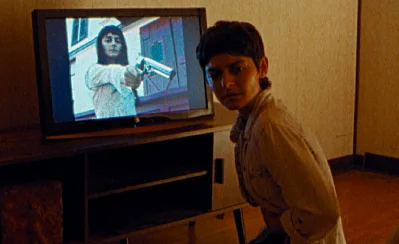
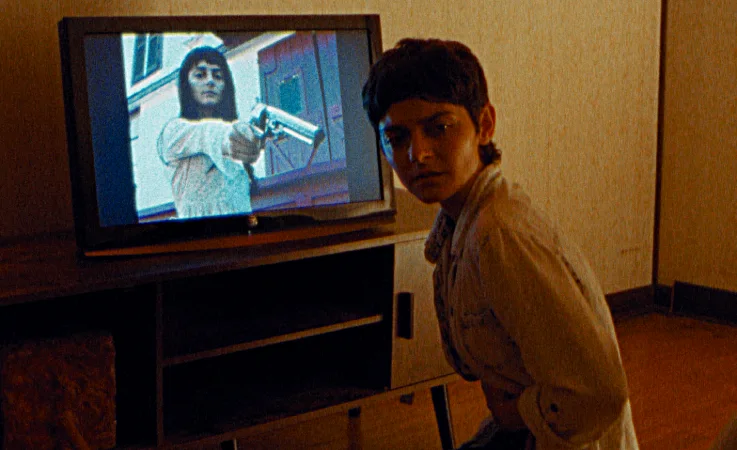
Frankie, a single mother with a shrouded past, suffers from a rare condition known as dyschronometria which affects her sense of time and causes sporadic blackouts. She listens to cassette tapes of her own voice to prevent from slipping into an episode. “Focus. What do you see?” The tinny recording iterates during the opening scene as Frankie gazes up at a block of flats, inadvertently witnessing a violent altercation between a man and a woman in a dimly lit apartment.
After a confrontation with the woman, Paige (Renee Gagner), at a grief support group for suicide-loss survivors, Frankie grows closer to her and, desperate for money, ends up accepting a job to recover Paige’s car from her abusive brother. Paige vanishes soon after, the police discover a body of a doctor in the boot and Frankie is their lead suspect. The race is on to track Paige down and uncover the truth, fractured memory working against her.
Inspired by the approach Nolan took in his debut Following, the electrician-turned-director opted to shoot in 16mm, channelling influences as diverse as Taxi Driver, Memento and Vertigo to capture an angsty, paranoid tone that feels essential to the film’s own internal language. Indeed, Sloan’s wears his passion for cinema with pride in Gazer, something that is bound to frustrate some and delight others. It even braves a nod to master of surrealist horror David Lynch during Frankie’s nightmare sequences, a point at which the film teeters on the brink of self-indulgence. But in realizing Frankie’s growing confusion towards her own past trauma, it works; there’s a freedom at play in Gazer, something even a little infectious for fellow cinephiles. It’s impressive for a self-funded film that cost $80,000 to look as polished as Gazer does.
Frankie’s investigation leads her to one dead end after another amidst the industrial, claustrophobic backstreets of New Jersey. The closer she comes to the truth, the further her plans for a life with her daughter beyond her current predicament appear. Taking over two years of weekend shoots to produce, this extended window afforded Sloan the opportunity to really capture his environment as a gritty maze within which Frankie is trapped, doomed to fail, her deteriorating cognition compounding our despair for her. Mastroianni succeeds where more seasoned actresses would not in adopting physicality as a means of portraying vulnerability. As her conviction grows, so too does her stolen voice, and Frankie’s payoff ensures that she remains an active force in her own narrative.
Despite sometimes suffering from familiar plot beats and twists, with Frankie’s blackouts serving as convenient time jumps to important cues, these gripes don’t detract from a conclusion in which Frankie finds some measure of justice for herself and her daughter. A question mark hangs over the final scene, however there’s an inevitability in the final moments that serve as a closing of a chapter, leaving us intrigued at the collaborator’s promise of a connected trilogy.
Gazer is in select cinemas from the 25th July from Bulldog Film Distribution.
words Jake Munn