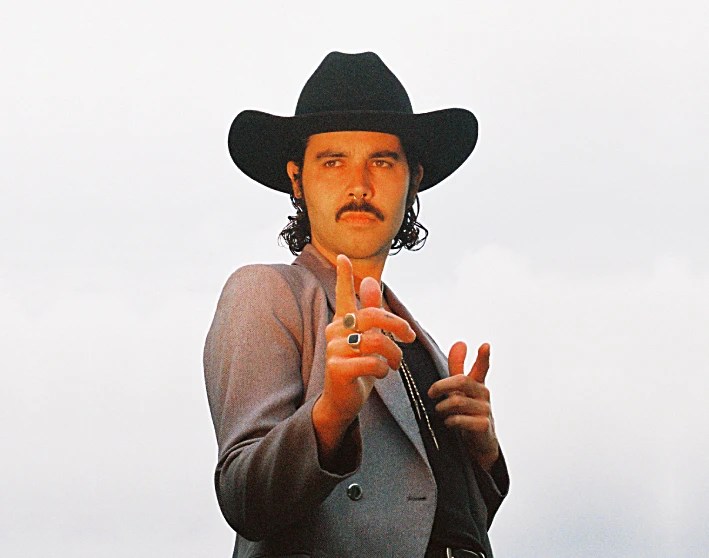
Hemi Hemingway opens his new album Wings of Desire with the line “I wanna live on the wings of desire,” a nod to Wim Wenders’ 1987 film and its monochrome angels, doomed romance, and eventual bloom into colour — basically the entire Hemi Hemingway aesthetic moodboard distilled into one cinematic reference. But more importantly, it’s a manifesto. After the end of a long-term relationship and a move from London back to New Zealand, he found himself forced into a kind of emotional rebrand: heartbreak as rebirth, longing as propulsion.

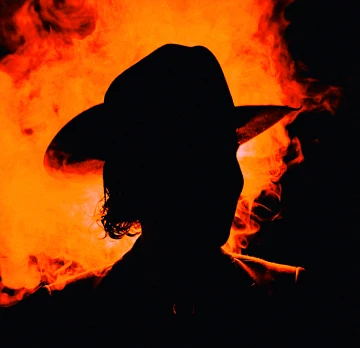
“A friend of mine described it as a yearn-fest,” he says, amused by the accuracy. Much of the record is built on that restless ache, the push-pull between desire, regret, and the weird dissociation that comes when you no longer recognise yourself. “I think I had been at a point in my life where I felt really disconnected from myself and from my own desire, and from feeling desirable to other people… So writing these songs was a grieving of this long-term relationship, but it was also a sort of rediscovery of myself.” Hence the cover: Hemingway, phoenix-like, in front of a fire — subtlety is not the point.
Hemi Hemingway began as a London studio project during the pandemic, a chance to shed inhibitions, dive into post-punk and garage grit, and write frankly about things he once avoided. “I was trying to write about things like love, where I hadn’t been able to in the past,” he says. The name itself is a reclamation of his Māori identity, one he’d long felt pushed away from. The project quickly picked up momentum — a 2021 EP, sold-out Moth Club and Shacklewell shows, support slots for Kurt Vile — and then, abruptly, he left the UK. Back in Wellington, he found a scene so gloriously low-stakes it became freeing: “Things can end up being a bit more raw and explorative here, because there’s this feeling of well, who’s gonna hear it or care anyway? So you kind of just make it totally for yourself.”
Working with producer James Goldsmith, he built Wings of Desire into his most collaborative project yet, with demos left charmingly untouched in places and meticulously reworked in others. The result mixes his signature ‘50s/‘60s swoon with gothy ‘80s post-punk and New Romantic smoulder: the melodrama of “Wings of Desire”, “Promises” and “If Love Is A Winter’s Day,” the slink of “This City’s Tryna Break My Heart” and “Long Distance Lover.” “Desiree” drifts back to the sweet, clumsy intensity of early love — “When did we become the grown-ups?” — while “Long Distance Lover” brings hip-loosening bass and a reminder that desire can survive almost anything, even geography.
The emotional gut-punch arrives with “Promises” and “If Love Is A Winter’s Day,” both gently excavating the aftermath of heartbreak, before the album’s two heaviest moments tighten the frame: “6th April ’13,” a stark reckoning with a traumatic assault, and “No Future No Future No Future,” his most explicitly political work yet, confronting government moves to erode Māori rights. “It’s an acknowledgement of how bad it already is, and how, if pushed, we’ll have no choice but to burn the whole system to the ground,” he says, sounding entirely done with subtle euphemism.
Suffused with loneliness and yearning, “” is the lead single from the album which combines the romantic ‘50s and ‘60s influences that are familiar to Hemi Hemingway with a newfound obsession with gothy ‘80s post-punk and New Romantic. Bringing in fellow NZ artist Vera Ellen (Flying Nun) on vocals, it’s an epic inspired by the novel Astragal by Albertine Sarrazin, drenched in frustration while waiting for the future to happen. You can listen to it HERE
“Oh, My Albertine” was written after reading ‘Astragal’ by Albertine Sarrazin. The story spoke of a young woman breaking out of prison to rejoin her love, desperate to flee and start a new life for her and her young partner. It spoke of her frustration as she was holed up, waiting for her leg to heal (which she broke escaping from prison) and avoiding recapture, while her boyfriend was working long hours to save money for their new life. I read it at a time when I myself was feeling quite lonely and frustrated, waiting for the future to happen to me, in a bed of grief that never quite seemed like it would ease. I sent it to Vera and we talked about her harnessing Jonnine Standish of ‘HTRK’ (à la I Know A Girl Called Jonny by Rowland S. Howard), but what she brought far exceeded what I could have ever envisioned.”
For Hemingway, the album is a decisive step into himself. “It feels like I have connected with Hemi Hemingway a lot more with this album,” he says. “I’m trying to lean in fully, and do it unapologetically. It feels a lot more like me.” If this is the yearn-fest, it’s also the transformation — a widescreen portrait of someone setting fire to the past just to see what shape the future makes in the smoke.
words Alexa Wang