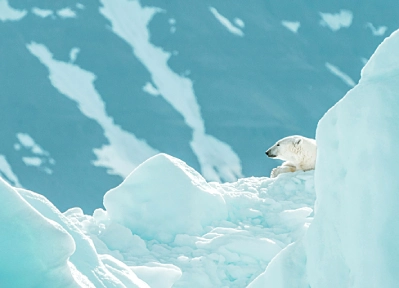
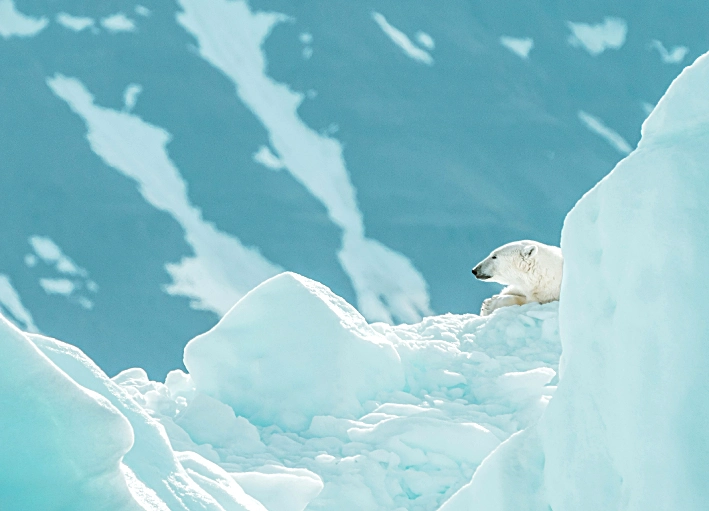
Svalbard sits well above mainland Norway, between the northern coast of Europe and the North Pole. On a map it looks remote, and it is, but that’s exactly why interest in the archipelago has grown so quickly. People arrive hoping to spot polar bears on sea ice, watch glaciers calve into the sea and experience weeks of uninterrupted daylight during summer.
What catches many first-time visitors off guard is how much variety exists beyond the wildlife. Longyearbyen has museums, old mining infrastructure and a surprisingly international population. Scientific research stations operate in some of the world’s harshest conditions, and a vault buried inside a mountainside quietly stores seeds from across the planet. For a destination with only a few thousand residents, a lot is happening here.
Svalbard by Expedition Ship: Polar Wildlife, Sea Ice, and the Edge of the World
A large part of Svalbard can only realistically be reached by ship. Outside Longyearbyen, there are no roads linking settlements, and much of the coastline remains completely undeveloped. Once vessels leave Isfjorden, the landscape quickly becomes bigger and emptier. Mountains rise directly from the sea, glaciers occupy entire valleys, and old trapper cabins occasionally appear on isolated stretches of shoreline.
Wildlife often dictates the day’s schedule. A walrus colony resting on a beach can bring Zodiac operations to a halt for an hour. Arctic foxes are regularly spotted around seabird cliffs, while whales surface unexpectedly in the fjords. This unpredictability is one reason travellers book celebrated Svalbard cruises, particularly itineraries that focus on navigating the pack ice around northern Spitsbergen. These voyages are designed around real-time conditions, allowing expedition leaders to search for polar bears near drifting ice edges, explore glacier fronts and reach remote areas such as Hinlopen Strait or the islands around Nordaustlandet when conditions allow.
Life onboard settles into its own routine. People gather on open decks scanning the horizon, cameras ready. Lectures fill gaps between landings. Then there are moments when nothing much happens at all, apart from a ship gliding through loose sea ice at midnight beneath a bright Arctic sky.
Longyearbyen: The World’s Northernmost Town and Its Surprising Depth of Culture
Nearly every visitor passes through Longyearbyen, and most end up spending longer here than expected. The settlement stretches through a broad valley beneath mountains that still hold snow well into summer. Colourful houses stand above the river, while snowmobiles remain parked outside homes long after winter has ended.
The main street contains outdoor gear shops, galleries and practical services used by residents year-round. Walking between the town centre and the waterfront takes only a short time, yet there is plenty to stop and look at. The Svalbard Museum covers everything, from polar bears to early trapping history, and the North Pole Expedition Museum focuses on the explorers who passed through these waters during the race to reach the Arctic.
Old mining structures are visible from almost everywhere. A visit to Mine 3 provides a useful look at the industry that built the settlement. Around the harbour, expedition vessels, research ships and supply boats sit side by side. On busy summer days, people carrying hiking gear mingle with scientists unloading equipment from small boats.
Spitsbergen’s Glaciers and Fjords: The Wildest Landscapes You’ll Ever Stand In
Spitsbergen covers most of Svalbard’s landmass, and much of it remains untouched by modern development. Travelling through the fjords often means hours without seeing another vessel. Mountains, glaciers and open water dominate nearly every view.
Kongsfjorden is one of the best places to understand the scale of the Arctic environment. Several glaciers feed directly into the fjord, sending icebergs drifting across the water. Further north, Monaco Glacier stretches across the head of Liefdefjorden. From a distance, it resembles a frozen cliff running across the landscape. Up close, the size becomes easier to appreciate. Sections of ice regularly break away with a crack that can echo across the fjord.
During summer, reindeer graze on exposed tundra, and geese gather along the shoreline. Some landing sites involve walking across uneven ground covered in mosses and small Arctic flowers. Conditions can change quickly. A sunny morning can become foggy within an hour, particularly around glacier fronts where cold air moves across the water.
Ny-Ålesund: The Remote Arctic Research Station Open to Curious Travellers
Ny-Ålesund sits on the southern side of Kongsfjorden and ranks among the northernmost permanently inhabited settlements in the world. It began as a mining community but now serves primarily as a research station with scientists studying climate, glaciers and atmospheric conditions.
It’s hard to ignore how quiet the place feels. Gravel roads replace paved streets. Research buildings sit among historic wooden structures left behind from earlier decades. One of the most visited landmarks is the mast associated with Roald Amundsen’s airship expeditions in the 1920s. It still stands above the settlement and can be seen from a considerable distance.
The settlement’s small post office attracts a steady stream of visitors posting cards home from the high Arctic. Around the shoreline, Arctic terns are often active during summer and can become quite protective of nesting areas. Scientists carrying instruments between laboratories are a common sight, making Ny-Ålesund feel very different from a typical tourist destination.
The Svalbard Global Seed Vault: An Eerie, Unmissable Stop at the End of the World
A short distance outside Longyearbyen, on the road towards the airport, a concrete entrance emerges from the side of Platåberget mountain. This is the Svalbard Global Seed Vault, one of the most recognisable structures in the Arctic.
The facility stores duplicate seed samples from gene banks around the world. Deep inside the mountain, protected by permafrost and stable temperatures, millions of seeds are preserved as a backup for future generations. The project rarely attracts daily attention, yet it plays an important role in protecting agricultural diversity.
Visitors cannot enter the vault itself, but the entrance has become a popular stop. The illuminated artwork above the tunnel is visible from a distance, particularly during darker months. Looking back towards Longyearbyen from this area also provides a good view across Adventdalen and Adventfjorden. Even people with little interest in agriculture often find themselves spending longer here than expected.
Is Svalbard the world’s ultimate Arctic adventure?
Svalbard occupies a rare place on the map. Few destinations allow travellers to venture this far north while still providing access to expedition ships, research stations, historic settlements and some of the Arctic’s most important wildlife habitats. Polar bears roam the sea ice, glaciers spill into remote fjords and, during summer, daylight continues long after midnight. The combination of wildlife, extreme geography and genuine isolation gives the archipelago a character that is difficult to find elsewhere.
Part of Svalbard’s appeal comes from how remote it feels. Beyond Longyearbyen, there are vast areas with no roads, villages or permanent residents, only mountains, ice and open water stretching towards the North Pole. For travellers who want to experience the Arctic in a meaningful way, few places bring together so many defining elements of the polar world in a single journey.
words Al Woods