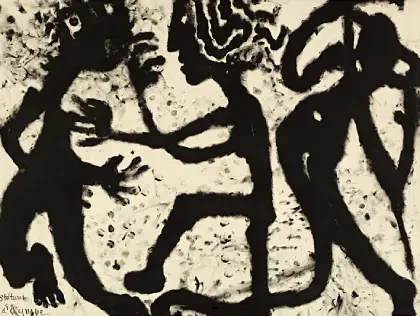
At the end of his life, the Swiss artist abandoned the brush for his fingers, creating a haunting cast of figures that seem to move between myth, memory and delirium.
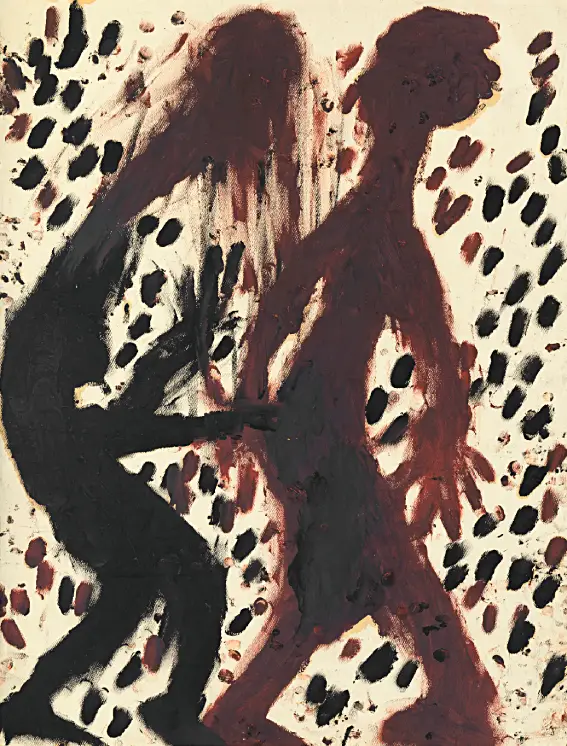
There is something almost disconcertingly immediate about the late drawings of Louis Soutter. Figures appear out of darkness, their elongated bodies assembled from restless lines and pools of ink. Some seem to dance; others gather in mysterious processions or confront one another across the page. They have the quality of apparitions: at once primitive and sophisticated, theatrical and strangely intimate. Their maker, by then in the final years of his life, had dispensed with the conventional instruments of drawing. He worked instead with his fingers.
Galerie Karsten Greve Paris turns its attention to this extraordinary period in Louis Soutter: Finger Painting, 1937–1942, an exhibition devoted to the works produced during the last five years of the Swiss artist’s life. It was a period of remarkable invention, in which Soutter developed a singular visual language, applying ink directly to paper with his fingertips. The resulting images possess an unusual physical urgency. Gesture becomes subject; the act of making seems inseparable from what is made.
Born in Morges, Switzerland, in 1871, Soutter was hardly the isolated outsider his later reputation might suggest. He received a broad education in the visual arts, architecture and music, studying violin in Brussels under the celebrated Eugène Ysaÿe before moving to the United States. In Colorado, where he settled with his American wife, he taught drawing and headed the Department of Fine Arts at Colorado College. Following the collapse of his marriage in 1903, he returned to Switzerland, where financial hardship, personal difficulties and deteriorating health gradually narrowed his world.
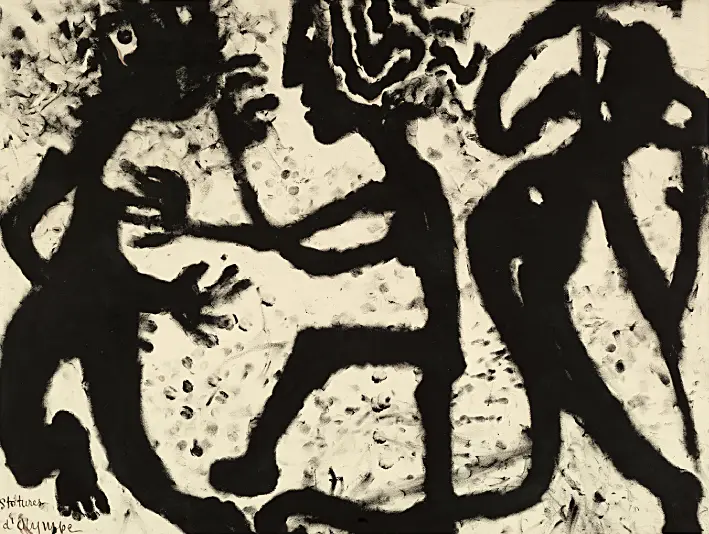
In 1923, aged fifty-two, he was admitted by his family to the hospice at Ballaigues. It was there, in relative seclusion, that he continued to work until his death in 1942. The circumstances of his confinement did not diminish his artistic ambition. If anything, they coincided with an increasingly radical exploration of what drawing could become.
Beginning in 1937, Soutter’s fingers became his principal instruments. The resulting compositions are built from a striking economy of means: black against white, line against void, with occasional flashes of colour interrupting the starkness. His figures, often attenuated and animated by nervous, almost electrical strokes, inhabit spaces that seem at once theatrical and indeterminate. Their apparent spontaneity conceals a highly developed sense of rhythm, movement and composition.
The imagery draws upon an expansive private mythology. Music, biblical episodes, classical antiquity and ritual recur throughout the work, sometimes announced in titles such as Le Jésu, Abel and Prêtresses, druides. Yet Soutter was no mere illustrator of inherited stories. He transformed these references into something more elusive, allowing ancient figures and symbolic gestures to emerge in unfamiliar, often unsettling forms.
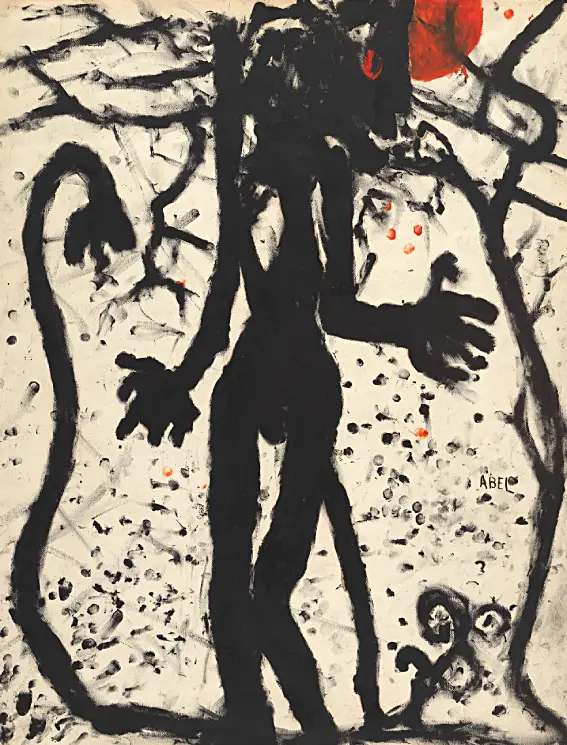
Soutter occupies a singular position in the history of modern art, resisting the categories through which his contemporaries and successors might be understood. His work would later resonate with Jean Dubuffet and the discourse surrounding Art Brut, although its cultural sophistication and formal intelligence complicate any straightforward association with outsider art. The drawings are neither naïve nor easily explained. Their power lies precisely in their refusal to settle into a single interpretation.
During his lifetime, Soutter attracted the attention of figures including the writer Jean Giono, the Vallotton brothers, who exhibited his work in Lausanne, and his cousin, the architect Le Corbusier, who wrote about him in the journal Minotaure in 1936. His reputation continued to grow after his death, with retrospectives and exhibitions bringing his work to an increasingly international audience. Today, his drawings are held in major collections, including the Kunstmuseum Basel, the Kunsthaus Zürich, the Centre Pompidou and the Museum of Modern Art in New York.
What remains most compelling about these late works, however, is their extraordinary sense of life. Made in conditions of physical vulnerability and social isolation, they are anything but withdrawn. Their figures surge, gather, dance and collide. The hand seems to think as it moves across the paper, leaving behind a world in which the ancient and the immediate, the bodily and the spiritual, coexist. In Soutter’s final years, drawing became less a representation of the world than an act of reaching into it.
The exhibition is accompanied by a catalogue featuring texts by Julie Borgeaud and Peter Sloterdijk.
Louis Soutter: Finger Painting, 1937–1942 is on view at Galerie Karsten Greve, 5 rue Debelleyme, Paris, from November 14, 2026, through January 30, 2027.
written by Adrien Wahlberg