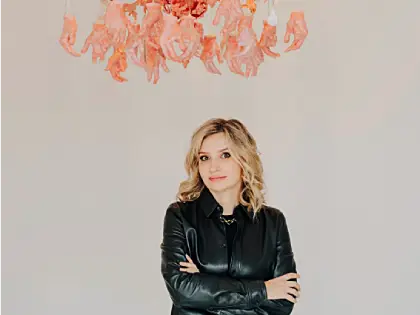
Maria Gvardeitseva is a Belarusian-born visual artist working across installation, sculpture and text. On November 13, Riga’s CUT ART Gallery opened her new exhibition, La Petite Mort.
The show grows out of the artist’s book 5-Minute Bedtime Stories, published by Skira in 2025, which reworks classic fairy tales into stories of divorce and lost love. Ahead of the opening, Maria spoke with us about her path to art, the ideas that shape her practice, and what visitors can expect from the new project.
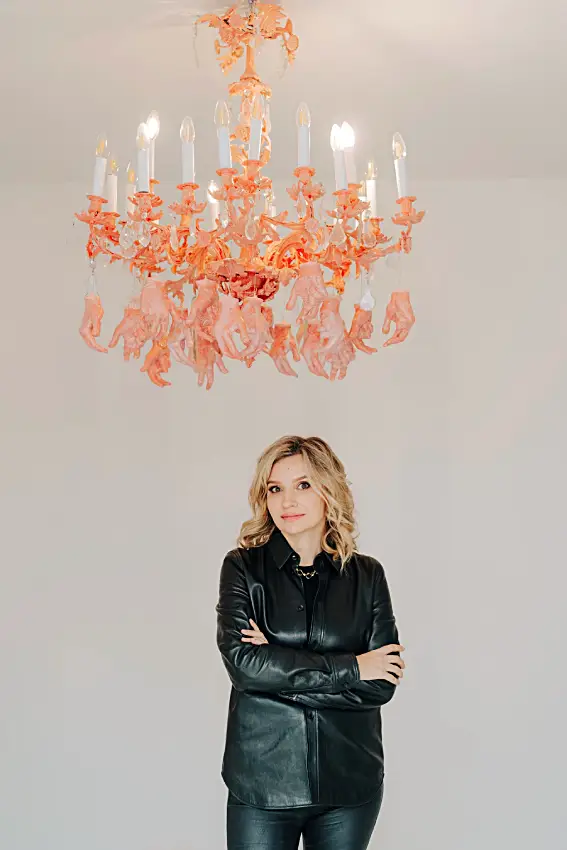
Having a strong background in Public Relations and Marketing alongside your MA in Arts and Politics from Goldsmiths, how does your managerial and strategic background influence how you structure, present, and position your art in the international contemporary art market?
Honestly, much less than one might expect. I have sixteen years of experience in PR and marketing, but like most professionals, I have a blind spot when it comes to myself. More importantly, I discovered quite quickly that the strategies I knew from business simply cannot be transferred to the contemporary art world. You cannot build an artistic career in the same way you build a brand.
The part of the art world that interests me most is institutional: museums, commissions, large-scale installations. Institutional time is extraordinarily slow — major institutions may programme three years ahead. There are no business speeds here, and I’ve learned not to fight that.
Perhaps the more significant influence of my previous career is something I now have to resist. A communications professional is trained to make a message clear, immediate and legible. As an artist, I have the privilege of doing almost the opposite. A work can remain difficult, ambiguous or unresolved. It doesn’t have to communicate everything immediately, and I don’t think it should.
I also increasingly believe in the importance of distance. Earlier in my practice, I sometimes responded very quickly to political events. Today I’m much less interested in reactive art. I prefer to allow something to settle before trying to understand what it means. Perhaps that is the greatest contradiction between my two professional lives: I spent years understanding how things are positioned, and becoming an artist taught me the value of not positioning everything at all.
How do you define the boundary between art and activism in your practice, and do you view your work primarily as political statements, personal catharsis, or historical documentation?
I wouldn’t tick any of those boxes, to be honest. I don’t think of myself as an activist artist, and I don’t see my work primarily as political statement, personal catharsis or historical documentation. All three can enter a work, but none of them defines my practice.
The political enters my work because it enters the reality I’m trying to understand. When I renounced my Belarusian citizenship, it was a six-month process that eventually ended with a presidential decree signed by Lukashenko personally removing my citizenship. At that moment, questions of citizenship and belonging inevitably entered my work and became part of Migrants Altar. But that doesn’t make the work activism.
I don’t believe in complete neutrality in art. Even observation is a position: what you choose to look at, what you make visible, what you leave outside the frame. Activism usually begins with an objective — it wants to persuade, mobilise or produce change. Art can remain unresolved. It can allow contradiction, uncertainty and discomfort. So perhaps that is the boundary for me: activism begins with a position it wants to communicate; my art usually begins with a question I don’t yet know how to answer.
Your artistic practice uses a wide range of distinct materials: from organic matter (salt, wax, bitter herbs) to symbolic objects (men’s suits, passports, vintage window frames, silicone, and 3D prints). How do you select specific materials to translate complex emotional concepts like grief, memory, and trauma?
I’m drawn to materials that have a life of their own. Salt dissolves, wax responds to heat, latex ages and changes, plants dry and decay. Hair is particularly interesting because even when separated from the body, it retains an extraordinarily strong sense of human presence. None of these materials is stable or permanent, and neither are we.
For me, material is not simply there to symbolise grief, memory or trauma. I’m much more interested in what it actually does. It can age, preserve a trace, become fragile, deteriorate or transform. There is an honesty in that physical behaviour that feels very close to the vulnerability of the human body.
Hair is perhaps the most obvious example. Attached to the body, it can be intimate, desirable, even beautiful; once detached, exactly the same material can suddenly be perceived as disturbing. I’m interested in precisely that instability — in materials that resist being completely controlled and whose own transformation becomes part of the work.
Your project DRYGVA. Breathe In, Breathe Out was shortlisted for the Belarusian Pavilion at the 59th Venice Biennale in 2022 but was censored due to your political position. How did this experience of state censorship impact your trajectory and the way you approach national identity in subsequent projects?
In terms of my trajectory, honestly, not very much. DRYGVA was censored, but I was fortunate enough to realise the project independently at the Mark Rothko Art Centre in Daugavpils. What interests me much more now is what happened to my understanding of national identity afterwards.
A few years later, I explored this directly in The Adoration of the Mystic Goat. The title plays with The Adoration of the Mystic Lamb, the Ghent Altarpiece, but replaces the Christian lamb with the goat from the Belarusian Koliada ritual. In the ritual, the goat falls and has to be brought back to life. For me, that became a metaphor for my relationship with my Belarusian identity: something still alive, but something I now have to make a conscious effort to sustain.
There are relatively few Belarusians in the world, and after many years of living abroad, I may speak Belarusian only a couple of times a month. I read Belarusian media, I maintain certain connections, but identity no longer happens automatically through everyday life. It flickers. You have to keep returning to it.
Perhaps censorship taught me something quite different from what was intended. A state can decide who is allowed to represent a country officially, but it cannot really determine what someone’s relationship with that culture, language or memory is.
How has living and working internationally shaped your perception of “home,” belonging, and cultural identity?
I’ve spent a great deal of my practice thinking about memory, the body and intimacy, and perhaps this has also shaped the way I think about home. I increasingly feel that the only home we really have is our body. Everything else is temporary.
We often define home through the people we love — home is where our family is, where our children are, where someone is waiting for us. But my children are growing up; some of them already have lives in different places. I’ve lived in several countries myself. So the idea that home can be located at a particular geographical point no longer makes much sense to me.
In your SKIRA-published book and project 5-Minute Bedtime Stories, you use the structure of folk tales and Vladimir Propp’s theories to reframe divorce and separation as transformative initiation rites. Why was the fairy-tale archetype the right lens through which to explore female autonomy and non-linear “happily ever afters”?
Fairy tales were the right lens because I discovered a blind spot in them. They teach us an enormous amount about love — how to find it, recognise it, fight for it, suffer for it. But then comes “happily ever after”, and the story stops. There are remarkably few stories about what happens after love ends.
That became the starting point for 5-Minute Bedtime Stories. I took twelve extraordinary real-life stories of women and translated them into fairy tales, using Propp’s structures but changing where the story could lead. I wanted to fill that narrative blind spot: divorce does not have to be the failed ending of a love story; it can be another chapter with its own transformations.
The exhibition developing from the book takes this one step further. It introduces something else I found missing: rituals for separation and for the life that begins afterwards. We have an extraordinary number of rituals for entering a marriage, but almost none for leaving one.
Research clearly plays a massive role in your projects. How do you balance it with artistic intuitive expression?
I don’t really experience research and intuition as two things that need to be balanced. Research is what allows intuition to happen. I need to understand a subject deeply before I can work with it freely.
One of the most valuable things Goldsmiths gave me was a conceptual framework for doing that. In many ways, a good Master’s degree is also an extraordinary reading list. I’ve kept that habit: whenever I begin exploring a new subject, I create my own reading list and try to understand the intellectual territory around it.
For Man’s Cookbook, the project I’m developing now, I spent almost two months researching at the Pauls Stradiņš Museum of the History of Medicine in Riga, working through its collection and archival material. I was looking at historical prescription books, patient records, surgical diaries and folk medicine — the different ways in which the body has been diagnosed, treated, classified and sometimes ritualised. New technology also made it possible for me to work quite quickly across sources in Latin, German and Latvian, which opened material that would previously have been much less accessible to me.
The project itself began with a very simple contradiction. In a culinary or medical recipe, repeating the same actions with the same ingredients should produce roughly the same result. In human relationships, of course, it doesn’t. So alongside the archival research, I’ve been reading around the history of medicine, sexuality and the cultural interpretation of illness — from Foucault to Sontag.
Once I’ve lived with a subject for long enough, the visual language tends to come quite naturally. Images begin to appear, connections form, and at that point I trust intuition. So perhaps research gives me the territory, but intuition decides what I do inside it.
Looking ahead, what new themes, experimental materials, or unexplored mediums are you eager to dive into next?
I’m increasingly interested in scale. Next year, at INDUSTRA ART, I’ll have the opportunity to develop my first truly large-scale sculptural installation, approximately eight to ten metres in scale. Until now, much of my work has retained a relationship to the scale of the human body, so I’m curious to see what happens when that changes.
I’m also beginning a project around the politics of how suffering is remembered. I’m particularly interested in the relative absence, in Western European culture, of memorialisation around the pain and physical experience of childbirth. Having given birth four times myself, this is not an abstract subject for me. I want to understand why certain forms of suffering enter public memory while others are treated as simply part of life.
written by Charly Wells