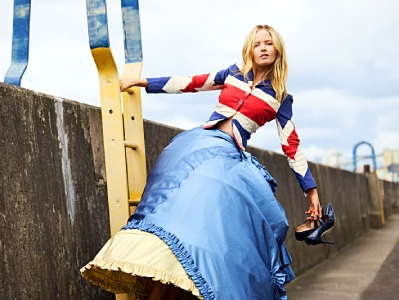
British/New Zealand director James Lucas’ Moss and Freud, revisits the unexpected and surprising collaboration between supermodel Kate Moss (Ellie Bamber) and artist Lucian Freud (Derek Jacobi).
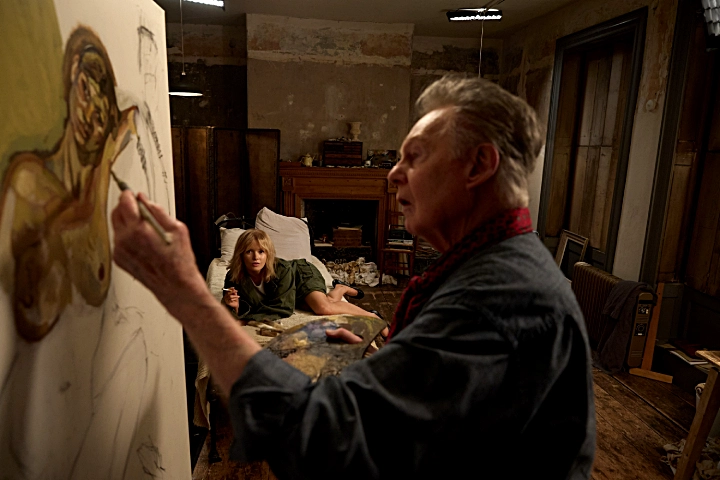
The story is set in the nine months in 2001-2002, when Moss agreed to pose for Freud in his London studio in Holland Park. The sessions ran from early evening until the early hours, with Moss accommodating, even embracing Freud’s slow and painstaking process. Later on, Moss would say the experience taught her “discipline.”
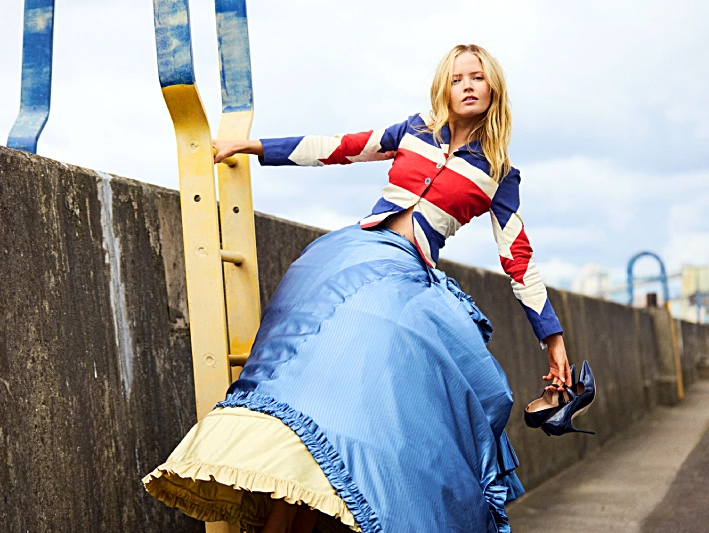
What made the collaboration surprising, aside from the different worlds the pair occupied, was that Freud, who was considered one of the century’s greatest painters, showed little interest in painting celebrity portraits. Lucas’ film is the story of two unlikely friends who reveal one another’s vulnerabilities and sides of their personalities that frame them through a more human lens.
The finished painting of Moss, titled Naked Portrait, was sold at auction in 2005 for £3.5 million.
Moss and Freud is Lucas’ directorial feature debut. He previously directed the short films Paint The Dragons’ Eyes and The Phoenix of Gloucester. He executive produced the 2015 Oscar-winning short film The Phone Call, which he co-wrote with the film’s director Mat Kirkby.
In conversation with Flux Magazine, Lucas discussed learning in Ridley Scott’s shadow, understanding one’s place in the film industry, and why the “pain and struggle” is worth it. He also spoke about his desire to capture beauty, Neo-Platonism influences, how the film is a soul divided between two worlds, and revealing an unseen side of Moss while protecting her mystique.
The following has been edited for clarity.
WHY FILMMAKING AS A MEANS OF CREATIVE EXPRESSION? WAS THERE AN INSPIRATIONAL OR DEFINING MOMENT FOR YOU PERSONALLY?
I’ve always been interested in telling stories from a very young age. And I was a child of the 80s when Hollywood was at a high point. Growing up an only child, my mum was always away working. So, I spent a lot of time at home, and film became my companion. I became lost and immersed in these beautiful cinematic worlds, and it never left me.
I remember watching the Oscars one evening from a small-town in New Zealand. I thought to myself, ‘Oh, I’d quite like to win an Oscar one day.’ In a very weird and wonderful way, I went about my journey or odyssey to try and achieve that. I believe in the film gods, and they might have been looking down on me because they gave me a chance, and I managed to get there in the end.
I studied film at university, and that was a great education into the more academic side of film. But my real education came when I managed to get my foot in the door at Ridley Scott’s commercial production company, RSA Films. I proceeded to work there for 12 years, and I wouldn’t say this lightly, but I think I learned from the best, from Ridley on downwards. His number two, Kai Hsiung, was a great mentor of mine, and that’s really what made it all possible.
TO JUMP IN THERE, WHAT MAKES RIDLEY SCOTT A GREAT FILMMAKER?
He’s an artist and his films are beautifully crafted. The art direction, production design, and the misé-en-scène, everything is beautiful. But what I also respect about Ridley is the way that he operates in the film business. He has an insane work ethic and, coming from the advertising world and going to Hollywood, he has just taken it all in his stride. And his output in terms of the films he produces and directs has actually increased as he’s gotten older.
He just has that 360-degree panoramic view of film, and that’s to be respected because I have learned that as much as I want to be a director, you have to be au fait with all the different associated aspects of the film business.
LISTENING TO YOU DISCUSS NAVIGATING INDUSTRY POLITICS, I REMEMBER DANISH DIRECTOR JOACHIM TRIER TELLING ME THAT YOU HAVE TO BE ALLOWED TO MAKE A FILM.
[…] What it boils down to is, I’m an independent filmmaker, and the options are, do you want to make a film or not? They’re your choices. And so, in order to make a film, you’re going to have to make compromises and sacrifices. You are going to have to, in some way, join the machinations of the film business, but hopefully only at various degrees.
But ultimately, I recognise that I’m a small part of this industry and if I want my voice to be heard, if I want to be able to enact my cinematic vision, then I have to play the game to some degree.
Filmmaking is crazy, particularly as an independent filmmaker. It’s a completely speculative enterprise, and you’re asking people for huge sums of money with no guarantee that there will be a return, and certainly not the return that they may get from an AI startup or whatever else. So, I’m respectful of that and I understand. And what I’ve also had to learn on my journey is that making an independent film is like building a house of cards on a foundation of sand. At least that’s how I describe it to people.
UNTIL YOU GET INTO THE EDIT AND POST-PRODUCTION, THE PROCESS IS ONE OF PRE-VISUALISATION. YOU HAVE TO IMAGINE HOW THIS FRAGMENTED THING WILL EVENTUALLY LOOK AND SOUND. WHEN YOU THINK ABOUT THE FILMMAKING ENTERPRISE, IT’S BONKERS.
It is, but it’s an alchemy and somehow these various moving parts align, and you are able to create magic. Every time I ask myself whether all this pain and struggle and all the rest of it is worth it? But then you sit down in the seat, the lights go out, and you see this beautiful film appear on the screen, and it all makes perfect sense to me. That’s why I keep doing it, because I’m an artist in pursuit of beauty. And for me personally, film is the art form that best serves my interests, and it also encompasses so many different artistic modes, from production design through to cinematography and editing. I find it incredible.
PICKING UP ON YOUR POINT ABOUT WANTING TO CAPTURE BEAUTY, KATE MOSS WAS ONE OF THE MOST PHOTOGRAPHED WOMEN IN THE WORLD, WHO DEFINED BEAUTY. IN AN EARLY SCENE, SHE AND FREUD HAVE A CONVERSATION ABOUT TRUTH AND NAKEDNESS. IT’S A MOMENT THAT HAS AN AIR OF VULNERABILITY. IN THIS FILM, IT APPEARS YOU ARE TRYING TO CAPTURE THE BEAUTY OF HUMAN BEINGS IN SPITE OF THEIR ROUGH EDGES AND BLEMISHES.
It’s the Neo-Platonism in me that challenges me to explore what it is to be a human being, and certainly, in the context of this story, not just the beauty of the exterior and the beauty of nature and creativity, but also the interior. And this desire to transcend and try and find out what our purpose is. I suppose there’s an existential bent to it, in the sense that we all go through this period of what is good? What is my purpose? And in this story, Kate goes on her own personal journey of self-exploration, as well as navigating the shark-like and hedonistic world of fashion. And that becomes what’s most important to her.
It’s almost like a soul divided between the material world and the spiritual and intellectual world. And to that point, I explored both those things through the prism of Kate’s journey — the material world of fashion, the industry that she works in, and also the spiritual and intellectual side of what’s inside her? What’s her purpose? What does she want to do? What will make her happy? What is good? It’s a world of ideas.
That’s what makes us interesting, and it’s what makes this movie interesting. I’d like to think it transcends into all these areas, provoking interest and perhaps a sense of commonality in our audience. I want to provoke or allow an audience to not only consider Kate’s journey, but their own interior journey.
ONE OF THE PHILOSOPHICAL IDEAS THAT EMERGES IS THAT WE MUST ALL RECKON WITH THE ROAD TRAVELLED. PERHAPS IT ALSO COUNSELS US TO BE WARY OF REGRET, AND TO APPRECIATE A LIFE LIVED.
Yes, these are themes that I’m interested in, but I wanted the story to be recognisable, and that’s why I talk about this commonality. I want people to go away from the theatre and think to themselves, ‘Gosh, I’m actually going through the same emotional transformation as Kate Moss, this icon.’ And that taps into this desire to make the themes accessible.
And yes, there’s a philosophical bend to the story, but also, it’s an interesting and entertaining film. It would be a folly to make a Kate Moss film without some of the wildness and hedonism that we can recognise, laugh at and enjoy. So, I’m trying to balance different things and make it accessible. But I wanted to paint a portrait of Kate and Lucian that has depth and truth and is learned to an extent.
HOW DID YOU NAVIGATE THE CHALLENGE OF FITTING THIS CHAPTER IN THE LIVES OF KATE AND LUCIAN INTO THE FILM’S RUNTIME?
They say in film production, there’s never enough time and there’s never enough money, and that’s a truism. We have to compress things to fit, and here, fit someone’s personal story into the parameters of a film. So, I have to build my narrative structure that has a beginning, a middle, and an end. And you have to quickly get to the core of the story that you want to tell — what the story’s about and what change is going to occur in your characters and how problems are going to be resolved.
I knew I wanted this to be more than a standard biographical picture. There are elements of it that actually, as it transpired, were partly semi-autobiographical in some respects, in so much as I was there in London in the noughties. It was very much a very formative time for me as well as everyone else that was around at that time.
Going back to my desire to entertain people, you have to make your choices. You have to choose what you think is going to be the most entertaining and emotionally powerful. I’d like to think that we made the right choices. I could have made a three-hour film, there’s no question. On the subject of this need to compromise and make sacrifices (“kill your babies”), I had to do that in this case, but I’m still pleased with the result.
IT NEVER FEELS LIKE THE FILM VISUALLY SETTLES. INSTEAD, IT’S TRANSITIONING THROUGHOUT, EVEN LEANING INTO A DREAMLIKE AESTHETIC.
That would definitely be a hallmark of my style in some respects. The other reason for that as well is that I wanted the cinematography to mirror Kate’s own psychological and emotional state. In the beginning, it’s fast cuts and the camera movements are more jagged and stilted. Then, as we see Kate and Lucian’s rapport and burgeoning relationship grow, everything starts to slow down a little.
Symbolically, I started writing the screenplay in Lucian’s studio. I thought that was an important thing to do. The studio is incredibly encompassing and warm; I describe it as “womb like.” And so, that’s probably why you start seeing this dreamy and fantastical aesthetic towards the back end of the movie.
THE POWER DYNAMIC BETWEEN KATE AND LUCIAN IS FASCINATING. INITIALLY, HE’S AN INTIMIDATING PRESENCE AND IT FEELS AS IF HE HAS ALL THE POWER. THEN, AS HE BECOMES DEPENDENT ON HER, THE POWER SHIFTS.
KATE JUXTAPOSES VULNERABILITY AND STRENGTH, SHOWING HERSELF TO BE HYPER-AWARE OF HER SURROUNDINGS, HER SENSE OF SELF AND HOW OTHERS PERCEIVE HER.
THE STORY CONSIDERS HOW THE MORE YOU OPEN UP AND THE MORE YOU GIVE SOMEONE EQUATES TO THE LOSS OF MYSTIQUE, WHICH COULD BE CONSIDERED SURRENDERING PART OF ONE’S POWER.
You’re spot on, and I would like to think that there is also truth in those shifts in the power dynamics.
Kate is enchanting and incredibly charming and irreverent — she’s unavoidable. She has an amazing spirit that does enchant people and Lucian was obviously fascinated by her, being one of the few celebrity portraits that he ever did — her and the queen. So, the power dynamics are very much part of the story, and it’s definitely one of the narrative levers.
BEING IN THE PUBLIC SPOTLIGHT, YOU CAN LOSE CONTROL OF YOUR OWN NARRATIVE. BY BEING INVOLVED IN THE CASTING OF ELLIE BAMBER, DO YOU THINK KATE SAW THIS FILM AS AN OPPORTUNITY TO EXPRESS A SIDE OF HERSELF OR VERSION OF HER STORY THAT TRANSFORMS HER PUBLIC IMAGE?
Yes, very much so, and the reason I say that is because out of all the filmmakers, studios, producers that have approached her over the years, this is the story that she chose to tell — not about her fashion career, but about herself. That’s a special and brave thing to do, and it’s the reason I hold her in such high regard.
Not only was the casting spot on, but the story that we’re telling is illuminating. It’s a peek behind the curtain, and it’s a side of Kate that the public haven’t seen before.
WHILE INSIGHTFUL AND REVEALING, YOU STILL PROTECT KATE’S MYSTIQUE.
I like the idea of retaining some of her mystique, which is honourable. I don’t think it would be good form to fully expose someone’s inner being. She has something special inside her, and that needs to stay inside. We can pontificate all we like, but I’m just making observations and giving ideas and clues, but Kate Moss remains Kate Moss — she’s singular.
Moss and Freud in UK cinemas now.
words Paul Risker