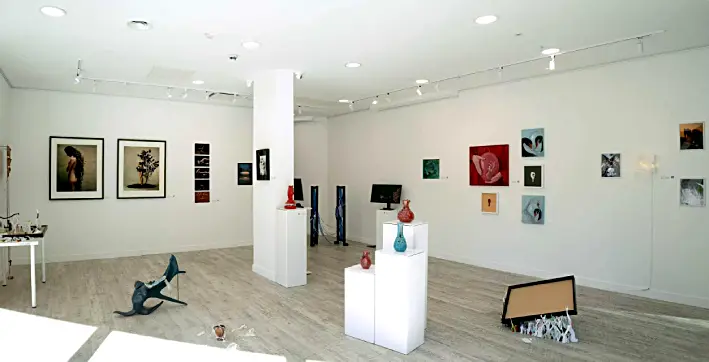
The sweeping glass panes of Calder Contemporary, a gallery nestled between an array of sky-high buildings, reveal a selection of curious art forms. Part of the London Design Festival 2026 programme, Residuals: What Never Stays is a group exhibition presented by LILIS LAB that took place from 19–21 September.
Curated by Jiayin Lu, the exhibition was born out of an eager questioning. While making their own 3D-printed works, they looked to the leftover filaments and were struck by a sudden sentiment. These excess scraps are not only made with the same material, but are also produced at the same time as the desired artwork. What a shame they are often treated as waste!
Lu thought to themselves, what if we held this leftover residue with the same compassion as its counterpart, and gave it a stage? From these residual fragments, the exhibition expands into a wider reflection on what residue can be: not only as material debris, but as traces held in the body, memory, absence and transformation. Lu advocates for these overlooked fragments to be considered, and facilitates a wondrous reframing of what remains.
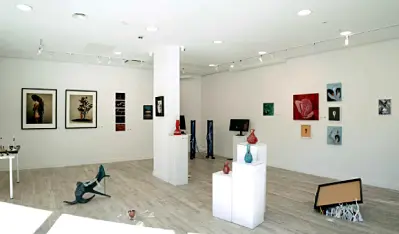
Erupting, organic forms sprout through ceramic vases on plinths in one corner, while red tattoo ink sinks into pig skin in another. Screens unveiling abstract scenes of nature and everyday life sit across a display of a never-ending expansion of digital clay. An interactive station, filled with 3D-printed leftovers, waits for hands to attach, construct and repurpose the fragments into something truly spectacular. There is a lot to see in the small space, and the eyes feast on the gleaming presentation.
For Yu Yu (Spencer), it all started with an unbearable sensation: a clothing label, fervently rubbing against their skin. In an explosion of overstimulation, they sought desperate relief, tearing off one label, then another, collecting a flurry of excess thread and fabric. Arranged as a restrained collage titled Chronic Irritation, these residual materials become a record of the momentous event. The labels also map the unspoken anxieties and emotions fizzing under our masks. There are truths you always feel, but can’t always express. Instead, they chafe, chew and chip away at the everyday. These remnants speak what the artist could not. Here, residue is not only what is physically left behind, but what an experience reveals within the body.
Enmeshed in the corner, Manisha Puri’s mixed-media sculpture Between States stands tall. She deconstructs the rigid frame of a room divider, weaving blue organza fabric through the metal wires that hold it taut. It resembles an instrument, a portal, an artefact that is raw, permeable and waiting. The broad washes of white Indian ink on the delicate fabric are the remains of her intuitive painting as she listened to the sound of bells. In Hindu temples, bells are used in ritual practices and prayer. For Puri, their sounds also relieve waves of anxiety. As these chimes flow through her bold gestures, the residual marks float in an uncertain space, between completion and incompletion – a body in an unstable state. The work shifts our understanding of residue from something discarded to something integral to lived experience, infused in this layered assemblage.
By the window, Ziyo Li’s Overflow rests on the ground as an intricate network of yarn, clay and mixed fibres. A terracotta cup holds white yarns that have since cascaded out of its container and tumbled onto the floor in a web-like spillage. Upon closer inspection, some of these strands stretch and grow into skeletons of newer cups, like strange ghosts of their mother. Li sees the cup as a stand-in for our bodies. As we fill our cup with a scatter of emotions, there is a subconscious attempt to contain them. The artist embraces the overflow: of crying, feeling and growing a new body outside of one’s own. Crocheted forms swirl in and out of recognisable shapes as they are captured at the cusps of transformation. It is a hopeful piece, laid out tenderly for one to loom over.
The works observed so far have lingered on the visceral experiences of the artists’ present lives. Yun Wen reaches further back in history, asking what might remain from lives that came before us. Her five photographs hang on the wall, one above the other. Remains depicts a person seemingly caught in a trance, performing a dance that has perhaps been encountered thousands of times before. There is something ancient about the way their body falls in swan-like movements, wrestling against the dark soil, as if calling to a forgotten ritual. Wen did not instruct the dancer to pose as a swan; she let them embody the animal as their silhouette blended with the earth. She often wonders about events that took place, years and years ago. Could traces of those histories still reside in our bodies today? What remains from our ancestors? Using this molten dance as a vessel, Wen allows forgotten ancestral memories to drift through a modern body.
While Wen channels something ancient from the past, Jill Yao takes the idea of residue a scrap further, into the realm of the imaginary: they envision an excavation of residual materials from the fictional realm of Atlantis, thousands of years from now. A feat of speculative archaeology, Yao presents a publication of their research, complete with field notes, scan analyses and structural diagrams. One excavated relic sits alongside this deep dive as a surreal sculpture. It is a peculiar mix of a female pelvic bone, a tail of a dolphin or a shark, and strings that suggest a harp-like instrument. It seems to be something forged straight out of a dream.
On top of this life form perches another life form: an abstract structure of a crab, made with a skin-like material. Using elements of marine forms that already exist, Yao assembles these speculative organisms to critique the human need to discover things. Atlantis is submerged but not lost. It still exists without being found, analysed or interpreted. To encounter its residue, they say, perhaps we need to remain in the state of listening.
As these residual forms expand and contract, glide and warp, they flutter against these gallery walls and flood into the body. Across the exhibition, residue shifts from something materially left behind to something felt, remembered, imagined and continually transformed. Perhaps this is where the exhibition complicates its own starting point: what begins as an act of rescuing 3D-printing waste becomes a question not of what residue is, but of what we choose to recognise as worth keeping close.
One leaves with the lingering kernels: What stays in our bodies, minds and souls as we go through the inescapable stages of existence? How can we hold what we imagine or create, differently? Not simply as a residual abandoned, but leftover from a tender tomorrow. A new life.culture
Participating artists: Yu Yu (Spencer), Wei Lu, Angel Pan, Manisha Puri, Ziyo Li, Dimension Ceramic (Di Meng), Xinyue Hope Shen, Jeff and Siena Wang, Yun Wen, Tongxin Lu, Bingxu Qiang, Tatiana Fetisova, Shaw Liu, Jill Yao, Jiabao Zhao, Jiayin Lu and Wan’er Li.
Residual: What Never Stays
Presented by LILIS LAB
Curated by Jiayin Lu
19–21 September 2026
Calder Contemporary, London
Part of London Design Festival 2026
Article written by Yulin Huang