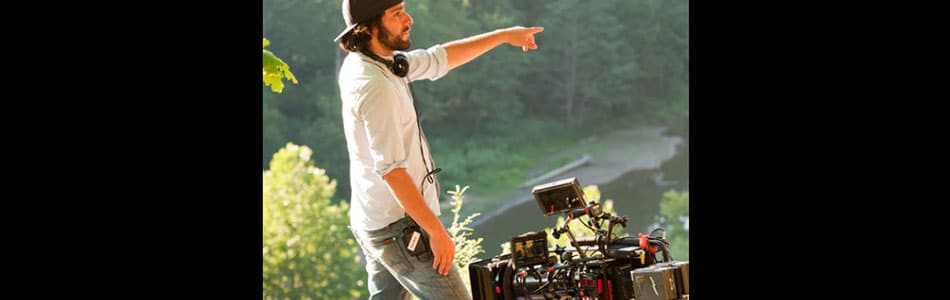
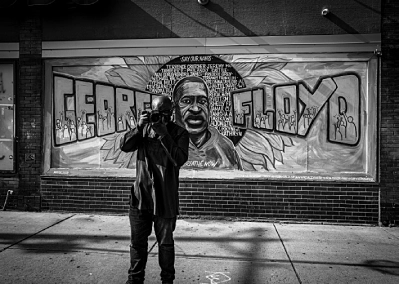
Nigerian director Andy Mundy-Castle’s documentary Shoot the People is an apt title given it’s about the Nigerian photographer and activist Misan Harriman, who documents global protests. The film, however, is not only a document of this one individual, but an acknowledgement of a broader ideal.
Harriman’s photographs and Mundy-Castle’s film are an echo, if not a celebration of South African photographer Peter Magubane’s belief: “A struggle without documentation, is no struggle at all.”
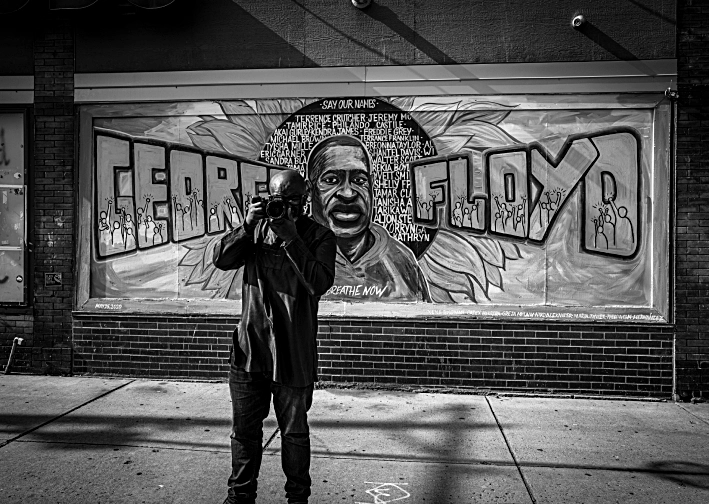
Offering a revealing insight into his subject, who started out working in the finance sector, Shoot the People feels like an intimate journey we accompany Harriman on. He considers the way his photography connects with others and its place within a world that has been shaped by protest. We are also present for important moments, like when he visits with Martin Luther King III, and the two men discuss their indirect connections.
Mundy-Castle’s documentary is an empowering story about protest, from grassroots activism and beyond as ordinary people strive to make a difference and have their voices heard as they speak up for equality, civil rights, and social justice. And yet, Shoot the People is a title with a double meaning. As much as it is about documenting struggle, it echoes the violence perpetrated against protesters and those unwilling to morally rationalise and look the other way. These three words are empowering, yes, but they are also a reminder of man’s capacity for violence.
Mundy-Castle’s previous credits include The Fade, about four Afro barbers in four different countries (U.S., U.K., Ghana, and Jamaica), and Lenny Henry: The Commonwealth Kid, which explored the actor and comedian’s family roots and the relationship between Britain and the Caribbean Commonwealth countries. He has also directed the BAFTA Award-Winning White Nanny Black Child, which tells the 40-year story, beginning in 1955, of white British families unofficially fostering more than 70,000 West African children.
In conversation with Flux Magazine, Mundy-Castle discussed being a child of Empire, history reversioning itself and tribalism. He also reflected on the interconnection between change and protest, the dangers of the digital age, and his hopes for the film.
The following has been edited for clarity.

WHAT ARE THE ROOTS OF YOUR INTEREST IN DOCUMENTARY FILMMAKING?
I suppose my journey is quite specific and traditional, and like many people, I grew up just being in awe of the silver screen. The magic that those pixels and frames would put out there would just allow you to dream. From early on, it was always a space of wonder. Then, as I got into my more formative years, I was very fortunate to see the work of some documentarians that allowed me to think about real stories as a vehicle for communication and feeling. In particular, I was watching films by John Akomfrah. He made a film called Handsworth Songs that I saw quite early on and also a director called Sorious Samura. And this was in the days of VHS. I was an avid video shop person, and I’d go and find these tapes.
I was drawn to that obscure unscripted space. I just don’t like fantasy and things that I can’t truly grasp. So, you couldn’t talk to me about The Lord of the Rings because I’m just not interested, and I still haven’t watched Game of Thrones, for instance. I know some people see that as sacrilegious, but for me there’s something about that world that I just couldn’t grapple with, whereas real life is so much more exciting.
It’s very fortunate that from the age of 14, I watched films like Cry Freetown, Handsworth Songs, Bang Bang In Da Manor by Ishmahil Blagrove, The Day I Would Never Forget by Kim Longinotto, that were about real people, real stories, real drama, and real jeopardy. And I just locked onto that unscripted space which has obviously merged into a load of other things now. And that doesn’t preclude me from thinking about drama that is based in reality, but my fascination was telling stories that connected real people, real things, and real scenarios.
Since the age of 15, I’ve done almost everything I needed to do to be on that path and to stay on it. The challenge obviously is making that a business and something that becomes your reality. Fortunately, I’ve managed to do that up until now, and I’m just about to touch my fifth decade.
IT’S NOT EASY TO TURN CREATIVITY INTO A WAY OF LIFE THAT GIVES YOU A LIVING, BUT FOR SOME, BEING CREATIVE IS LIKE BREATHING — IT’S NOT A CHOICE; IT’S A CALLING.
Absolutely, and as artists, as creatives, there has been an indoctrination that you can’t celebrate the financial or commercial wins of what you’re doing. It’s like you’re doing it for your art, for your life, and this is your passion project. I was speaking to a group of young emerging individuals the other day and the amount of people that say I’ve got this passion project, and the world has to hear about it. I pushed back on that and said, “But does the world really care about your passion project? How are you going to make the world care?” This was met with, “But I need to get this done.”
If you don’t think about the commerce of it all, if you don’t think about, well, how am I going to facilitate this, then it is just your passion project, and it’s never going to yield any results for you to consistently invest in that passion.
To be honest, for me, it’s got a lot to do with my Nigerian mother, who was just a staunch businesswoman who never took no for answer. She was up at 5am every morning. She was a market stall trader, and I saw her consistently turn nothing into something. She’d always get up and go and there was never a time when she stopped. Even to this day, she’s still thinking of ideas, and she just turned 74. So, I suppose there is an element of being a child of Empire and an immigrant child that you’re constantly moving, and you’re thinking about how to stay alive and make your way. For those people that just can’t take no for an answer, art and creation are a means of survival.
I’VE A FRIEND IN AMERICA WHO WAS TALKING ABOUT HOW SEGREGATION WAS STILL AROUND WHEN HE WAS A YOUNG BOY. AND WATCHING THE COMING-OF-AGE DRAMA I’LL BE GONE IN JUNE, IT DAWNED ON ME HOW LITTLE TIME SEPARATED THE BERLIN WALL COMING DOWN AND THE BEGINNING OF THE WAR ON TERROR. THE POINT I’M TRYING TO MAKE IS THE WORLD IS MOVING AT A BREAKNECK PACE WHICH CAN DISTORT OUR PERCEPTION OF TIME.
I remember reading about it, but I haven’t seen it yet. And yes, it’s very recent history.
One of the things I wanted to capture in the film was this idea of history reversioning and replaying itself. It is not something new; it’s not a distant past that we’re talking about. As you’ve just referred to, 50 or 60 years ago, people still had to be on opposite sides of the street, and they couldn’t share the same spaces. And that wasn’t just in America, it was globally and in many different ways.
Unfortunately, there’s a tribal mentality around the world, and what was important for me to communicate in the film was the fact that people have habitual ways about them. And it’s so easy to fall for the lowest common denominator and not push and challenge yourself to think a bit harder about what you’re consuming. For instance, the riots and the protests that are going on by far-right thugs up and down the country. When you hear those people interviewed on the street, you realise they don’t actually know what they’re fighting for. There’s a level where you just need to be cuddled or told that you’re loved and that everything’s going to be okay, that you’re not really under threat and there’s enough for everyone to share. It was key for me to have that conversation with what we were saying in the film.
I CAME ACROSS THE IDEA THAT PEOPLE ARE PRONE TO FORMING A POINT OF VIEW AROUND WHAT THEY’VE READ OR HEARD VERSUS TAKING THE TIME TO SCRUTINISE THEIR SOURCES OF INFORMATION AND FORMULATE AN OPINION.
That’s exactly it, and that becomes more of a problem as we move forward in this digital age. We’re all guilty of it because you see something, and you just latch onto it, right? If it’s within your echo chamber, if it’s something that aligns with your point of view, you respond. And I suppose the more radical you are, the more dangerous that becomes.
TRAUMA AND C-PTSD COMPLICATES MATTERS, BECAUSE SOMETIMES THE PEOPLE THAT APPEAR THE ANGRIEST AND RADICAL, ARE, OUTSIDE THE TRAUMA, COMPASSIONATE AND REASONABLE.
Absolutely. You couldn’t be more on the point there.
TO BRING US AROUND TO THE DOCUMENTARY, WHAT STRUCK YOU ABOUT MISAN BEING A POTENTIAL SUBJECT?
We’ve just talked about a number of things, and I think that what Misan represents, in the kind of characters that I like, is somebody that’s flawed and complex. He’s trying to work things out but is also curious and allows himself to be vulnerable. He’s there to learn, and he’s trying to understand. So, he’s unlearning what he knows and doesn’t know. And that’s what I gravitate to and so, when his name came into prominence after the murder of George Floyd, it was hard not to look at what he was saying or how he was putting himself out there.
When I’m looking at a character to work with, I’m looking at what layers that person can offer me. Is somebody just working on the surface and going to give you monotone responses all the time or are they going to have a wealth of history, thought, and curiosity that’s going to invite you into a world of difference? So, it all started for us in that summer of 2020, when we were all locked up in our houses and were made to watch this modern-day lynching of George Floyd.
I know there are some idiots that think they were right to kill him, but that’s not what the police are there to do. I think even for police officers, they would find some tragedy in that regardless. The sort of people that sit on the fence of is that right or wrong lack a certain type of compassion or humanity. And that same type of argument and threads of that idea run throughout the film.
The conversation I’m having is: what’s the basic level of decency that allows you to understand that this person who’s a bit less fortunate than you deserves a tiny bit of compassion or deserves to be seen in a way that you may not have seen them before? Some people just can’t access that part of their mind or heart. As you just said, that could be influenced by trauma. It could be a trauma response mechanism, or it could just be a nonchalant privilege that is blind. But what I was excited about when working with Misan was that we could have these conversations. We could pick away at these things to create a little agitation and make people feel a little uncomfortable to get us to a place of clarity.
EARLY ON, MISAN REFLECTS ON THE PURPOSE OF PROTEST AND HOW IT DEFINES THE HISTORY OF THE TWENTIETH CENTURY. THESE ARE IMPORTANT THINGS FOR EACH OF US TO THINK ABOUT, ESPECIALLY IN THE CURRENT POLITICAL CLIMATE.
I think it is, but it’s funny because I was actually going to start the film with a wonderful animation I saw by Steve Cutts called A Brief Disagreement. What that animation shows you is that protest and challenge have been around since the beginning of man [laughs].
What we’re dealing with now is a white supremacist imperial war machine that dominates the whole conversation and the way in which we all engage and interact with each other. And then somewhere within that is the capitalistic system as well. So, you’re dealing with a problem that is centuries old, and protest is just the voice of the unheard pushing back to say, “Give us a little bit of what you have. Give us a tiny bit of humility and grace so that we, too, can be heard.” We’re just at one point on the timeline of a long history that predates us.
What we can say we’ve learned through the making of the film is that protests might not lead to change, but wherever change has happened in any country, protest has been at the heart of it. That might have been an asylum protest, or if you look at the suffragettes here or the fall of the Berlin Wall, anywhere that has seen change, protest has been involved.
The parallel story that’s being told in the film is that protest takes time, but with well-meaning individuals it does agitate, and it does create change. And it has become more important as a democratic voice for the people because of the way in which our ability to speak up is being minimised, clouded and pushed underneath an unequal system.
THE OVERTURNING OF ROE V WADE WAS IMPORTANT IN MY MIND BECAUSE IT WAS A STERN REMINDER THAT AN UNWILLINGNESS TO DEFEND PROGRESS RISKS IT BEING ROLLED BACK.
SHOOT THE PEOPLE DOCUMENTS, IN SOUTH AFRICA TODAY, PEOPLE ARE STILL FIGHTING FOR JUSTICE AND ACCOUNTABILITY OVER THE WAY THEY WERE TREATED DURING THE APARTHEID ERA. SO, THE STRUGGLE CONTINUES EVEN AFTER A HARD-FOUGHT VICTORY.
Absolutely, and one of the important things that we try and comment on is the inspiration that Misan had from the South African photographer Peter Magubane, and his quote: “A struggle without documentation, is no struggle at all.” This shows that fighting doesn’t only mean physical fighting. It can also mean fighting with your voice, your camera, your words, your art, your platform, or whatever it may be. That fight now, as we are seeing play out in real time, comes in many different forms. But I agree, fighting back and the pushback has to be part of our armoury now.
MISAN AND PETER’S WORK SERVES AS A TESTAMENT TO THE IMPORTANCE OF THE IMAGE, WHICH TELLS US SOMETHING ABOUT OURSELVES, OUR HISTORY, AND EVEN SPEAKS TO OUR BETTER ANGELS.
I think so, and what’s it all for, really? The deeper angels is a really good way of framing it, because I don’t think anyone’s born evil. I don’t think anyone’s born with hatred. That’s definitely taught and massaged within your mindset from an early age. We should never lose sight of the ability to dream, to help people change and to influence others in a different way, because I truly believe that our deeper angels mean the best and don’t want us to spread hate.
I remember reading an article in the National Geographic about how hate ages you. It’s a psychological cancer, and it’s important to recognise that.
THE COLLABORATION BETWEEN YOU AND MISAN STRIKES ME AS INTERESTING BECAUSE YOU MUST HAVE BEEN ABLE TO CONNECT IN A WAY THAT HELPED TO SHAPE THE FILM.
That’s a really important observation because what you’re talking about is cultural nuance and having the ability to hear the unspoken and feel his feelings when they might not be so obvious to everyone. And through that there might also be some things that I know that he wants to communicate, and I can channel that in a certain way. I could then communicate that through the bigger story of Shoot the People, and we definitely cut through a lot of small talk with that shared understanding. And we’re both Nigerian men, so there was a whole weight of shared culture going on there, too.
IT’S INTERESTING HOW THE WEST HAS HELD ITSELF UP WITH A SENSE OF SUPERIORITY, AND YET NOW, WE’RE WITNESSING THE INHERENT VULNERABILITIES OF OUR CHERISHED DEMOCRACIES. ONE MIGHT SAY OUR CHICKENS ARE COMING HOME TO ROOST.
I’m a fan of that adage: “We are here because you were there.” The other way of saying that is: “The chickens are coming home to roost.” I also feel that now, especially from an African diaspora perspective, there’s a real reckoning of this idea of home, place, and identity and where do you truly belong? And for the children of those places that don’t suffice for Western ideologies, it’s like we were also indoctrinated to some degree to think less of those places. But I feel now, there is a reawakening, there is a resistance to not feeling accepted or not being accepted. And I know there are a lot of people that would say, “Well, just fuck off back to where you came from”, but you know, it’s kind of like, actually, now we will.
Where you come from is a sense of acceptance. It’s a sense of I’m not going to be judged when I walk down the street, and if I’m trying to get my kid into a school, I’m going to be accepted for who I am.
Take Britain, for example. With this rise of the right, so many of them are disconnected from the very recent history of why Muslims, Sikhs, Africans, and others are here. It’s because many of these places are the backbone of why Britain is such a powerful country and economy. It should not go unnoticed that the reason Britain is supposedly “great” is because of all of those people within its former colonies, “The Empire”, as it was called, that have helped build this country and make it what it is. It’s so easy to say we are suffocated and things are changing. We also have to recognise that, yes, things are changing.
I hope that the film goes some way to proving that change is hopeful, and it’s not something that we need to fear. It’s something that we need to embrace and accept each other’s differences.
Shoot the People is in UK cinemas from Friday 10th July.
words Paul Risker