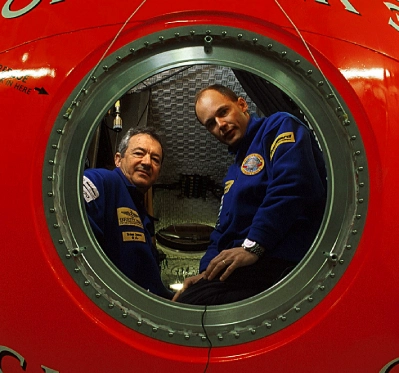
BAFTA Award-winning British documentarian John Dower’s The Balloonists, is set in the winter of 1999. It follows Swiss explorer Bertrand Piccard and British aeronaut Brian Jones’ attempts to be the first to circumnavigate the globe nonstop in a hot-air balloon.
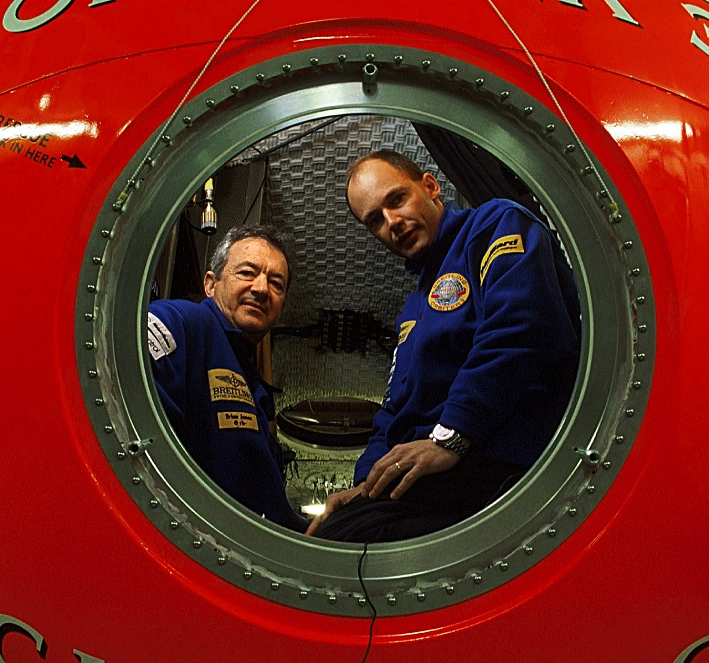
After the failure of the first two Breitling Orbiter missions, Bertrand made the decision to part ways with his British engineer and co-pilot, Andy Elson, who would enter the race with his own enterprise, upping the stakes. With all hopes for the Orbiter team pinned on a third attempt, Bertrand and Jones were pitted against nature, their own mental and physical fatigue, as well as life-threatening technical hitches.
Besides having one eye on Elson’s progress, going up against the likes of British millionaire Richard Branson to complete the last great aviation challenge of the 20th century, had an underdog or David versus Goliath vibe.
Bertrand comes from a family with a rich history of daring expeditions. In 1931, his grandfather, Auguste Piccard, made history, when he became the first person to reach the stratosphere in a balloon. Then, in 1960, Bertrand’s father, Jacques Piccard, with U.S. Navy Lieutenant Don Walsh, made history when their submarine undertook a four-hour descent to the depths of the Mariana Trench in the North Pacific Ocean.
The Balloonists is the real-life story of a man searching for his own legacy and the desire to be able to call himself an explorer, and those that are willing to follow him and risk their lives for the rarest of experiences.
Dower’s previous credits include sports documentaries that have covered the subjects of boxing, cycling and cricket. Thrilla in Manilla explored the rivalry between heavyweight boxing champions Joe Frazier and Muhammad Ali, and the men behind their larger-than-life personas. Dower documented British cyclist Bradley Wiggins’ reflections on winning the Tour de France, as well as a challenging period in the life and career of the English cricketer Freddie Flintoff. He has also directed documentaries on the Lockerbie terrorist attack and collaborated with the British-American journalist Louis Theroux on My Scientology Movie.
In conversation with Flux Magazine, Dower discussed his filmmaking journey, the Wes Anderson-like vibes of The Balloonists, how parts of the story defy belief, and that some people are made different. He also reflected on the awe and wonder of nature, sacrifices in the edit, and the irony of being the one to tell this story.
The following has been edited for clarity.
WHAT ORIGINALLY LED YOU DOWN THE DOCUMENTARY ROUTE?
Well, there is actually a very simple reason. I tried many, many years ago to write a novel, and it was so unspeakably rubbish that I abandoned it. But at least I had that moment of self-awareness, which is unusual for people in this industry. I thought documentaries and maybe not writing was the way to go, and blimey, it was 27 years ago now that I started making my own film about a character I knew.
I sent it everywhere and everyone ignored it, apart from one guy at Channel 4 who worked on 4Later. Those days are long gone now. They used to make some crazy and very low-budget stuff. He liked the film, and he asked me to do another one for him. So, it’s the old cliché of “A bit of luck and a bit of hard work” — like our balloonist friends.
YOUR SELF-AWARE COMMENT MADE ME CHUCKLE BECAUSE IT SEEMS TO BE LACKING NOWADAYS, BROADLY SPEAKING.
Even a lot of documentary directors are lunatics. In fact, I’ve just finished a documentary series for Sky, and I’m very proud that there’s a line by one of the contributors I haven’t exchanged: “The problem with directors is they’re this terrible toxic mix of fear and ego.” I think that’s pretty spot on.
DESPITE NOT HAVING PLANNED THIS CAREER, COULD YOU IMAGINE DOING ANYTHING ELSE?
It’s a bit of a worry actually, because I obviously don’t have any transferable skills. So, I just have to hope that I can keep doing this.
I didn’t even expect to be making this film. I’m a total coward, I’m terrified of heights and I never thought I’d make anything in the adventure genre. So, I spent a whole year making a film about two balloonists and never once did I get in a hot air balloon.
There was just something about this story that felt a little bit different, a little bit unusual, a little bit eccentric, compared to your normal sort of mountaineering.
WITH NO SERIOUS INTEREST IN BALLOONING, ALONG WITH BEING TERRIFIED OF HEIGHTS, WOULD YOU DIG A LITTLE DEEPER INTO WHAT COMPELLED YOU TO TELL THIS STORY?
Bizarrely, another producer had contacted me about a mountaineering film called K2, which has just been bought by Apple. I turned it down and a few weeks later, this came along.
When the two producers from Rise Films approached me, the first thing that came into my head when they said balloons were those children’s entertainers who make balloon animals. It was something that I never really thought about, partly because I knew nothing about the story, which is always a good entry point for directing a documentary. It allows you share that journey with the viewer.
But listen, my first question with documentaries is who is telling the story? There was just something about these two characters that I really liked. They were an unlikely couple, and so, in many ways, it was an unlikely buddy movie. It’s a sort of Lethal Weapon, but with balloonists. So, what attracted me was the combination of Bertrand and Brian.
I’m always resistant to saying this because it sounds a bit pompous, but it has that sense of awe and wonder, particularly when they’re up there, and they’re going over the Sahara or that incredible sequence when they’re going over the Pacific Ocean. It’s sort of akin to that moment when you look into the sky at night, or you listen to a piece of music, and you feel that profound connection to others or the vast universe. You can tell that Brian and Bertrand experienced that. And I’d just spent a year and a half making a very dark story about Lockerbie, which left me feeling broken. There was something about Bertrand and Brian’s story that had that awe and wonder. And hell, we could all do with a bit of that in our lives at the moment, right? So, that appealed to me.
THERE ARE MOMENTS IN THE FILM WHERE THE BRILLIANCE OF NATURE IS TRULY HUMBLING. IN THESE MOMENTS, ALL WE CAN DO IS MARVEL AT ITS WONDER.
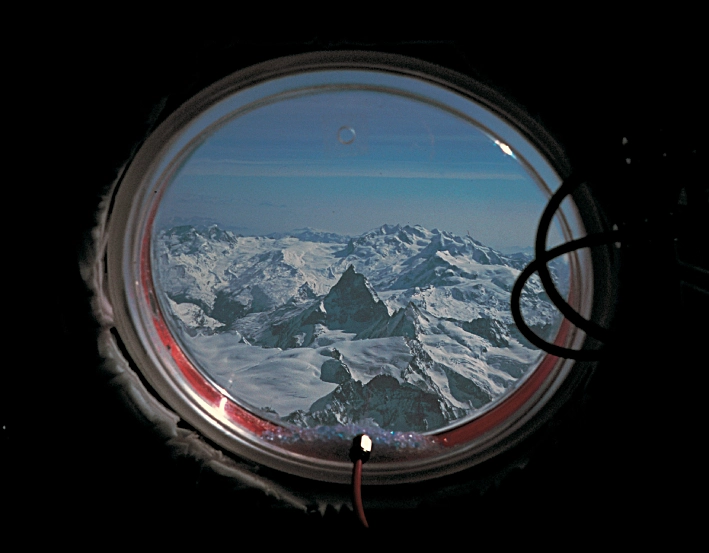
You’re spot on. There are moments in the film which capture the awesome, unpredictable and at times, terrifying elements of nature. There are the thunderstorms, the frost from their breath on the inside of the capsule when it plunges to minus 50, and the endless Sahara Desert. And I love that moment when Bertrand says people think deserts are just emptiness, but they’re not. They are made up of this incredible pattern of shapes, textures, and colours.
There’s that moment where the sun comes up when they’re crossing the Sahara. Bertrand says it feels like they are witnessing the creation of the world. And these guys were doing it in a balloon, in a glorified picnic hamper. It was genuinely bonkers and I liked that element.
This is a massive cliché, and I’m not comparing myself to Wes Anderson, unfortunately, but if he was going to make a documentary, you can imagine him picking this subject and these characters. After all, it’s not just Bertrand and Brian. Who would have thought a Belgian weatherman [Luc Trullemans] could be so entertaining. And there was Pierre [Eckert], the guy who was controlling [the mission] from the ground. But, yes, you’re right, it’s about nature. And the essence of ballooning, which I had to keep getting my head around, is that they don’t have an engine or anything. They literally have to look for tunnels of wind, which is nuts.
IT’S EASY TO GET CAUGHT UP IN THE ROMANTISATION OF BERTRAND AND BRIAN’S ADVENTURE, BUT THIS IS OFFSET BY THE DEADLY REAL-LIFE STAKES.
It’s a very good point and, as Brian says, if they were to ditch in the Pacific, it would take a boat four weeks to reach them. We’ve become used to being so interconnected, and you suddenly realise how huge the Atlantic and Pacific Ocean they’re flying across are, in, as I say, this sort of upscale picnic basketball.
IS ONE OF THE CHALLENGES OF DOCUMENTARY FILMMAKING SIFTING THROUGH A MASS OF FOOTAGE, AND DECIDING WHAT YOU ARE FORCED LEAVE ON THE CUTTING ROOM FLOOR? AND IS IT ALSO NECESSARY TO GUARD AGAINST BEING SEDUCED BY THE ALLURE OF THE DRAMA ITSELF?
We did shoot some observational sequences of Brian and Bertrand in their lives now. And we shot some material at the balloon factory in Bristol with the owner. Early on in the edit, it was quite a different film. It was more observational, and it was mainly my editor, David Charap, who said, “No, we’ve got to cut this right back.” And Teddy [Leifer], the producer, always said we can’t wait longer than half an hour to hit take-off. So, we scaled it right back and tried to make it as lean as possible.
One thing I genuinely regret taking out is something I always find myself telling people when they’re asking about the story. Bertrand comes from this rich family history, and his grandfather was actually the inspiration for the character of Professor Calculus in the Tintin books. We included that in the film, but we took it out. I’m not sure why. I think it was because there was too much backstory and, again, we needed to get up in the air as quickly as possible.
Bertrand’s grandfather went [to the stratosphere] in the first balloon, and when he reached the right altitude, he crashed [on the descent]. Everyone presumed he was dead. He was missing for several hours and there’s this wonderful archive footage of him suddenly crawling out of the capsule as if nothing had happened.
There was a lot in Bertrand’s backstory. He started out paragliding, and on his first flight he crashed into a chimney, which is like a moment in a Wes Anderson film. Some of that stuff I loved, but we were very disciplined and cut it back to the main journey. But we were always going to have Bertrand’s first two failures.
So, a lot of stuff did hit the floor. It wasn’t masses, because we didn’t have huge amounts of them in the balloon, and that was the hardest challenge.
Today when everything’s filmed, you’d think we would have our pick. But no, they only had these little GoPros in the capsule, and it was very dependent on when they remembered to turn them on. We squeezed every last drop out of the stuff that they recorded, and there was never going to be any dramatic reconstruction in this film. No way were we going to take you out of the story. We wanted to keep you inside the capsule’s claustrophobic space.
SOME WORDS OF WISDOM AND PERSONAL PHILOSOPHY ARE SHARED IN THIS FILM. FOR EXAMPLE, ANDY ELSON RESPONDS TO THE FAILURE OF HIS OWN, LATER EXPEDITION BY SAYING HE JUST FOUND A WAY THAT DIDN’T WORK. THE MOMENT BERTRAND PARTS WAYS WITH ANDY CREATES A CRISIS POINT, BECAUSE WE WANT TO SEE THEM BOTH CIRCUMNAVIGATE THE GLOBE FIRST.
I love that line from Andy. It’s so British, and such an understatement. He was a great character.
And what I like about Bertrand is there’s honesty to him. Nowadays, with a lot of documentaries, particularly celebrity ones, there are signs of airbrushing. Bertrand is very open and admits he can be difficult, but there’s a reason for that, and it eventually pays off.
It was a difficult moment, and I like the fact that Andy coughs up to his mistake. But then again, it’s just so low tech, right? That second balloon fails because they haven’t screwed the window down properly. First, they try and fix it with some polythene bags, which is so basic, and then Andy climbs out, but they’ve only got one alum key. So, he’s at 30,000 feet with this alum key trying to fix it… it’s bonkers.
THE IRONY IS WE’VE PUT A MAN ON THE MOON BEFORE WE WERE ABLE TO CIRCUMNAVIGATE THE GLOBE IN A BALLOON. WE REALLY DON’T NEED TO GO THAT FAR TO FIND ADVENTURE, RIGHT?
What I liked about these characters is they are quite old-fashioned — these slightly lunatic adventurers. It’s not in the film, but Andy told us about this wonderful moment when he was thirteen or fourteen and he disappeared for the day. His parents didn’t know where he was. He had taken a dinghy across the channel. Can you imagine that? He’d gone across the channel in a small boat at fourteen-years-old and he had to call them from like Dieppe and say, “Oh, I don’t think I’ll make it back. Can you send me the money to get a ferry?” It’s like there are just people that are somehow made differently.
The Balloonists was released in UK and Irish cinemas on 22 May.
words Paul Risker