
Buying a ring online is easy right up until  you have to choose the size. Even if you know the style you want, sizing can turn into guesswork fast. In a perfect world, you would always use a physical ring sizer. But when you do not have one on hand, it can still be done properly at home, as long as you use tools that are designed to be accurate, not just “close enough”.
That is the appeal of Ring Size Online (ringsize.online). Instead of sending you down a rabbit hole of conflicting charts, it lays out the main methods in one place and groups them by the only question that matters at the start: do you have a reference ring, or are you measuring your finger directly?
The biggest issue with online ring sizing is bad charts and mixed information
Most sizing mistakes are not about people being careless. They come from the internet being messy. Printable charts that are not truly to scale, conversions that round too aggressively, and guides that swap diameter and circumference as if they were interchangeable.
Ring sizing is measured in small increments, so tiny errors can become noticeable on the hand. The safer approach is to pick a method that fits your situation and then use a calculator or chart that is clear about what it is measuring and how it converts sizes.
If you have a reference ring
If you already own a ring that fits the intended finger, these methods tend to be the most reliable because you are sizing something solid and consistent.
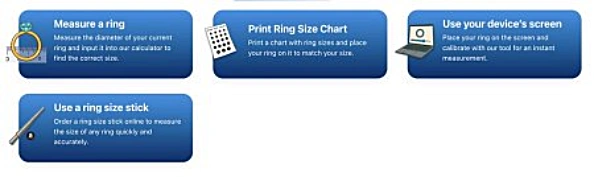
Measure a ring (inner diameter)
This is the simplest option if you have a ruler or measuring tape: measure the ring’s inner diameter and input that number into a calculator.
Where the platform helps is the translation. Rather than leaving you to interpret a generic table, it converts that diameter into the official sizing systems people actually shop with, so you can view equivalents across regions without bouncing between multiple sites.
Print a ring size chart (ring on circles)
Printing a chart and matching your ring to the circles is quick and intuitive, but it only works when the chart is printed at true scale.
Ring Size Online includes charts that are meant to be checked for scale before you trust the result, which is exactly the step most random “free charts” skip. That scale check is not a formality, it is the difference between a precise match and an almost-right guess.
Use the screen (no printing needed)
If you cannot print, the platform includes an option that does not require paper at all. You can measure directly on your laptop or phone screen: calibrate your display, place your ring on the screen, and match it to the guide.
It is also practical that you are not forced into one unit system. The tool supports both metric and imperial, so you can calibrate and measure in millimetres or inches depending on what you have available, then get the same consistent sizing output.
Use a ring size stick
If you prefer a physical tool, a ring size stick is a simple at-home option: slide the ring down, read the size, and then convert it if your retailer uses a different system.
Ring Size Online also makes the shopping side easier by recommending ring sizer sticks that follow official sizing standards and include the details people actually need for accuracy, like clear markings and half sizes, so you can buy a reliable one online without second-guessing the listing.
If you do not have a reference ring
When you are measuring your finger directly, structure matters more. This is where the internet’s “quick tips” and sloppy charts tend to cause the most sizing issues.
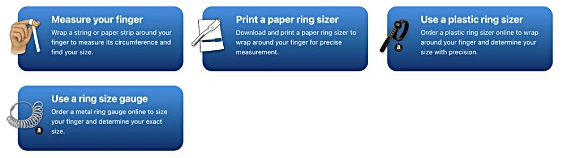
Measure your finger with paper or string (circumference)
Wrap a strip around the finger, mark the overlap, then measure the length. That gives you your finger’s circumference, which can then be converted into a ring size.
Ring Size Online does more than tell you to wrap and measure. It walks you through the method and then connects that number to the right sizing outputs, so you are not guessing whether your measurement should be treated as circumference or diameter.
Print a paper ring sizer (wrap and read)
Printable paper sizers are popular because they feel closer to using an actual tool. You cut it out, wrap it around your finger, and read the size directly.
The advantage is repeatability. You can try it more than once, adjust for comfort, and confirm you are not between sizes before you order.
Use a plastic ring sizer
A plastic sizer is inexpensive, consistent, and easy to use. Once you have it, it often becomes the quickest way to check sizing at different times of day or for different fingers.
Ring Size Online includes guidance on how to tighten it correctly (snug, not painful) and how to translate that result when a store lists sizes in a different system. It also points readers toward recommended plastic sizers that match official sizing standards, so you can order one online with confidence and use it as a repeatable reference going forward.
Use a metal ring gauge
A metal ring gauge is the most jeweller-like option at home. You try rings from the set until you find the fit that feels right.
The platform then helps on the conversion side, which is crucial if your gauge is in one system but the retailer lists another. And if you are buying a set, it highlights what to look for (durable metal, readable markings, half sizes) and recommends options that are built to standard, rather than bargain sets that can be inconsistent.
Conversions, explained the way online shoppers actually need them
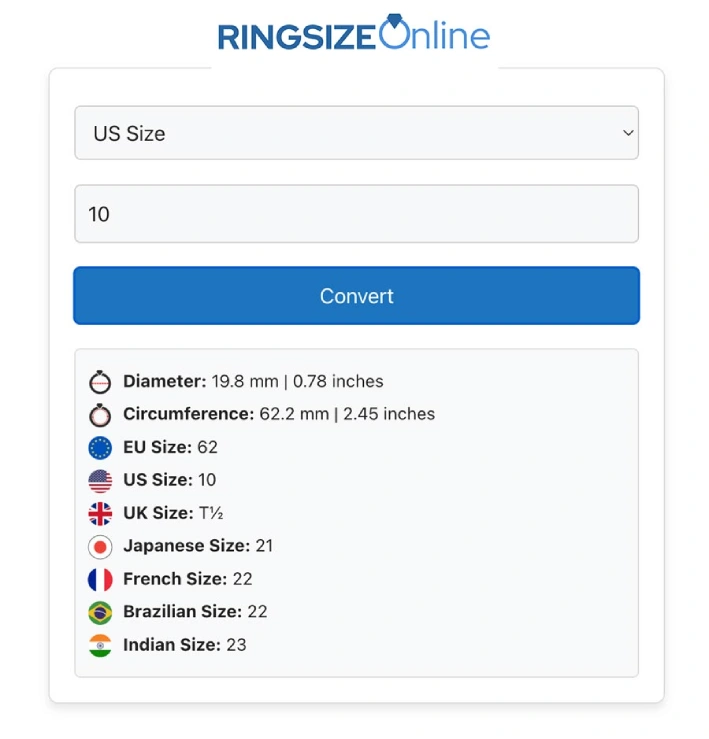
One of Ring Size Online’s strongest points is how it handles conversion between systems. Ring sizing is global, but sizing standards are not. A US number, a British letter, a European size, and a Japanese size do not map cleanly unless the conversion is based on official definitions.
Ring Size Online is built around official norms across the major standards, including ISO 8653:2016, and that matters because it anchors conversions to the measurements that systems are actually defined by. That is why the platform can offer conversions that feel more “exact” than the generic tables people find elsewhere.
It also helps that it does not stop at one chart. The site provides detailed, system-by-system tables covering the main standards shoppers run into, including European Standard, USA System, British Standard, Japanese Standard, French System, Brazilian Standard, and more. And for anyone who does not want to scan a table line by line, there is an automatic conversion tool: you enter any size (or a measurement), select the system you are starting from, and it returns the equivalent sizes across the other systems in one step. The result is that international buying becomes simpler because you are converting from a single reliable reference point, not “guessing between charts”.
Two small checks that make any method more accurate
If you want to keep it simple and still avoid the most common mistakes, these habits make a real difference:
- If you print anything, double-check your printer did not scale the page. As we explain in How to Check Your Ring Size at Home: A Step-by-Step Guide, a quick scale check is often what separates a “close enough” result from a reliable one.
- Aim for a fit that slides over the knuckle with slight resistance and then sits comfortably at the base of the finger. Once it is on, make a fist and relax your hand a couple of times. If it pinches, it is too tight. If it spins freely, it is likely too loose.
- If you land between two sizes, use the ring’s width and inner profile as the tie-breaker: wider bands and flatter interiors usually feel tighter, while narrow rings and comfort-fit interiors are more forgiving.
- Measure when your hands are at a normal temperature, not immediately after exercise or a hot shower.