Interdisciplinary artist Zan Wang works across painting and installation, exploring how layered and transparent materials shape spatial perception. Her new cyanotype painting series introduces a renewed approach, moving from material layering as formal construction toward color as trace. Presented in Echoes of Presence at Blackdot Gallery during London Craft Week (15–18 May 2025), these works reconfigure cyanotype as a hauntological surface, capturing what has departed yet continues to resonate.

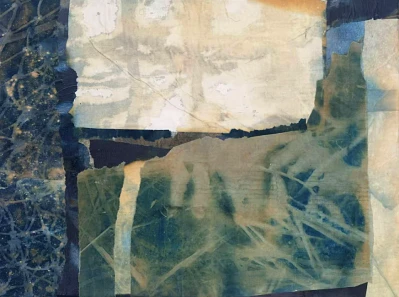
Wang’s palette is characterized by a subtle interplay of warm and cool tones, with its yellows, blues, and browns. In Ghost Dance (2024), Wang creates an in-between space with faded yellows and blues. Her use of bio-chemicals, such as fruit acid extracts, gives her cyanotype a gentle warmth that departs from traditional Prussian blues, holding a kind of time-stain. On the right side of the composition, blue-green hues evoke the shadow of plants cast on frosted glass, while on the left, warmer tones recall the paper windows lit by distant sunlight. These subtly tonalized colors hold exterior brightness and interior dimness in tension, forming an ambiguous spatial threshold.
In this oscillation of light and shadow, what becomes most compelling is how Wang composes her surface as a site of in-betweenness, which is always relational. There is no figure in the scene, but the viewer is invited to take the absent position, as if looking out through a translucent window, trying to grasp a moment that is always on the verge of change.
This in-between space, central to Wang’s paintings, treats absence as an active, generative force. The subtle tonal oppositions are complicated by layering and collage, leaving the painting with fluid boundaries between figure and background, form and void. It is worth mentioning that Wang’s use of absence as form through cyanotype draws from the affective power of negative space in Song dynasty ink landscape painting, where emptiness is never a void but a presence—a site for imagination, wandering, and potential becoming. In Of Mountain and Sea (2024), rather than offering a complete representation, the painting operates within a perceptual field of absence. The image of the mountain appears suspended—layered and mirrored—caught in a tension between the upper and lower halves of the composition, as if the form is being drawn by gravity. Yellow washes resemble flowing water or drifting sand, from which the mountain emerges, only to dissolve again into the blue-brown reflections. Here, the interplay between mountain and water evokes a moment of flux. Through this suspended composition and its use of void as an active force, Wang’s paintings gesture toward a deeper transformation, one that hints at cycles of becoming and dispersal.
While Wang’s relational surfaces operate within a perceptual field of absence, her use of non-linear perspective reminds us that the painting unfolds through sustained, uncertain looking. In Time Rings (2024), Wang’s compositional structure resembles a Cubist logic, in which collaged elements generate a centrifugal pull that draws the eye into a continual meditative circulation. This visual oscillation destabilizes the boundary between form and background, as plant traces spiral inward, becoming microscopic and abstract, resembling dark neural folds or synaptic pathways scattered across a fading yellow ground. Her layered compositions invite the viewer to linger, allowing forms to emerge gradually: a shadow dissolves, a trace resurfaces like something half-remembered. The luminosity in her work seems to emanate from behind the surface, as if light were diffused through frosted glass but never fully revealed. Each layer carries its own instability, surfacing and dissolving from another, echoing the porous nature of presence and absence. In this suspended space, the viewer is drawn into a slow dialogue with what is no longer there and what is just beginning to appear.
Echoes of Presence, Blackdot Gallery, London Craft Week, 15–18 May 2025
Written by Clara Whitmore
– Published December 24, 2025