Most games from 2007 are museum pieces now. You boot them up out of nostalgia, wince at the graphics, and close the tab. Old School RuneScape did the opposite. It launched as a throwback, a snapshot of the game as it existed in 2007, and then it grew.
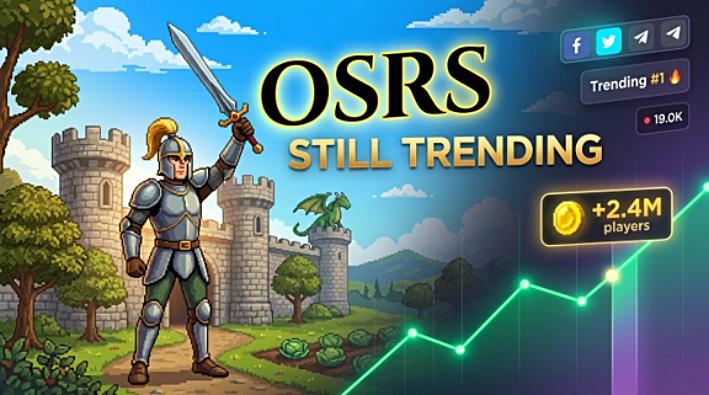
Nearly twenty years on, it pulls hundreds of thousands of daily players, sells out real-world community events, and still tops streaming charts on a good week. For a blocky point-and-click set in a medieval fantasy world, that is a strange kind of immortality.
The question worth asking is not how it survived. It is what the survival tells us about the way people actually want to spend their time.
A game that respects the slow lane
OSRS runs against almost everything modern game design preaches. There are no cinematic cutscenes pulling you along. Progress is slow, sometimes brutally so. Levelling a single skill to its cap can take weeks of real time. Fishing, mining, and woodcutting are exactly as repetitive as they sound.
And yet that grind is the point. In a culture that has speed-run leisure itself, OSRS offers a rare thing: a task with a clear beginning, a long middle, and a visible finish line. People put it on a second monitor during work calls. They chip away at it on a phone during a commute. The rhythm is meditative rather than frantic. It feels less like a game trying to hook you and more like a hobby you keep coming back to, closer to model railways or long-distance running than to a flashy console blockbuster.
There is also something honest about a game that shows you the cost up front. When you look at a high-level skill, you can see exactly how many hours stand between you and the goal. Nothing is hidden behind loot boxes or random drops that never come. The road is long, but it is a straight road, and you always know where you are on it. That clarity is rare, and it builds a strange sort of trust between the game and the person playing it.
The community keeps it honest too. Every major update goes to a player poll, and a change needs strong majority support to make it in. That means the game evolves at the pace its own audience wants, which is a big reason the world still feels coherent after all these years. Players do not just consume the game. They vote on what it becomes, and that sense of ownership keeps them around long after most people would have drifted away.
The economy nobody planned but everybody uses
Here is where OSRS gets genuinely fascinating. The game has a real, functioning economy, and it emerged mostly on its own.
Gold pieces are the currency. Players earn them by killing monsters, running skills, and flipping items on the in-game marketplace called the Grand Exchange. Prices there rise and fall on supply and demand, the same way any market does. A rare item can spike after an update. A common resource can crash when a new method makes it easier to farm. Economists have looked at RuneScape’s market as a genuine case study. Players track price charts with the seriousness of day traders.
Some players barely bother with combat or quests at all. They treat the Grand Exchange itself as the game. They buy low, wait, and sell high, turning a modest pile of gold into a fortune through patience and market sense alone. It is capitalism in a cartoon coat, and it works because thousands of real people are making real decisions about what things are worth. No developer scripted those prices. They came from the crowd.
Gold matters because almost everything worth having costs a lot of it. The best gear, the expensive skills, the flashy cosmetics, all of it sits behind a wall of currency that takes serious time to earn. And time is the one thing plenty of adult players simply do not have.
Why so many players buy their gold
This is the part the game rarely talks about openly, but it is everywhere. A large slice of the OSRS player base is now in their thirties and forties. They grew up with the game. They still love it. They also have jobs, kids, mortgages, and maybe two free hours on a Sunday night.
For those people, grinding out millions of gold the slow way is not relaxing, it is a chore. So they skip it. Rather than spend forty hours mining ore to afford a piece of gear, they buy osrs gold and get straight to the content they actually enjoy, the boss fights, the raids, the parts that made them fall in love with the game in the first place. It is the same logic as paying for a cleaner or ordering takeaway. You are trading money for time, and for a busy adult that trade often makes sense.
Jagex, the studio behind OSRS, officially discourages the practice, and there are risks worth understanding before anyone goes down that road. Buying gold breaks the game’s rules, and accounts can be penalised for it, so anyone who chooses to do it is making a personal call with those risks in mind. But the demand is real and it has been for years. The existence of a thriving gold market is not a bug in the culture around OSRS. It is a direct result of the game asking for more hours than its grown-up audience can spare.
The nostalgia is only half the story
It is tempting to explain all of this with one word: nostalgia. And nostalgia is clearly part of it. Plenty of players return because the music, the map, and the clunky combat drop them straight back into being fifteen again.
But nostalgia alone fades fast. What keeps people is that the game rewards commitment in a way modern life rarely does. Effort turns into visible progress. A goal set in January is actually reached by March. In a world of endless feeds and instant everything, there is real satisfaction in a task that refuses to hand you anything for free. The game gives back exactly what you put in, and that fairness feels almost old fashioned.
The gold trade sits at the honest edge of all this. When a hobby is worth keeping but the hours are not there, people find shortcuts. That is not laziness. It is the same calculation adults make about everything else they love but cannot fully fit into a busy week.
What the whole thing says about play
OSRS works because it never pretended to be new. It leaned into the grind, handed real control to its community, and let a genuine economy grow around its currency. The result is a game that feels less like entertainment and more like a place people live in part time.
It has lasted this long precisely because it lets players decide how much of the slow road they want to walk, and how much they would rather skip. Some grind every step for the pride of it. Some pay to leap ahead to the good part. The game is big enough to hold both, and that flexibility, more than any graphics update ever could, is why it is still standing.
words Al Woods