
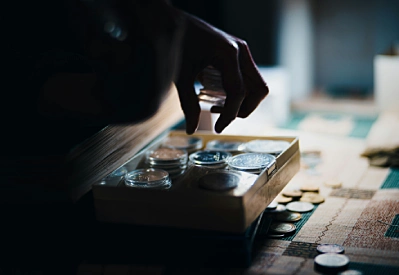
An inherited coin collection rarely arrives with clear instructions. There might be an album with a few empty spaces, envelopes covered in tiny handwriting, or a biscuit tin that nobody has opened for years. Even knowing where to start can feel like a decision you are not ready to make.
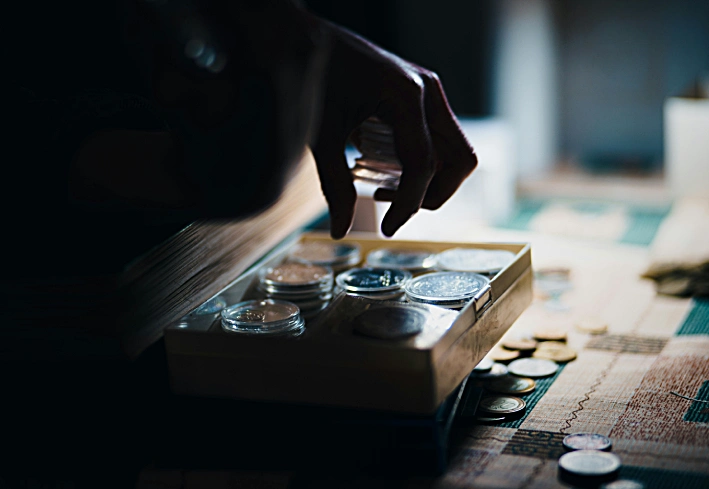
You do not have to decide what to sell on the first afternoon. The useful first step is much smaller: find out what is there without changing it. Give yourself a clear table, a little time and somewhere safe to put everything when you stop.
Keep the collection as you found it
Before sorting, take photographs of the boxes and their contents. Photograph handwritten labels too. A note that seems meaningless now might help explain why someone kept two apparently identical coins in separate envelopes.
Leave coins in their existing holders while you make that first record. Keep receipts, certificates and presentation boxes with the items they belong to. If a holder has a label, copy its wording rather than trying to interpret every abbreviation straight away.
Resist the urge to make the collection look better. This is not the moment for polish, a kitchen cleaning recipe or an attempt to remove a mark. Surface condition can affect what a collector will pay. A coin does not need to look new for someone to be interested in it.
Make a simple inventory, not a valuation
A notebook is enough. Start with the container, then write down what you can see: the country, denomination, date and any lettering on a holder. Use a photograph number to connect the note to the right item. Put a question mark beside anything you cannot read.
You can group obvious sets together without taking them apart. An album of pennies, a boxed set and a handful of loose silver coloured coins can each have their own entry. The point is to make the collection easier to discuss, not to solve every identification problem yourself.
Keep family information in the record as well. Was a coin a birthday present? Did someone bring it home from a trip? Those details may not change a purchase offer, but they can change whether you want to sell it.
Avoid treating an old price sticker as a current valuation. It is a clue about the collection’s history, not a promise about what it would bring today.
Separate what you know from what you hope
Online searches can help you put a name to a coin. Prices are harder to compare. A listing with a striking asking price does not show that anybody paid it, and a similar looking coin may differ in a detail you have missed.
Date, mintmark and condition can matter alongside the metal itself. Age alone does not establish value. Nor does every gold or silver coin belong in the same category: some attract collectors for the particular coin, while others are mainly assessed for their metal content.
If you want to learn the vocabulary before speaking to anyone, the American Numismatic Association’s collecting basics overview introduces subjects including grading, storage and the variables that determine value. You do not need to become an expert. Being able to describe what you have is a useful start.
Ask what an evaluation will actually involve
Before booking an appointment, explain roughly what is in the collection. Ask whether the person regularly handles those sorts of coins, what you should bring and whether there is a fee. A purchase offer and a formal written appraisal are different services, so say which one you are looking for.
For someone in northwest Arkansas, Northwest Arkansas Coin Buyers provides information about arranging a local evaluation of coins and collections. Reading what a buyer handles can help you prepare your questions before a visit. It does not commit you to accepting an offer.
During an evaluation, ask what is driving the figure for each group of items. Is the interest in the coin as a collectible, its gold or silver content, or both? If some pieces are being grouped together, ask which ones and why. Write the explanation beside your inventory entry so you do not have to remember it later.
If you want another opinion, keep the item descriptions consistent. Comparing two totals is less useful if one covers the whole collection and the other leaves out several pieces.
Make the decision in smaller parts
Keeping a collection does not have to mean keeping every box. Selling some of it does not mean the rest has to go. You might keep the coin with a family story, give an album to someone who wants to learn about it and take more time over the unfamiliar pieces.
Where other family members have a stake in the collection, agree on what is being considered before arranging a sale. Avoid making a rushed decision simply because the boxes are taking up space.
Once you have decided, update the inventory. Record what you kept, what went elsewhere and any paperwork that belongs with it. Put the photographs somewhere you can find them again.
The aim is not to turn a family collection into a perfect spreadsheet. It is to replace a box of unanswered questions with a few decisions you understand and feel comfortable making.
written by Al Woods