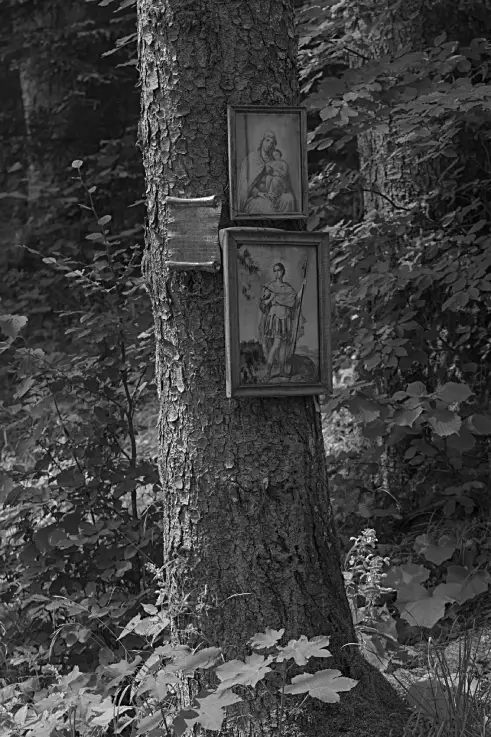
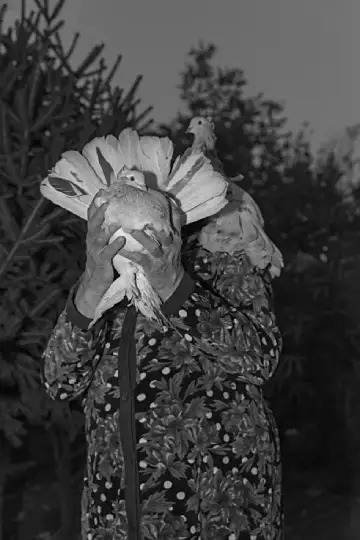
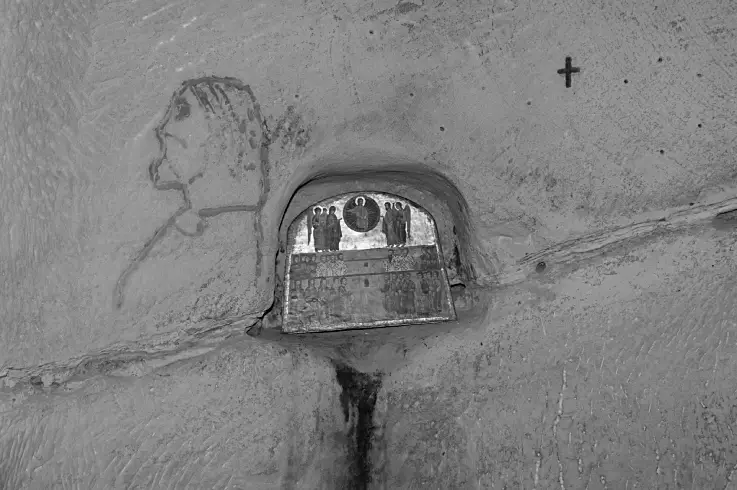
In On Heaven’s Doorsill, Roxana Savin turns her lens toward the porous edge between the living and the dead — a threshold she has known, in one way or another, since childhood. The Romanian-born artist’s new photographic series and monograph emerge from a deeply personal space, steeped in the mythology, folk tales, and ancestral customs of rural Romania, where Savin was born and raised. It is a world shaped by imagination and ritual, where time is measured by the seasons and life unfolds in harmony with the ancient rhythms of the landscape.
The project is inspired by Savin’s grandmother, Alexandra, who lived her entire life in a small village bound to those rhythms. Long after she became a widow, Alexandra dreamt that her late husband appeared to her.
“When she asked, ‘Have you come to take me across?’ he replied, ‘Not yet. I will be back for you at harvest time.’”
So she waited. The leaves turned gold, the hay was cut, and the fields swelled with ripeness. When harvest came, she crossed over — just as he had promised — entering the gates to the other side.
Through this story, Savin builds a visual language that blurs the line between the everyday and the mystical. The photographs — suffused with both solace and unease — echo the oral traditions and rituals that have long shaped Romanian village life. “Daily life was tightly woven with the rhythms of the land and the wisdom of those who came before us,” Savin reflects. “People, animals, the changing seasons, and even spirits all shared the same space, shaping how we understood the world.”
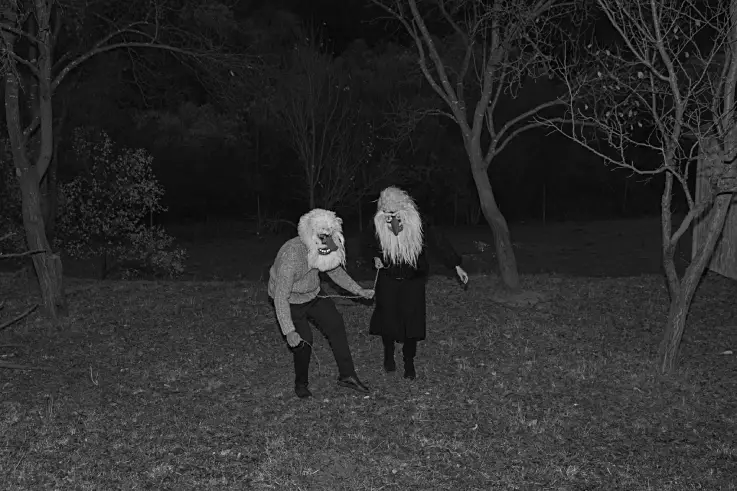
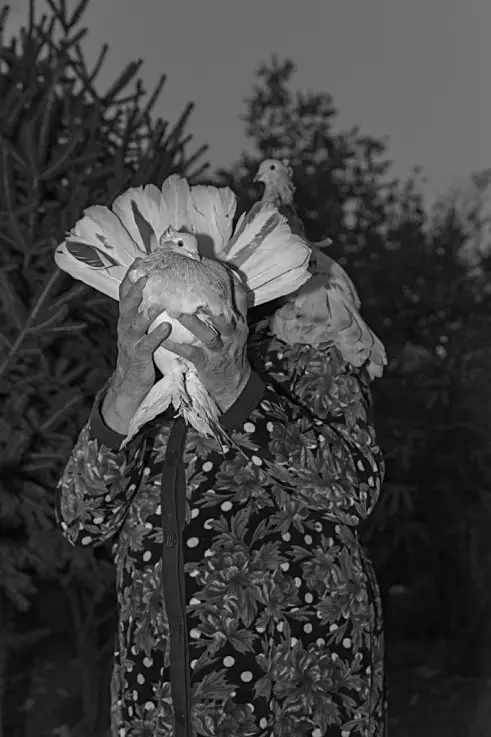
Despite Romania’s Orthodox Christianity, pre-Christian customs remain deeply embedded in its cultural soil. One such tradition — Chipărușul, an ancient funeral dance unique to the mountainous Vrancea region — appears on the cover of Savin’s book. The ritual involves masked villagers, linked by chains, leaping over fire to purify the deceased’s soul and guide it toward transcendence, while warding off evil spirits. The book closes with a quieter image: a woman in a traditional headscarf, a nod to Alexandra, the artist’s grandmother. Between these two moments — fire and fabric, ritual and remembrance — Savin’s work evokes the natural cycle of life and death.
Her memories of early mornings in her grandparents’ village — when she would walk to the cemetery beside her grandmother, carrying pomană, or offerings for the dead — permeate the series. In Romania, pomană is more than a ritual. It is a gesture of compassion, a sacred exchange between the living and those beyond. Food, bread, wine, candles — small, luminous acts of care meant to ease the soul’s passage. “It was believed that the connection between the living and the dead did not end with burial,” Savin recalls. “My grandmother thought the soul’s journey after death depended on the participation of the living: without their prayers, offerings or remembrance the departed could not find peace.”
The photographs, shot in a muted palette that feels suspended between duskart b and dawn, suggest that the boundary between this world and the next is less a line than a breath. In them, Savin preserves a worldview that might otherwise fade — one in which the invisible is never entirely gone. “The enduring practice of these traditions acts as a bridge between past and present, life and death, enforcing a sense of community that anchors its people in something far older and larger than themselves,” she says. “These beliefs, rites, and mythic narratives are the foundation of my spiritual and cultural identity, grounding me in a worldview that transcends the individual. Though my grandparents, who embodied these ways of life, are now gone, and I myself have long since moved away—”
It’s here, on that unfinished thought, that On Heaven’s Doorsill lingers — in the space between departure and return, between light and its fading.