There is a particular kind of attention that wildlife demands of you. Not the reactive, scroll-and-move-on kind that governs most of modern life, but something slower and more deliberate — the kind that notices a shift in the light, a change in the soundscape, a silhouette at the edge of vision. It is, in its own way, not unlike looking at a great painting or listening to an album properly for the first time.
Safari has long been understood as one of the last genuine antidotes to distraction. But within that world, a quiet revolution has been taking place. While the traditional pursuit of lions, leopards, and elephants remains as compelling as ever, a growing number of travellers — cultured, curious, unhurried — are turning their gaze upward. To the birds.
The Case for a Birdwatching Safari
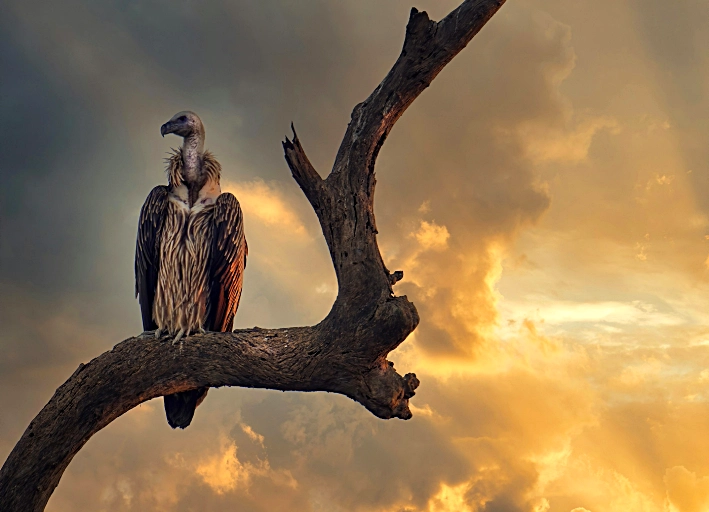
Africa is home to over 2,300 bird species. That number, presented baldly, tells you very little. What it means in practice is this: a lilac-breasted roller perched on a termite mound, its plumage an impossible arrangement of turquoise, cobalt, and rose, catching the last of the afternoon sun. A martial eagle riding a thermal above the Okavango Delta. A flock of carmine bee-eaters bursting from a riverbank like a scattering of embers.
A birdwatching safari asks something of you that a standard game drive does not. It requires a finer quality of attention — the ability to distinguish a call from forty metres, to catch movement in the canopy, to understand habitat well enough to know where to look. Expert guides in the best destinations combine ornithological knowledge with a broader ecological fluency that enriches everything around it: the mammals, the insects, the plant life, the water systems. Birding, it turns out, is one of the most effective ways of understanding an ecosystem in full.
This is not a niche pursuit for specialists in khaki vests with binocular-specific neck strain. It is, increasingly, the preference of travellers who want depth over volume — who would rather spend an hour understanding one extraordinary creature than check seven species off a list.
The Destinations That Define It
Certain places reward the upward gaze more generously than others.
Botswana’s Okavango Delta is arguably the finest birding destination on the continent. The Delta’s extraordinary hydrological system — the world’s largest inland delta, flooding seasonally from rains that fall hundreds of miles to the north — creates a mosaic of habitats that supports over 550 bird species. The papyrus beds conceal rare warblers; the fig trees draw hornbills and barbets; the waterways produce kingfishers in five species simultaneously. The camps that operate within the Delta’s private concessions are some of the most architecturally refined in Africa, placing serious comfort and serious ornithology in the same experience without compromise.
Tanzania’s Rift Valley lakes — Manyara, Natron, Eyasi — offer spectacle on a scale that is almost operatic. Lake Manyara alone hosts one of the largest breeding colonies of lesser flamingos on earth. The numbers are staggering: tens of thousands of birds turning the shallows pink, moving in formations that seem choreographed. Tree-climbing lions are an added peculiarity.
Uganda and Rwanda, anchored by their mountain gorilla experiences, also contain some of the richest birding in Africa. The Albertine Rift is a biodiversity hotspot of global significance, with endemic species found nowhere else on earth — the African green broadbill, the Shelley’s crimson-wing, the handsome francolin. For travellers combining a gorilla trek with a few days in the forest lodges, the birding adds an entire additional dimension to the journey.
The Luxury Family Safari: More Than You Might Expect
Here is where the birdwatching safari reveals one of its less-discussed advantages: it is, perhaps surprisingly, one of the most engaging experiences available on a luxury family safari.
Children are, by nature, attuned to movement, colour, and sound — which makes them, in many respects, natural birders. The challenge of spotting and identifying something fast-moving and brilliantly coloured is the kind of problem that engages young minds in a way that a distant view of sleeping lions sometimes does not. Several of the finest family safari camps in East and Southern Africa have developed dedicated junior naturalist programmes built substantially around birds — identification challenges, field journal keeping, guided dawn walks with expert trackers — as a way of drawing younger guests into a deeper engagement with the landscape.
The luxury family safari has matured significantly as a category. The best properties now think carefully about what each generation needs, and that thinking extends beyond mealtimes and family room configurations. The experiential design — what children actually do, what they learn, what they carry home — has become as considered as the architecture of the rooms they sleep in.
Birds, as it happens, are a perfect vehicle for this. They are everywhere, at every hour, in every habitat. They are identifiable. They are beautiful. And understanding them — even partially — creates a framework for understanding everything else. A child who learns to identify a grey crowned crane or a saddle-billed stork on a family safari in Uganda is building an attention to the natural world that no amount of screen time can replicate.
What to Look For in a Birding-Focused Safari Camp
Not every camp handles the birding dimension equally well. A few markers of quality worth noting when planning:
The guide. Birding expertise is specific and not universal among safari guides. The best birding-focused properties employ dedicated ornithological guides or trackers alongside their broader naturalist team. It is worth asking directly about this when booking.
The habitat diversity. Camps positioned at the edge of multiple ecosystems — where woodland meets wetland, or savannah transitions to riverine forest — will consistently offer richer birding than those in a single habitat. Diversity of environment means diversity of species.
The pace. A genuine birdwatching safari operates at a different tempo to a standard game drive. It stops more, waits longer, and values observation over movement. Camps that understand this build it into their guiding philosophy rather than treating birding as an optional add-on to a conventional itinerary.
The equipment. Quality binoculars provided for guest use, field guides specific to the region, and spotting scopes available at the camp or in the vehicle are all markers of a property that takes the experience seriously.
A Different Kind of Safari
There is something instructive about the growing appetite for birdwatching safaris among travellers who have already seen the obvious things and want to go further. It reflects, perhaps, a broader cultural shift: away from the accumulative logic of the checklist and toward something more contemplative. The desire to see rather than simply to have seen.
Africa, experienced this way — through the lens of its extraordinary avifauna, in the comfort of its finest camps, shared across generations — is a different proposition entirely from the conventional safari narrative. It is quieter, subtler, and in many respects more rewarding for it.
The Big Five will always be there. But the birds are something else. And once you start noticing them, it is very difficult to stop.
words Al Woods