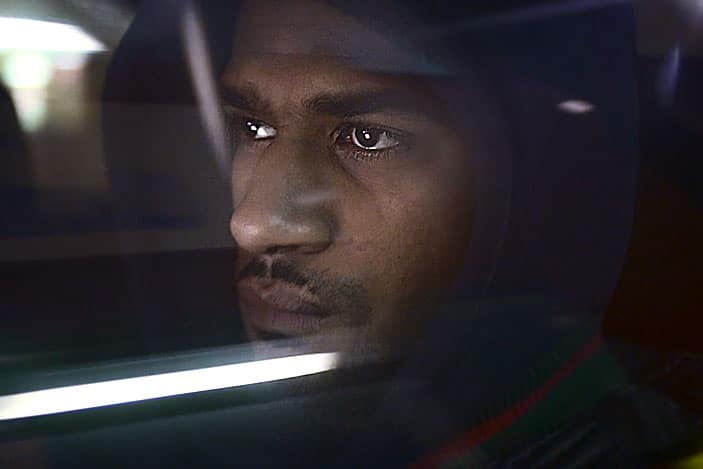
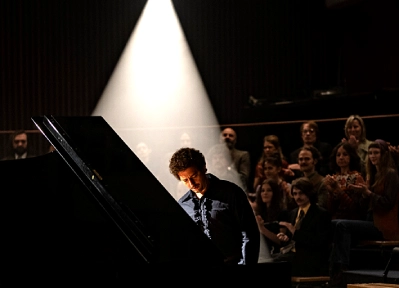
Israeli-American director Ido Fluk’s Köln 75, is based on the true story of how Keith Jarrett’s iconic solo double album, recorded live in Cologne’s Opera House in January 1975, nearly never happened. The concert, known as “The Kóln Concert”, was orchestrated, against all odds, by the tenaciously driven eighteen-year-old promoter Vera Brandes (Mala Emde).
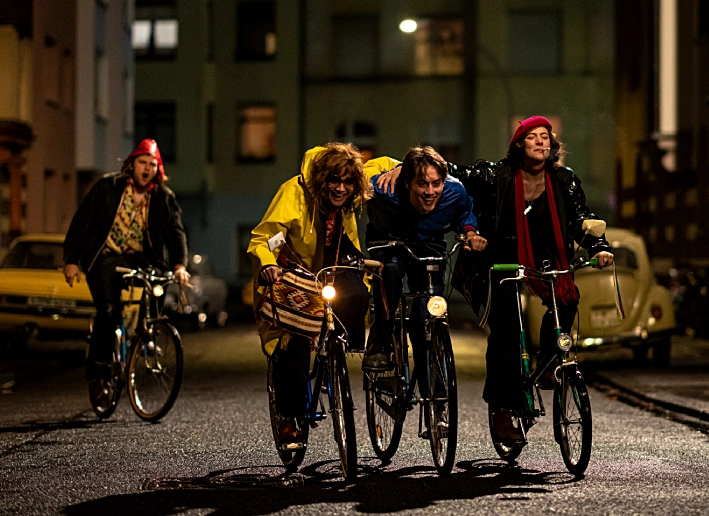
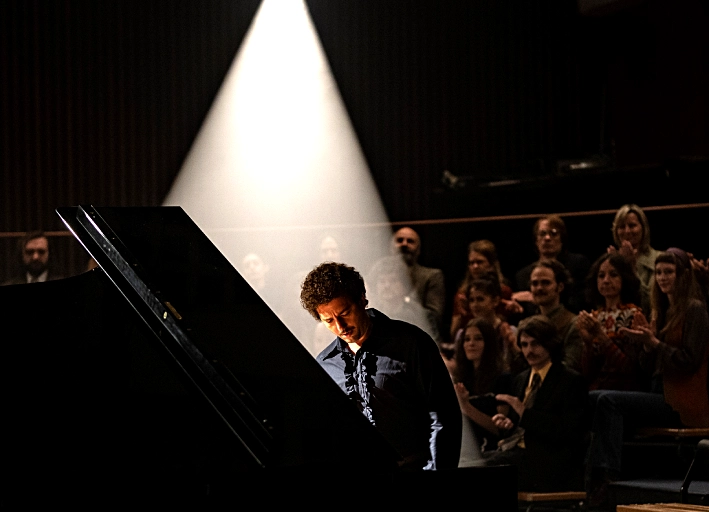
The vivacious youngster secures the venue, sells tickets, and convinces American classical pianist and composer Jarrett, who played with legendary jazz musician Miles Davis, to perform in the Opera House’s first jazz concert. The only time Brandes could schedule the concert was at 23:30, after an opera performance. It mattered none, because The Kóln Concert was a success, selling out. However, it was far from smooth sailing because a misunderstanding by the Opera House meant that Jarrett wouldn’t have the Bösendorfer Imperial piano he specifically requested. Instead, he had a baby grand piano intended only for rehearsals. In spite of this and the rest of the drama that could have derailed the show, Jarrett’s live recording went on to become the best-selling album in jazz history.
Fluk’s previous credits include his debut feature, Never Too Late (Af Paam Lo Meuchar), about a 30-year-old Israeli man who returns home and reckons with the memories of the country he left behind eight years earlier. In his sophomore feature, The Ticket, a blind man miraculously regaining his sight brings out the worst in him. Köln 75 is Fluk’s third feature. He has also directed the horror short film The Amazing Charleroux, in which the world’s greatest magician performs the ‘Sawing a woman in half’ illusion with grisly perfection.
In conversation with Flux Magazine, Fluk discussed the punk rock heart of his jazz story, how great art emerges out of imperfect conditions, and the challenges filmmakers must surmount in the streaming age. He also spoke about cinema being like his second family and falling in love with jazz.
The following has been edited for clarity.
CAN YOU RECALL WHAT SPARKED YOUR INTEREST IN CINEMA AND A CAREER IN FILMMAKING?
I grew up in a time when films were something you watched in the theatre, not at home. I was born in Tel Aviv, but at the age of six, the entire family moved to Paris. I think my mom was stuck with me for many hours and to get me to be quiet, she would take me to the movie theatre. I probably watched a film a day back then and a lot of them were dubbed in French, which is really funny, because I don’t think she would bother to find the original version. But that left a mark and I grew up with cinema being like a second family. I thought about film as a companion, and also like a home. So, when people talk about going to the movies to lose themselves, that’s something I can identify with.
I don’t remember a point in my life where I said, “I’m going to do this.” The question was always, could I do this? And I’m happy that it seems to have worked out so far, but you never know.
LIKEWISE, I IDENTIFY WITH LOSING YOURSELF IN A FILM. I HAVE EXPERIENCED A SNIDE BACKLASH WHEN YOU TALK ABOUT FILM AS SOMETHING MORE TRANSCENDENTAL. BUT FOR SOME OF US, CINEMA CAN BE MORE THAN A STORY WITH A BEGINNING, A MIDDLE AND AN END.
Yes, and especially when you think about how cinema is perceived these days, and especially how the art house or the independent scene is something that you stream at home. That’s a completely different way of consuming, enjoying or experiencing art. It’s like the equivalent of looking at a painting on your phone versus in a museum or a gallery. There’s something different when you’re in a space that is dedicated to that, and yet that’s the world we live in.
I don’t want to sound like I’m lamenting streaming because it’s the reality, but as filmmakers, we are thinking about ways to adjust to make the art relevant, so it works on your living room couch. Part of what I did with this film was to try and make it so energetic, as if it’s trying to attack you in the way that it grabs you. And whether you are watching it in the cinema or at home, you can’t look away. As a modern filmmaker, I see that as the big challenge that we have to consider and find a way to surmount.
KÖLN 75 NEEDS THAT ENERGY, BECAUSE VERA IS STEPPING OUTSIDE OF HER LATE ADOLESCENCE AND INTO THE ADULT WORLD. TENACIOUS, SHE REFUSES TO WAIT FOR PERMISSION AND SETS OFF AN ADVENTURE BEYOND HER YEARS.
It’s a film about jazz, but she has the audacity of a punk rock heroine. That’s why I love this story, because you’re telling a story about jazz, but it’s like a punk rock story filled with all the great tunes of 70s Germany. When you think about it, so much music comes out of Germany at that time — it’s a bubbling cauldron. Kraftwerk are inventing electronic music, then there’s Donna Summer and Giorgio Moroder doing euro disco, and Iggy Pop, Lou Reed and David Bowie are all in Berlin. And of course, there’s all the psychedelic rock. It’s unbelievable the type of cultural development that happened in Germany in the 70s because of the political upheaval, the generation gap, and the conflict. It was special, and it’s a good case study for what we need to create in cities and in countries around the world if we want to make art interesting, and to facilitate the continuation of what we saw in 70s Germany.
WE SHOULD NEVER FORGET THAT CREATIVITY FEEDS OFF CREATIVITY.
It’s not just that creativity feeds off creativity, it also feeds on defects, conflicts, and problems — it can be like the weeds that grow between the cracks of the concrete.
When a part of a town or a city is struggling, developers will turn to artists and say, “Oh, let’s get some residency going.” I don’t think that’s by chance or an accident. When cities allow these conditions to develop, they can create substantial change. This brings me to the greatest piece that Keith Jarrett is known for, which was played on a broken piano under bad conditions.
My thesis is that we sometimes need those bad conditions — we need those mistakes, problems and obstructions to create good art. And especially nowadays with AI and the race for perfection, in terms of what’s the most realistic image AI can create, people will start to realise that perfection is boring.
What makes art good or special are the mistakes, the defects, and all the little things we do to shape the work that make it better than it was supposed to be. Keith Jarrett played hundreds of concerts, maybe thousands on perfectly tuned Bösendorfer Imperial pianos, but this is the concert that transcended, because he had to get outside his comfort zone and play it on a small broken piano.
WAS THE REASON TO MAKE KÖLN 75 BECAUSE YOU FELT THE STORY HAS SOMETHING TO SAY?
Well, it’s the artistic process. When I read about this story in a small magazine piece, I said, “We should make a film about this.” The thing that stood out was that this is an intrinsic truth I knew from making movies. Being a film director, you’re faced with a broken piano every day on set.
Every artist has these challenges and as you mature as an artist, the way you handle these challenges is what makes you special. A lot of people can do the work in perfect conditions, but the conditions are never perfect, and so, how do you work around these and improvise? How do you use the problem to your advantage? And how do those things make art interesting or your work special?
That is something that has been explored throughout the ages. Orson Welles speaks about accidents in filmmaking, often embracing mistakes and even looking for them. This story really encapsulates that. It’s almost as if someone had to tell a story about how you make a piece of art special through Keith Jarrett’s career. So, I fell in love with it for that reason. And I wasn’t a big jazz guy coming into this. I fell in love with the story of making a piece of art through mistakes, and now, thanks to this project, I love jazz.
MARTIN SCORSESE IS NOT A SPORTS FAN AND HE DOESN’T HAVE AN INTEREST IN AVIATION, AND YET HE MADE RAGING BULL AND THE AVIATOR. JOHN DOWER, WHO HE SPENT A YEAR MAKING A FILM ABOUT THE FIRST PILOTS TO CIRCUMNAVIGATE THE EARTH IN A BALLOON IS TERRIFIED OF HEIGHTS. SOMETIMES IT’S NOT ABOUT WHETHER YOU’VE AN ESTABLISHED INTEREST, BUT WHETHER YOU’RE OPENMINDED ENOUGH TO TELL THE STORY.
My favourite thing about this line of work is that you immerse yourself in a world. I wrote a film about a submarine mission, and I got so deep into it that at the end of the writing process, I felt I could work on a submarine. I knew the vernacular and what everything did.
I love that, and I’m also of the opinion that everything can be interesting if you look hard enough. And in this instance, I fell in love with the world of this film, the character, the music of the time, jazz, and with what it means to improvise. There are so many interesting things that I learned from Köln 75 that I take with me. So, it’s a gift to be able to do these different things and learn about these different worlds.
RETURNING TO YOUR EARLIER OBSERVATION THAT KÖLN 75 IS A JAZZ FILM THAT’S ACTUALLY A PUNK ROCK STORY, IT IS ALSO ABOUT THE STORIES OF THE PEOPLE BEHIND THE MUSIC.
For me, this film is a reaction to music films. The musical biopic is such a common genre and in the last ten years or more we’re seeing what I like to say is the same movie being made again and again with a different soundtrack. And I wanted to make a music film that maybe put the spotlight on someone else, not just the front man, and Vera was perfect for that.
You look at a film’s credits and there’s three hundred names, but you only celebrate the stars and the filmmaker. There are so many invisible people in the arts, and they have stories too. And the truth is, without Vera Brandes, we wouldn’t have the Cologne concert.
We need the spark that’s created when an artist meets an organiser, a producer, or a promoter. As a filmmaker, when you’re younger, you think in very pure terms: I need to get everything I want done. It’s almost like creation by a dictatorship, where this is what I want, that’s what I need to strive for, and anyone that stands in my way, I will try to bulldoze over them. But as you mature in the arts, you actually realise the importance of so many organisers, producers, and the people that tell you what to do, or give you notes and their opinion. It’s not that you have to listen to everyone, and you still do a lot of bulldozing as a film director for sure, but there’s definitely something about hearing different perspectives, keeping yourself open that shapes the work and makes it interesting. You become more like water than brute force. That’s a smarter way to work, and it comes with maturity.
And sometimes you’ll see filmmakers who are in the latter stages of their career that have lost that ability and start bulldozing again. You really feel it in the work because everyone around them is a sycophant, and you can tell that nobody is there to say, “Oh, this doesn’t work.”
Köln 75 is in UK and Irish cinemas from June 5th.
words Paul Risker