As performance has diffused beyond the boundaries of traditional theatrical and screen acting, a new archetype of performer emerged as a vital and formative force in the global creative landscape. These artists refuse to be bound to a singular categorization; rather, the interdisciplinary nature of their practice and the variety of fields they move across becomes the more accurate measure of their presence.
With figures like Constance Wu and Ali Huang bringing cross-cultural fluency to major platforms and projects, the entertainment industry has grown increasingly attuned to the distinct commercial and creative values of performers who carry multiple worlds, languages, and inheritances within them. Yet as this multidimensional inhabitation of background and discipline becomes more prevalent, a sharper question arises: how does this blended pool of experience, spanning acting, modeling, and hosting, transform from a portfolio of skills into a unified and irreplicable artistic spirit.
Claire Zheng Wu approaches that question not as an abstract wondering, but as the foundational condition of her practice. Wu is an actor, model, and bilingual host based in New York City. She has walked the NYFW runway, served as a host for events like the Silicon Valley AI Film Festival, and won accolades in the 2025 Miss International Fashion Travel Pageant and the Miss Chinese Beauty Pageant, where she placed in the Top 10. With an international background spanning China, Australia, and the United States, Wu represents a new generation of multidimensional talent—one that bridges screen, runway, and stage with elegance, discipline, and ambition.
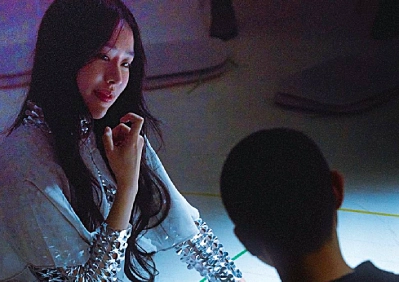
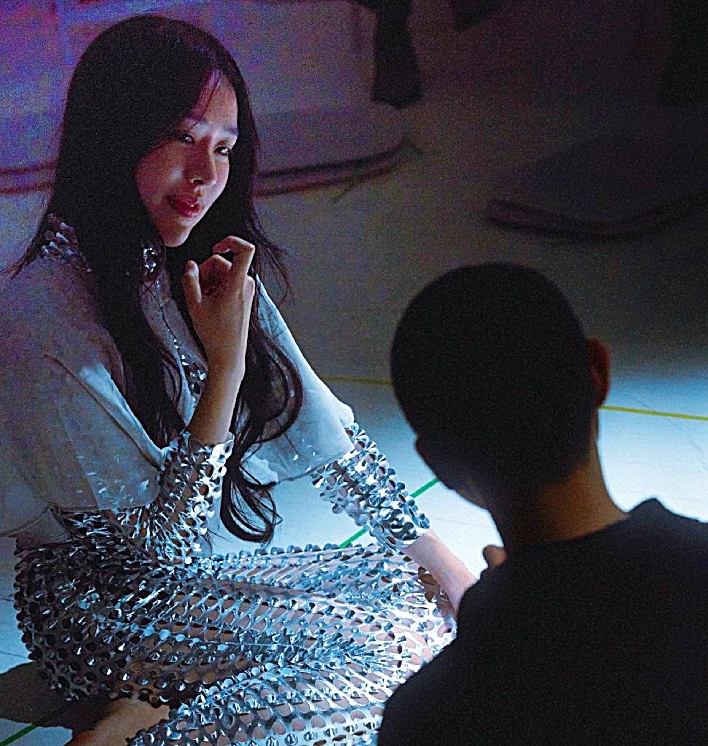
Her recent performance in 心nesthesia, an experimental theatre production by The Disappearing Ensemble, is a testament to how her interdisciplinary training and cross cultural background culminate in a character-building practice rooted in invention, collaboration, and intention. 心nesthesia is a participatory immersive experience in which sensorial response displaces conventional weight of narrative, privileging pure, intuitive, and multi-sensorial choreography.over the quest for plot. Within this framework, Wu does not simply follow choreographic instructions or anticipatory cues. Instead, she actively constructs the dreamworld the production inhabits.
For Wu, a stage or a frame is more than a space for presentation—it is simultaneously a portal, a mirror, a prompt, and a path. Through her authenticity and visceral sensibility, Wu continues to expand what performance means for both its makers and witnesses.
1.What was your role in 心nesthesia?
In this production, I performed the role of “the girl,” but my involvement extended beyond acting in the traditional sense. Since the piece was built around presence and interaction rather than a fixed narrative, I actively shaped the emotional structure of the performance—refining critical scenes, calibrating the intensity of interactions, and exploring how the character exists in relation to the audience. It felt less like executing a role and more like inhabiting a rough silhouette and filling it with my own interpretations as well as discoveries. My contributions were really about constructing the character’s internal world and translating that into something physically and emotionally relatable within the space.
- What was the foundation of your acting practice in this production—script-based, improvisational, or director-led?
It was a hybrid process, and primarily improvisational within a clear conceptual framework. We didn’t rely on a fixed script; instead, we worked from emotional intentions and situational prompts.
The director provided a clear structure and vision, but within that, I had to remain highly responsive—to the space, to my scene partners, and especially to the audience. Operating as a kind of dream master, my role controls most of the interactive props that define the participatory nature of the performance. For instance, there was a rotating magic cube with embedded sensors that triggered distinct sound and visual shifts when shaken or slid. By playing with the cube, I imposed scenic changes for the dreamer and shaped the production’s theatrical rhythm in real time. That sense of artistic agency over the pacing and emotional trajectory was especially thrilling and rewarding. It asked me to practice responsive, in-the-moment improvisation calibrated to my fellow performer’s actions and conditions. That required a different kind of discipline—less about control, more about presence and listening, which I value deeply in my acting practice.
- The performance dissolves the boundary between performers and the audience, between the stage and the pit. How did this setup shape your performance approach and your process of getting into character?
There was a distinct intimacy in this production that fundamentally changed how I approached the role. Without the usual separation between the performers and the viewers, every detail became visible—which also meant that it was impossible to hide behind anything. It demanded a level of honesty and precision that felt closer to film acting than traditional theatre.
The audience entered not as mere observers but as participants and storytellers. Their presence, their energy, even their silence directly influenced my acting choices in real time.
Compared to my previous stage experiences, this felt much more porous: existing within the audience rather than performing at them. To translate the sophisticated interiority of my character into something physically and emotionally legible, I stayed grounded in her internal logic while always allowing external stimuli to shift the moment organically.
- What qualities did you want to embody in “the girl,” and how did they serve the project’s vision?
I was drawn to a sense of quiet intensity in “the girl”—some one who feels deeply but withholds with audacity. There’s a tension between vulnerability and control, between wanting connection and holding something back.
“The girl” shifts register across the show, sometimes coercive, sometimes inviting, sometimes curious. I strove to navigate that range not by resolving the character’s contradictions, but by creating a negotiated balance: portraying the role accessible enough for the audience to connect with, but mysterious enough to sustain a generative suspicion. By resisting the impulse to decode her motivations, I tried to draw the audience into a realm preoccupied by pure, intuitive reception.Ambiguity was central to my performance, as I wanted to portray the girl’s existence as in-between—present, but slightly elusive. That ambiguity directly mirrors the project’s vision of creating an experience that resists clear definitions and invites interpretation.
- What was the most challenging and rewarding aspect of your performance?
The most challenging aspect was sustaining authenticity in such an exposed and fluid environment. As an actor without a meticulous script to rely on, I could not fall back on repetition. Instead, I had to be fully present every single time. However, that challenge was exactly what made this production so singularly alluring. When everything aligns—the space, the audience, the internal state—there’s an immediacy that’s very hard to replicate. Those moments feel alive in a way that reminds me why I’m drawn to this kind of work and why I dedicate myself to the art of performance.
Author: Cynthia Chen
Cynthia Chen is a writer based in New York City, originally from Shanghai. Her writings can be found in The Margins, The Common, Epiphany, Impulse Magazine, Cultbytes, mercuryfirs, grotto journal, No, Dear, and elsewhere. Her work has also been supported by the Community of Writers, Beijing Poetry Festival, and Accent Sisters. Her chapbook Believing YoYo is out from Tilted House Press.