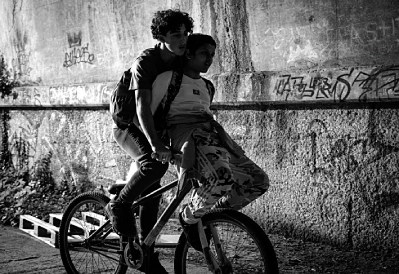
Multidisciplinary artist Imran Perretta’s directorial debut feature Ish, is set in Luton’s South Asian and Middle Eastern community.
The story, co-written by Enda Walsh and based on Perretta’s own life, revolves around two 12-year-old best friends, Ish (Farhan Hasnat) and Maram (Yahya Kitana).

Their youthful innocence is overshadowed by loss and political tensions, which they escape through one another’s company. The film bridges adolescence and adulthood as they struggle to keep their friendship intact after a police stop and search, after Ish manages to escape and runaway. Ish is a story about two adolescent boys becoming young men, and the role the past plays in shaping who they become.
Perretta is a writer, director, visual artist, and composer. His sound and moving image work in the contemporary art space has earned him critical acclaim. His work has been performed and shown at international galleries and festivals. Perretta’s film, The Destructors, showing at The Tate, London until 20 June 2027, explores British Muslim men’s coming of age in the aftermath of 9/11. In A Riot in Three Acts (2024), commissioned by Somerset House, he created a large-scale installation, utilising sound, sculpture and performance to explore how the identity of urban spaces is shaped by its inhabitants.
In conversation with Flux Magazine, Perretta discussed the personal roots of Ish, daring not to dream, and art as a cathartic outlet. He also reflected on Luton as a city in flux, the effects of capitalism on community, and how everyone’s life is worthy of being seen onscreen.
The following has been edited for clarity.

WHAT ARE THE ROOTS OF YOUR INTEREST IN FILMMAKING?
Well, I’ve done a lot of stuff over the years, but for the last decade plus, I’ve had a career in the contemporary art world. I’ve been making exhibitions for a while now, and so, my moving image practice developed within the context of the art world rather than the film world. But I never thought I’d get a chance to do anything like this. And I certainly wasn’t seeking it out, other than quietly in my own head, because it’s such an unlikely thing to happen. But I’m just glad that it has happened.
A LOT OF FILMMAKERS I SPEAK TO ARE REACHING FOR THAT MILESTONE OF A FEATURE DEBUT. YOUR EXPERIENCE IS A LITTLE DIFFERENT BECAUSE YOU WERE NOT SEEKING IT OUT.
I’ve always wanted to make something long form, but because I come from this world of the experimental moving image, I didn’t even dare to dream about it, because it just felt like such a remote possibility. And the experience of making Ish has been amazing.
What has been nice for me is that BBC film reached out and offered me the opportunity to start to develop a feature film after seeing one of my exhibitions called The Destructors. So, it’s really cool, because they obviously saw something that I didn’t expect to see myself, and I’m just super grateful.
WHAT WAS THE GENESIS OF THE IDEA FOR ISH?
It’s largely autobiographical, and it’s a portrait of a very formative time or set of circumstances from my own life. When I was given the opportunity, it was the natural time in my life to explore. This moment of coming into the adult world and the loss of innocence, is both a traumatic and a joyful time in a young person’s life. For me, that post-9/11 moment when I was the same age as the boys are in the film, was a very formative moment. It was a kind of reckoning and understanding of how I was seen outside of my family home. And there’s all this other normal teenage stuff of the heartbreak of losing a friend and the dissonances of becoming an adult before your time. All that is universal, and so, the work came from wanting to explore a moment from my own life on a personal and political level, which felt like a real reckoning.

ON THAT NOTE, DO YOU SEE FILMMAKING AS BEING THERAPEUTIC?
Definitely and I’m lucky that I found an outlet by having a creative practice. Of course, there are lots of people who don’t have an outlet, and they internalise a lot of this stuff, which can be problematic in so many ways. But I think there’s definitely a cathartic side to this and, to me, it’s about trying to navigate or process a set of conditions that are really complex. And you don’t necessarily come out with a neat answer. But I think doing the work involved in processing something that has happened to you is valuable for anyone. I’m just lucky that I’ve got a creative practice to help me to do that.
GIVEN ISH’S PERSONAL ROOTS, WERE THERE ANY CHALLENGES IN OPENING YOUR STORY UP FOR OTHERS TO BRING SOMETHING TO IT?
You can’t make the feature on your own and having an art practice, you actually do end up making a lot of stuff on your own. The trope of the lonely artist in the studio is true a lot of the time. You do spend a lot of time willing a work into being and doing it on your own coin, in your own time. And the beauty of the film world is that at no point are you really on your own — it’s a family effort. It felt like a real honour to share, and I’m glad that I did, because when you share with people, that’s when they do their best work, and that includes the boys.
So, it’s just about creating an environment where everyone feels like family. When you can do that, not only do you create good work, but everyone has a positive experience making it, and that’s the most important thing.
WHAT WAS THE THOUGHT PROCESS BEHIND THE FILM’S VISUAL LANGUAGE?
I come from a visual arts background, so in a sense, the visual language of the film is informed by not having learned the rules of how you’re supposed to do things in film school. But the visual side of it is, again, a collaborative effort. It’s me, Jermaine Edwards, the DOP, Elena Isolini, the production designer, Neesha Tulsi Champaneria, the costume designer, and Susana Mota, the hair and makeup. The image that you see is evidence of all of our work. When you bring people who have an interesting visual sensibility together, you get something that in many ways feels unusual or extraordinary. I would never take credit for that — it’s a testament to our collaboration.
HOW DOES THE STRIKING BLACK AND WHITE CINEMATOGRAPHY TRANSFORM THE TOWN OF LUTON FROM A SETTING TO A CHARACTER IN THE FILM?
Luton is seen as a commuter town — it’s seen as a hub rather than a destination, if that makes sense? It has a lot of infrastructure, but it hasn’t had a lot of love, from the point of view that it’s similar to many small towns in the UK. It has been utterly gutted by a decade plus of austerity. And so, it’s a place that, to the naked eye, is not currently the best version of itself. But if you look a bit closer, you can see a super soulful and interesting place with an amazing, vibrant community and a lot of interesting stuff going on. There’s also a varied architectural environment, and it’s a place that’s seconds away from dramatic and amazing natural landscapes. So, for me, it’s an amazing playground to make something cinematic and the black and white cinematography was part of that.
I felt as though I wanted to flatten it and to give a sense of the place that felt grand and classical rather than just the typical portrait of an austerity-ridden small town that you get from colour photography. I felt colour would negatively aestheticise the urban decay of the place, whereas black and white made the concrete look like marble. Also, what I wanted was for Luton to feel to the audience how it does to the boys, which is a place of possibility and light. To these two boys, it’s everything to them and I just wanted to honour the way that they see it.
ISH EXPLORES THE SHIFT BETWEEN AN ADOLESCENT AND ADULT PERSPECTIVE, PARTICULARLY ABOUT THE IDENTITY OF THE PLACE WE CALL HOME. BUT THEN, EVERYTHING IS CHANGING AND NOTHING STAYS THE SAME, INCLUDING OUR PERSPECTIVE. IN A PLAYFUL WAY ISH CONSIDERS WHETHER SOMETIMES PLACES DON’T CHANGE, WE CHANGE?
Maybe it’s about recognising what it is we should hold on to and what requires change. I like being critical of that and looking at the built environment communities exist in and thinking about what truly has value here. What is worth keeping and what is worth making better, because Luton is changing quickly. There’s a slow migration of people out of London moving towards towns and cities that are within reach and, so, house prices are going up in Luton, and it’s gentrifying in its own way. It’s changing the built environment, which means the community is changing. We’re seeing apartment blocks go up and the old stadium’s going to be knocked down, which is a real shame because Kenilworth Road is probably my favourite football stadium in the country — it’s very special.
So, in the context of Luton, everything feels like it’s in flux at the moment, and the film, in a weird way, is a document of that. But it’s also a document of pride because some parts of Luton feel timeless and feel like they’ll never change and they shouldn’t.
My fear is that all of it will change, in this late capitalist way where everything is game for expropriation and profiteering, including the community. And the community being a draw for whiter and higher income communities moving in and displacing people. Luton is an interesting place in that way. I think if you want to understand at a grassroots level a lot of the political forces that are shaping the UK, you can see them in Luton in quite often a stark way. So, in that sense, it feels like a bellwether for things that are happening all over the country and I hope the film can bring attention to and place an importance back on community: the preservation of community spaces, having a robust public sector where there are places the community can call their own that they don’t have to pay for, and spaces that are protected from development and gentrification.
THE CHARACTER OF THE GRANDMOTHER SHOWS AN ALTERNATIVE WAY TO GROW AND MOVE FORWARD. WHEN YOU’VE BEEN HURT AND IN THE WORST-CASE SCENARIO ARE TRAUMATISED, YOU EITHER FIND A PATH TO ACCEPTANCE OR THE PAIN, ANGER, AND HATRED SLOWLY EATS AWAY AT YOU. ONE OF THE POWERFUL ASPECTS OF ISH IS THAT QUESTION OF HOW DO WE MOVE FORWARD, ESPECIALLY WHEN WE ARE NOT ONLY SHAPED BY OUR OWN CHOICES BUT THOSE OF OTHERS?
That’s a really nice observation. The character of Nanu is based on my own grandmother and faith is her rock. That becomes the thing that keeps her grounded when everything around her is changing. I don’t have faith in the same way, and so, I’ve always been interested in what it means to have a spiritual practice and how it can be really grounding to have that in your life. Whether you have a spiritual practice or not, the lesson about grief in Ish’s context is to run towards it and interrogate it. In Nanu’s case, it’s through prayer — maybe the secular version of that is talking therapy.
It’s the idea that if you run towards the pain rather than run away from it, that’s what allows it to ease and allows one to begin to navigate something that feels so huge. And it’s not only a spiritual practice that offers that, physical practices like boxing or playing football do. There are all these ways to mediate one’s grief and also one’s joy — it’s not only about those more difficult emotions.
That’s such a valuable lesson in the contemporary moment where we’re surrounded by this real-time global mourning about the crisis that we find ourselves in. It’s not surprising to me that there has been a massive return to faith by the younger generation because of all that’s happening. How do you contend with the world falling apart in front of your eyes? Well, metaphysics, in a way, is the only way out of it. And I really respect that the older generation, like Nanu, who have seen so much of this already through the partition of India, for example, or any other number of flash points in colonial history, depending on where they come from, found their coping mechanisms. Not all of them are healthy, but they found their way to navigate big personal and political moments in their life. And young people are finding their own ways to cope. Again, some are healthy, some aren’t, but in the end, we’re all trying to find solutions for ourselves, while navigating what is an increasingly problematic material world we live in.
ROGER EBERT CALLED CINEMA AN “EMPATHY MACHINE.” IT’S IMPORTANT THAT PEOPLE FROM ETHNIC MINORITY BACKGROUNDS HAVE A VOICE TO SPEAK UP. THE ONLY WAY TO CREATE PROGRESS IS BY PEOPLE SHARING THEIR VULNERABILITY, WHICH CAN EDUCATE SOCIETY MORE BROADLY. THIS IS WHERE CINEMA CAN CREATE CHANGE THROUGH A TRICKLE EFFECT, WHICH ISH BELONGS TO.
The idea that cinema is an empathy machine is so interesting, and I hope that our film shows the value in telling stories about people, families and communities that are overlooked. I hope it’s a call to arms about whose lives were worth screen time. I think all our lives are worth being shown the love and respect of having long-form films made about them. All of our lives have value, and all of our lives are cinematic in scale, however small the story is.
Cinema is an empathy machine, but it’s also a propaganda machine. It’s a way of pushing narratives around nativism, patriarchy, and whiteness, and so many other narratives about political forces that are hiding in plain sight. Our film is hopefully a bit of an antidote to those normative stories that make up 90% of the ones we tell on screen. So, yes, I want people to know through Ish and not just my films, but other people’s films, that their lives are worthy of being seen on a big screen.
Ish is in UK theatres from July 31, with an extended run at BFI Southbank, followed by a release on BFI Player on September 7.
words Paul Risker