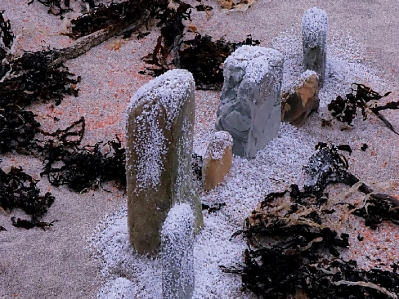
Developed at Linkshouse in Birsay, on the Orkney Islands, Zang 葬 (2026) is shaped as much by the conditions of the coast as by the decisions of its artists, Tingqi Liu (Ting) and Tong Niu. Wind enters the recordings, salt gathers on stone, seaweed contracts and softens, and footsteps send vibrations through the ground.

The work has no final or stable form. It changes with the weather, the tide and the presence of whoever enters it. At Linkshouse, the coastline is not treated as a setting placed behind the work. It is part of the work’s structure. Sound, stone, seawater, recording devices and the listener’s body remain in contact with one another, though never in exactly the same way twice.
The audio was gathered directly from the surrounding coast. Waves strike the cliffs; puffins call from a distance; the artists’ breathing passes through the recordings; footsteps travel across the stony ground as dull, physical vibrations. Wind is present throughout. At times it carries distant sounds towards the microphone; at others it overwhelms them. These interruptions have not been cleaned away. They preserve something of the difficulty of listening in an exposed landscape. The recordings do not offer an orderly portrait of the coast. Sounds appear without warning, disappear beneath the weather, or remain just beyond recognition. The microphone records its own vulnerability alongside everything else. “The same coastline never produces exactly the same sound. It exists through collisions and encounters, taking form through what we experience with and through the body.” This emphasis on bodily experience runs throughout Zang. Listening involves more than the ear. Low frequencies are felt through the floor and the body; distance is registered through changes in volume and pressure; the listener becomes conscious of breathing, balance and movement. A shift in position can alter what is heard. Remaining still can reveal sounds that initially seemed absent. The physical materials undergo their own changes. Seaweed taken from the water curls and hardens as it dries in the wind. When moisture returns to the air, it becomes flexible again. Salt slowly appears in the cracks and pores of the stones, leaving pale deposits across their surfaces. Rain dissolves these formations, sometimes before they have been fully noticed. Such changes are not represented through images or explained through scientific display. They take place within the installation. Liu and Niu arrange the materials and establish certain conditions, but they do not determine the exact result. The work remains partly dependent on processes that cannot be scheduled or repeated with precision. Its temporal scale is therefore uneven. Some changes can be heard or felt immediately; others become visible only after hours or days. The growth of salt crystals is gradual. Seaweed responds to shifts in humidity that may go unnoticed by the viewer. Stone retains traces of exposure without presenting a clear record of when each change occurred.
The work’s relation to entropy emerges through these small material losses and transformations. Surfaces alter, moisture passes between air and matter, and energy disperses through vibration, drying and erosion. The installation does not turn entropy into a diagram or a theme to be decoded. It allows irreversible change to remain ordinary, physical and close at hand. A fictional figure called the “Broch Trow” occupies another layer of the work. The artists invented it by bringing together the trow figures of Orcadian folklore with the archaeological presence of the brochs, the prehistoric stone towers found across the islands.
The Broch Trow is never shown. It has no face, body or fixed narrative. Its imagined movements are suggested through low-frequency sound, wind passing through stone structures and the temporary appearance of salt on rock. What the listener encounters is less a character than a series of traces. Keeping the figure out of sight matters. A visible creature would risk turning the installation into an illustration of folklore. Here, the Broch Trow remains uncertain: part spirit, part fiction, part device for drawing attention to things that register indirectly.
Its presence also introduces a tension that the work cannot entirely resolve. Orkney has long been represented through images of ruins, isolation, ancient history and supernatural belief. Zang makes use of this imaginative field, even as it avoids presenting its fictional figure as an authentic local tradition. The Broch Trow is identified as an invention by the artists, rather than recovered folklore. That distinction does not remove every question of cultural position, but it keeps the work from claiming an authority it does not possess. The title introduces a different cultural and ritual register. The Chinese character zang—葬—refers most directly to burial or interment. In the installation, burial is not presented as a single act completed once a body enters the ground. It is understood through concealment, decomposition, dispersal and return.
This is a funeral without a body.
The phrase gives the work one of its clearest images, yet the absence it names is never filled. There is no lost figure at the centre of the installation and no final object of mourning. Instead, disappearance is encountered through repeated material events: the tide covering and exposing the shore, salt crystallising and dissolving, seaweed drying and absorbing moisture again.
Mourning in Zang is therefore less an expression of grief than a form of attention. It asks the viewer to remain with processes whose beginnings and endings cannot always be identified. Something appears, changes and leaves a trace. Something else disappears before it can be fully recognised. The setting inevitably carries a certain visual and emotional force. The exposed coastline, the stone remains and the rapidly shifting weather can easily produce a romantic image of Orkney as remote, ancient and haunted. Zang does not fully escape that image, and at times its invented spirit comes close to reinforcing it. The work is strongest when the physical conditions of the site resist that romantic reading. Wind overwhelms the recordings. Dampness changes the materials. Salt formations collapse. The landscape refuses to remain still long enough to become a picturesque backdrop. It appears instead as a place of friction, instability and continual material exchange. The viewer is caught within those exchanges. Walking introduces another rhythm into the sound field. A pause can make distant calls or low vibrations perceptible. The body does not stand outside the installation and interpret it from a secure distance; it becomes one of the temporary conditions through which the work is experienced. No single encounter can contain the whole of Zang. Much of what happens remains outside the viewer’s time at the site. Crystals continue to form after the listener has left. Seaweed responds to changes in the air. The wind alters the soundscape without preserving a record of what has been lost.
The installation does not offer an explanation of the coast, nor does it reveal a hidden order beneath it. Its achievement lies in creating a situation in which listening, weathering and material change can be experienced together, without being resolved into a single image or conclusion. The wind moves through the work and passes on. Salt remains briefly on the stone. A sound is heard, then covered by another. Zang continues through these minor changes, whether or not someone is present to witness them.
Artists: Tingqi Liu (Ting) and Tong Niu
Medium: Sound installation incorporating field recordings, seaweed, seawater, salt crystallisation, stone, and low-frequency vibration
Location: Linkshouse, Birsay, Orkney, Scotland
Year: 06. 2026
Artistic and Project Support: Dr Emily Candela, Dr Rosa Woolf Ainley, Linkshouse, Pier Arts Centre, and Visual Arts Scotland (VAS).
Research: synaniutong.com · tingqi.net
Instagram: @tongniu_ · @tingqinet
By Clara Whitmore
24th july 2026