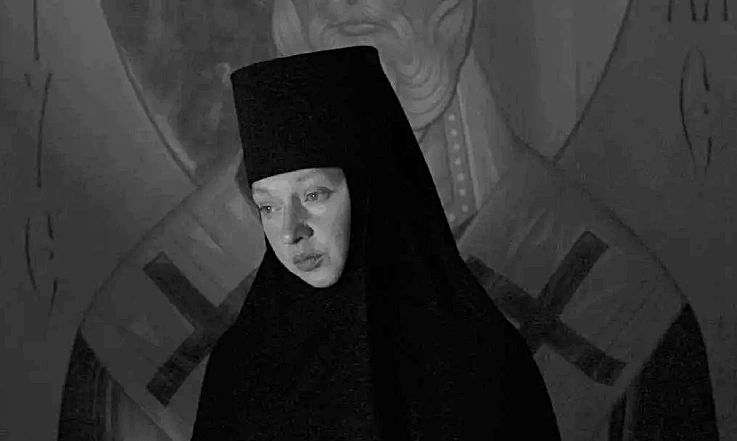
Alys Tomlinson and Cécile Embleton’s documentary Mother Vera, winner of the 2024 Grierson Documentary Competition at the BFI London Film Festival, offers an intimate exploration of a young Orthodox nun in a Belarusian monastery.
For the last twenty years, Vera has devoted herself to her spiritual calling. In her narration, she reveals the tragic past that led her to religious servitude. Her turbulent past gifts her a nuanced point-of-view when talking with some of the 200 men, rehabilitating and recovering addicts. A recovering heroin addict herself who lived on the fringes of society, Vera understands these men. She openly shares with Tomlinson and Embleton her contradictions, as she undertakes her own journey of self-discovery and redemption, and questioning whether it’s time to leave the monastery? Has she found the freedom she has desperately sought?
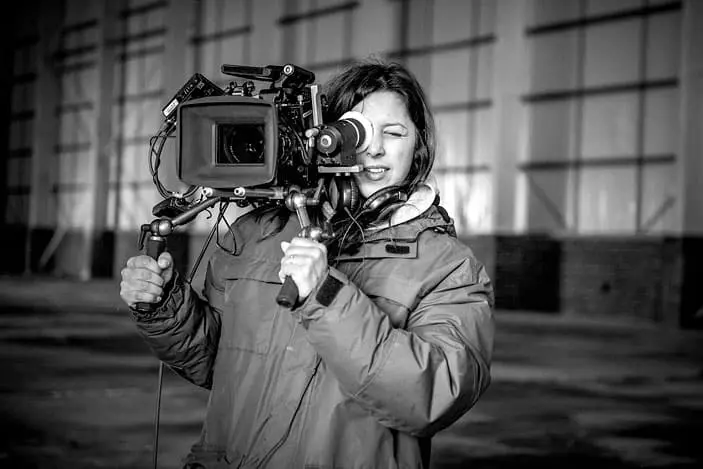
British photographer Alys Tomlinson and British-French film director Cécile Embleton merge different and shared visual backgrounds to create a film with a striking aesthetic. Embleton’s previous credits include the documentary short films, The Watchmaker (2016), about an Iranian man’s reflections on his craft, and Takashi (2017), which revolves around a blind viola player who overcomes his fear of movement with the help of music.
Tomlinson’s photography books include, the Lourdes set spiritual contemplation Ex-Voto, Lost Summer, a series of portraits featuring teenagers in the attire they would have worn had their proms not been cancelled during the Covid pandemic, and Gli Isolani (The Islanders), which Tomlinson describes as an exploration of “ritual, tradition and identity in the islands of the Venetian lagoon, Sicily and Sardinia.”
In conversation with Flux, Tomlinson and Embleton discussed their collaborative relationship, the striking spatial contradictions of Vera’s world, and their subject’s cathartic journey. They also reflected on their sensitive approach to exploring the layers of Vera’s story while creating layers in the audience’s emotional and contemplative experience.
Thinking about your different backgrounds in film and still photography, how much did this influence Mother Vera’s aesthetic?
Alys Tomlinson: My background is photography, and obviously, Cécile’s is filmmaking, although she also has a background in photography. So, we both have this experience and in terms of how it shaped the final film, what we found was Cëcile works in a very intuitive way when making a film, and I come from a background of very still and quiet photography, working with a big and old large format camera where I’m very much an observer.
It was challenging for me moving into the film world, because I was then having to think about many elements that don’t exist when I’m working purely on a still photography project. But certainly, we were both interested in exploring a similar aesthetic style, particularly within the monastery and its confines.
The idea was to build a visual aesthetic that was claustrophobic, where you felt you’d been submerged in a cavernous other world. Cécile’s film The Watchmaker, which was a slower meditative look at one man’s life, and my project about pilgrimage, which also looked at communities and faith, saw our backgrounds converge. It produced this aesthetic and mode of storytelling that really emphasised both of our interests, and visual styles.
Cécile Embleton: … Stillness and the sense of quiet is definitely present in Alys’ photography and also in my moving image work. I think that’s where we found each other. Also, having spent five years working on Alys’ project, Ex-Voto in Lourdes, and then in Poland, where we met Vera, we established a shared aesthetic.
I’m a French Catholic, and I’m not religious in any way, but because of this background, spirituality is very important, and Alys is coming more from a family of academics and atheists. Even though we come from very different backgrounds, we still had this overlap of an interest in places of contemplation.
In terms of the form of the project and the aesthetics, because we’d already been working together, it was not unspoken, but there was a clear understanding of the aesthetic we both enjoy and value. It’s one we feel is very powerful, particularly in these worlds where it’s pared back and very minimal; where you linger and focus on specific details.
We both have a high level of sensitivity to small things, and as Alys alluded to, the idea in the film was to move away from these closed internal and sacred spaces. This is where Vera confesses her past and everything she’s dealing with in her transformation. We wanted to move away from that small internal hidden space to big open landscapes. By moving from the finite small details of the hidden world to the infinite and the expanse of the world around us, it creates a dialogue between the two. That’s one thing we managed to develop quite well in this film, and it was beautiful to find that place and Vera, and to tell her story with so much of the richness of the world around her.
One of the striking things about the film was how claustrophobic the open spaces feel. Mother Vera explores the idea that claustrophobia is not only a physical, but an emotional and psychological sensation and state of mind.
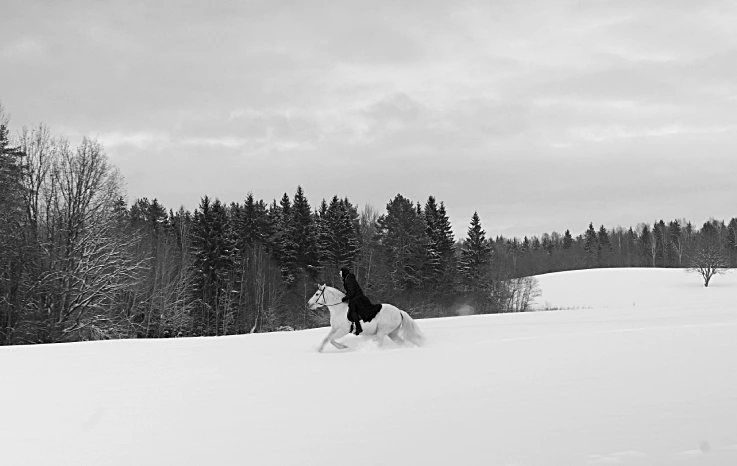
Tomlinson: There’s a lot of emphasis on Vera feeling trapped within her own emotional state. When you see her with the horses in the summer or even galloping through the snow with the white horse, there is a sense of her being set free. Emotionally, she’s being released in some way, but that sense of feeling trapped emotionally, you’re right, it doesn’t leave her. It stays with her whether she’s in the forest or inside the monastery. And in the monastery scenes, what we were trying to do was enhance that sense of being trapped emotionally and psychologically. There is a sense of it being released outside, but she is never entirely liberated and that’s something she is learning to deal with.
Embleton: The sense of claustrophobia and freedom that are both present in the openness, are two things that are always in dialogue with one another. We use a lot of winter landscapes because the coldness shows the austerity of this open space. You can feel connected to the beauty of nature, but also, as you say, it can feel quite isolating—particularly in her first monologue, where she says she didn’t want to be a nun. We put that against an open landscape with snow and a kind of island of trees.
The idea of that is to create exactly what you’re saying. It’s this idea of fragility around a human being who needs love and compassion—to be held in order to heal. We tried to create this contrast between the coldness of the atmosphere, of the landscapes, but also in contrast to the warmth of the community. And besides what’s happening with Vera, there’s also the collective character of the men and what’s happening between them. The men and the character of the landscape are psychological spaces.
When you first met Vera, what compelled you to want to make a film about her?
Embleton: Anyone that first meets Vera is intrigued because you can see she’s a person with many layers. She’s in a monastic outfit, but you can see her past lives are present in her physicality and the way she speaks, in her tattoos and her hands, and how charismatic she is. You can see that there’s a lot of life there, and so, she’s instantly intriguing. It was later going to Belarus and visiting her in the community, and discovering the whole world she was living in was a gift for film.
[…] We built a strong connection and realised there’s so much richness. Personally, I felt a strong connection to her spirituality, and the opposition to her earthly qualities in which she’s very sensual. That for me resonated deeply, and it felt urgent to make a film about her.
There was a lot to be explored here, and it was clear she wanted to explore it with us, but that was unspoken. And it felt there was an unspoken need in her to express something she wasn’t allowed to express, but you could feel it in her relationship with the horses, for example. It’s quite surprising to see a monastic sister lying on the ground with these horses in such a sensual way. It was like there was this desire in her that was being expressed to the camera, and it was cathartic for her—it was what she was looking for.
We didn’t know at the time, but she had been considering leaving the monastery for ten years, and when these two artists turned up with a camera and were ready to document her, she invited us in. It was something she needed to process to get through this decision.
Another reason I wanted to ask that question is because we’re prone to using the word “complicated” instead of “layered.”
Tomlinson: Complicated is used to readily, but certainly Vera is a layered character, and a complex one. We’re all complicated in our own ways, and as Cécile said, Vera is immediately visually striking. She has an ethereal presence, and she almost looked angelic when we first saw her. You can obviously be taken in by the way someone looks, and with her gestures, when we first started talking to her, she did look otherworldly.
[…] Cécile mentioned being very drawn to Vera’s spiritual side, whereas I was drawn to her as this incredible independent and adventurous woman, who had such fortitude, strength and courage. Of course, that is tied in with her faith that would steady her at times.
Vera is a very multilayered person, as perhaps we all are, but her past also speaks of someone that has multiple different ways of viewing the world, and also someone that has always followed her instincts, even though she was in a monastery for twenty years. She is someone that listens to herself, and she has a very strong idea of what she wants out of life. She’s still trying to figure out how to achieve that.
I would agree that complicated is a word that isn’t always appropriate, although certainly, she’s someone for who it took a long time to get to unravel or reveal some of her layers—she did that incrementally. We ended up spending many years in the monastery and the layers were peeled off each time we went, as we would learn more about her story. Then, there was the difficult job of trying to piece that together visually through her narration.
The image of a woman in monastic dress with Vera’s past creates an interesting conflict. The film is contemplative, and the audience are given space to enter the film. Neither of you take a judgemental position, instead, you extend an invitation for a conversation about human contradictions.
Embleton: […] One of the reasons why she’s such an incredible person to make a film about is she’s ready to show the good and the bad within herself, in a kind of confession. It is rare to bare your soul that much, and when someone is able to do that, we can see ourselves in that person.
As you said, complicated is not the best word—layered is maybe a better way to describe it. We’re all full of contradictions, and Vera, having lived so many different experiences, arrived at a place where she was able to confront that past and share it. And to forgive herself for her past and those experiences she has lived.
It’s nice to hear that you felt the space of the film was non-judgemental and allows the audience to enter very slowly and delicately into her inner world to experience what she’s sharing. There are very strong opposing forces that any film made about Vera would have because it’s within her.
On the idea of creating a non-judgemental space, we tried to suspend the viewer, giving the minimum of information needed to understand Vera’s story. Then, there’s more space for the emotion she’s sharing that you can reflect on and enter into. We tried as much as possible to pare it back for that emotional experience.
Tomlinson: There are a couple of shots onscreen that are black with her voiceover narration. That is obviously a very deliberate attempt to create space for the audience to find their own way through the narrative. It’s a direct way of relaying information, but you’re just looking at a black screen. There are these punctures in the film that allow you to do that. In fairness, we hope the viewer is drawn more into Vera’s story through these, but there is always that holding space where, to a degree, we’re not telling the audience to come to a conclusion about her moral behaviour or what has happened in her past. As Cécile says, we’re allowing the audience to reflect on their own situations and aspects of the human condition.
There are many themes that emerge around Vera’s character, and I feel these are themes and characteristics that we can relate back to ourselves. So, yes, this idea of holding back is important in terms of how we access Vera’s world and our own inner monologue.
Embleton: The black screens, of which there are three, I can’t believe we did that. It’s quite a brave decision, but it forces people to go inside because they’ve got nowhere else to go, right? You’re suspended, and the idea is to invite people to go into the silence and to reflect on their place in the world—their truth and whether it makes sense to them.
The power of Vera’s story is listening—she listens to her truth, and she gathers the courage to make that huge decision. What I love about filmmaking is the vulnerability and how cathartic it is for, hopefully, the protagonist, but also the filmmakers. It’s a process, and it’s a huge piece of personal development. It’s part of your life and it’s woven in. It’s not a job. Thinking about the film and the character, that affects you too, is a part of everyday living.
Mother Vera is in UK and Irish cinemas from 29th August 2025.
Interview by Paul Risker