The Silk Road isn’t a single route you can neatly follow on a map. It’s a network that cuts across cities, deserts, and mountain passes. In Central Asia, large parts of the route remain intact enough to follow with a clear sense of continuity.
Uzbekistan and Kyrgyzstan form one of the most accessible sections, where historic trading cities sit within a manageable distance of each other. Trains connect Tashkent, Samarkand, and Bukhara, while short drives fill in the gaps toward Khiva. From there, flights or overland routes lead into Kyrgyzstan, where the landscape shifts toward open valleys, alpine lakes, and a more nomadic way of life.
Historic Architecture and Markets in Samarkand
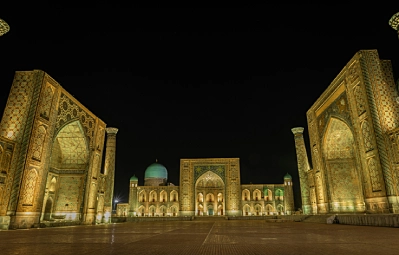
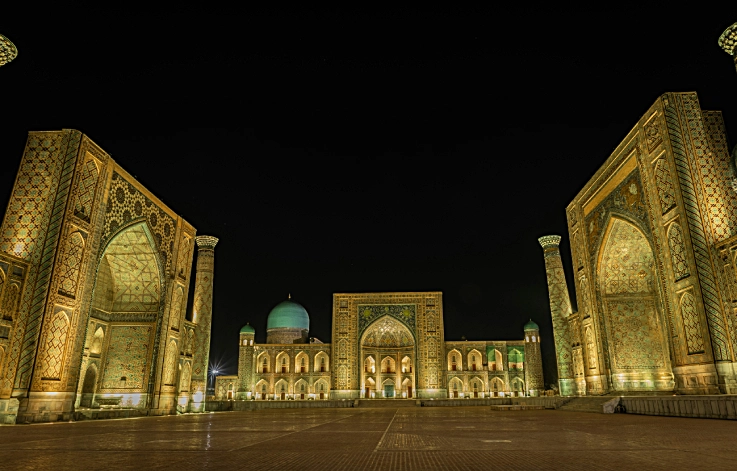
Samarkand is a strong starting point, where the scale of the Silk Road becomes clear. The Registan anchors the city, but it’s worth approaching on foot via Tashkent Road, where smaller shops and stalls lead you in gradually. Once there, the three madrasahs form a tight square, and most people circle through them before heading toward Bibi-Khanym Mosque, about a ten-minute walk away.
From Bibi-Khanym, the route continues into Siab Bazaar, where the city feels more authentic. Bread stalls line the entrance, and the layout opens into a wide grid of produce and spice sections. Walking back toward Shah-i-Zinda, the street narrows again. The necropolis sits along a slope, and climbing through its tiled corridors reveals how the city has built up over time.
For those looking to extend the trip beyond a single city, it helps to understand how routes connect across the region. If you want to travel the Silk Road yourself, starting in Samarkand and continuing west toward Bukhara by train works well as an introduction to the journey. It takes a few hours and follows a line that has been used in some form for centuries, linking the same cities that traders once moved between.
The Sacred Landmarks and Caravanserais of Bukhara
Bukhara feels more contained than Samarkand. Most of the key sites sit within walking distance of Lyabi-Hauz, a central pool surrounded by historic buildings. From here, it’s easy to reach the Nadir Divan-Begi Madrasa and the Khanqah, which both face the water.
A short walk north leads to the trading domes. Toki Zargaron, Toki Telpak Furushon, and Toki Sarrafon still function as covered markets, though their roles have shifted. The structure remains the same, with intersecting passages that once separated traders by craft. Moving through them makes it easier to see how trade was organized during the Silk Road era.
The Ark of Bukhara sits slightly apart, closer to Bukhara Square. Walking there takes about fifteen minutes, passing through quieter residential streets. Opposite it, the Bolo Haouz Mosque faces a long reflecting pool, and just behind that, the Po-i-Kalyan complex brings together the Kalyan Minaret, mosque, and madrasa in one open space.
Desert Landscapes and Ancient Fortresses of Khiva
Khiva is more isolated, and getting there usually involves a train to Urgench followed by a short drive. The city itself is compact, with most key sights contained within the Itchan Kala walls. Once through the west gate, the layout is easy to follow, with narrow lanes connecting mosques, minarets, and courtyards.
The Kalta Minor Minaret stands near the entrance, unfinished but still dominant. From there, it’s a short walk to the Kunya Ark, which sits along the inner wall and offers a raised view over the city. Climbing the Islam Khoja Minaret gives a similar perspective but from the opposite side, and it helps to see how tight the layout really is.
Outside the walls, the landscape opens up quickly. Many travelers arrange a day trip to the desert fortresses in Karakalpakstan, such as Ayaz Kala and Toprak Kala. These sit several hours away, so it’s usually a full day, but they are definitely worth the long drive.
Nomadic Traditions and Mountain Vistas in Kyrgyzstan
Crossing into Kyrgyzstan changes the pace completely. Cities become less central, and the movement is more about terrain. Bishkek is often the entry point, but most people don’t stay long. From there, the road east toward Issyk-Kul Lake passes through small settlements and open valleys.
The northern shore of Issyk-Kul is easier to access, with towns like Cholpon-Ata acting as a base. Petroglyph sites sit just outside the town, scattered across open fields, and the lake itself stretches far enough that it feels closer to a sea. Driving further east toward Karakol, the landscape changes again, with mountains closing in and roads narrowing.
From Karakol, routes branch into the Tian Shan range. Jeti-Oguz is one of the more accessible valleys, known for its red rock formations, while Altyn Arashan requires a rougher journey, usually by 4×4 or on foot. Yurt stays are common in these areas, typically set up along summer pastures away from the busier towns.
Modern Metropolises and Cultural Fusion in Tashkent
Tashkent can also act as a starting point, though many prefer to end their journey here, and it feels very different from the other stops along the Silk Road. The city spreads out, with wide avenues and a metro system that connects most districts. Chorsu Bazaar is a good introduction to the city, set near the old town. The market sits beneath a large dome, with surrounding streets spilling into smaller trading areas.
From Chorsu, it’s a short walk to Khast Imam Square, where religious buildings cluster together, including the Barak-Khan Madrasa. Amir Timur Square sits on the opposite end of the spectrum, surrounded by government buildings and hotels, with broad roads linking it to other districts.
The metro itself is worth using, not just for convenience but for its historical context, with stations built during the Soviet era that still reflect the design and identity of that period. Traveling between them offers a different view of the city. Lines extend into residential areas, where the pace shifts and daily life becomes more visible.
Are you ready for an epic adventure?
Following the Silk Road through Central Asia is not merely about ticking off landmarks, but following a historic route that still links cities and landscapes in a clear, continuous way.
Samarkand introduces the scale, Bukhara slows things down, and Khiva pulls everything into a tighter frame. Kyrgyzstan then opens it all back up, replacing cities with landscapes, before Tashkent brings things back into a modern setting.
It’s surprisingly easy to move between them. Trains, shared cars, and short flights fill the gaps, and most journeys don’t take as long as they appear on a map. It’s one of those trips where the connections matter as much as the stops themselves, which is what holds the whole journey together.
words Alexa Wang