From London and other parts of the UK, to Europe, the United States and China, and now Tokyo, curator Yuran Lin does not define her international practice by the number of places she has reached. She is more interested in a different set of questions: Why does a particular relationship need to unfold here? Who or what sets it in motion? And can it form a deeper connection with a place, leaving something behind?
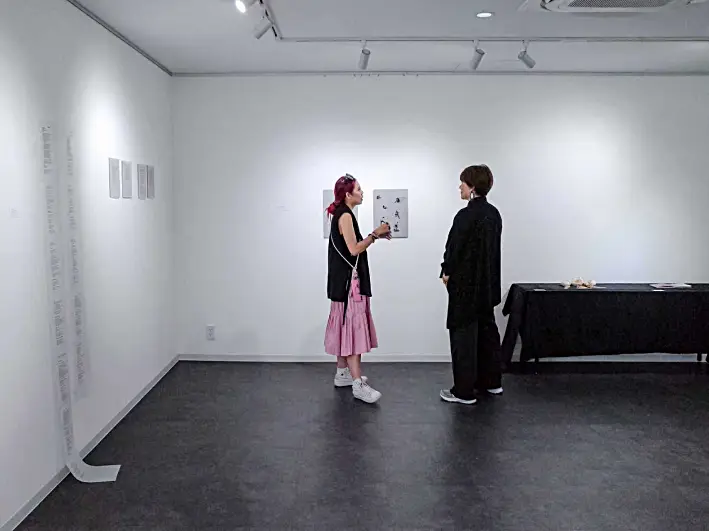
When Yuran Lin brought AI520 — Emotional Resonance to Tokyo in August 2026, her reason for choosing the city was unusually direct.
“Because the person I like is here.”
The exhibition took place at ARTGEN.GALLERY in Tokyo and was presented by LIN:K Projects, the curatorial platform Lin initiated in 2026. Yet for her, AI520 was never simply an exhibition about romantic love.
It began with a much harder question:
How do we actually understand another person?
The relationship behind that question has a much longer timeline than the exhibition itself.
The two met around ten years ago and were initially friends. He is British and later moved from London to Tokyo to work in the AI start-up sector; Lin grew up in China and has lived and worked in London for many years. It was only after she returned to the UK to pursue her doctorate that their long-standing friendship gradually began to change, developing into a relationship that continues to shape how she understands love, intimacy, cultural difference and emotional expression.
These experiences eventually formed the emotional and intellectual background from which AI520 emerged.
Even the title grew out of an intersection between language and lived experience. “AI” overlaps phonetically with ài, the Mandarin pronunciation of the Chinese word for love, while “520” is widely recognised in Chinese internet culture as a numerical shorthand for “I love you.”
What began as a linguistic coincidence embedded in private life eventually became a curatorial point of entry.
But the more significant transformation was not simply from a love story into an exhibition. It was the movement from one person’s experience towards a question that many people could enter.
“If AI520 had ultimately been nothing more than me putting my own love story into a gallery, that would not have been enough for me,” Lin says. “What really interested me was how a very personal question — ‘Why am I unable to understand this relationship?’ — could gradually become something broader: How do different people understand love, intimacy, distance and relationships?”
This process of transformation has increasingly become a clear methodological thread within her curatorial practice.
Before initiating LIN:K Projects, Lin had already worked extensively with arts institutions, galleries and independent art organisations of different scales, developing curatorial projects across the UK, Europe and China. Her practice has taken place within conventional exhibition spaces, but has also extended into communities, participatory projects and events centred around shared meals.
Rather than beginning with the question, “What kind of exhibition do I want to make?”, she is more inclined to start elsewhere:
“Where should this question take place? Who needs to enter it? And what kind of structure should we build around it?”
The answer does not always have to be an exhibition.
It might instead become a conversation, a workshop, a performance, a shared meal, or even a community relationship that takes time to develop.
This approach is closely connected to Lin’s parallel practice as a curator, artist and researcher.
Her doctoral research in the UK engages with autoethnography, cultural identity, community practice and participatory methodologies. At the same time, her artistic practice has long used personal experience as a way of entering broader cultural questions.
She once tried to keep these identities separate.
Now, she is more interested in understanding them as three distinct but interconnected modes of working.
“Art allows me to ask a deeply personal question; research helps me understand that question; and curating allows me to transform the question into a relationship.”
This understanding of transformation also runs throughout her long-term practice, Curate My Life.
The title does not refer to a life that has been carefully designed, organised or controlled.
Quite the opposite.
For Lin, it begins with an acknowledgement of what cannot be controlled: relationships change, people migrate, identities shift, plans fail, and loss rarely happens in the ways we expect.
What can be reconsidered is how we understand something after it has happened.
“I really value my ability to transform experience into practice,” she says.
“Pain can become a work of art, a question can become research, and a relationship can become a curatorial project.”
This does not mean turning every private experience into material for public display, nor does it mean searching for a positive meaning in every form of pain.
It is closer to a methodological question:
Can art and curating create a new structure through which an experience that has already taken place can be understood again?
This is also the boundary Lin is most attentive to in her use of autoethnography.
The self can be a point of departure, but it cannot remain the destination.
“How do you begin with yourself and eventually arrive at a question that is larger than yourself?”
AI520 became one concrete attempt to work through this question.
As artists from different backgrounds entered the exhibition, bringing with them experiences of intimacy, communication, family, memory, migration, the body, technology and connection, the question that had initially belonged to Lin began to detach itself from the relationship that had first generated it.
Audiences entered the exhibition with their own lived experiences. During the exhibition, the Artist Talk extended the conversation beyond the artworks themselves, creating dialogue between artists, collaborators and audiences, while also connecting participants who were unable to be physically present in Tokyo.
By that point, Lin felt that the original question no longer belonged to her alone.
This reflects a curatorial position that has become increasingly clear in her practice:
The curator is not the person responsible for providing a final answer, but the person who creates the conditions in which something can happen.
The conditions for artworks to encounter one another; for artists and institutions to build relationships; for audiences to enter a question; and for certain connections to remain possible even after an exhibition has ended.
Lin is also interested in the relationship between the word curator and the Latin curare — “to care.”
At the same time, she is careful not to romanticise curating.
Curating is intellectual work, but it is also highly concrete organisational labour.
Budgets, schedules, transportation, installation, communication and institutional coordination exist alongside curatorial concepts. Years of working with organisations of very different scales have also made her increasingly aware that art is not shaped by ideas alone. It is equally shaped by space, resources and organisational structures.
Large institutions, independent art spaces and community organisations produce fundamentally different ways of working.
Within community contexts in particular, even the idea of an “audience” needs to be reconsidered.
People entering a gallery have usually already made a decision to look at art.
In a community space, however, someone might simply have come to eat, to talk, or to spend time with other people.
At that point, the curatorial question is no longer simply:
“What kind of art should be shown here?”
Instead, it becomes:
“Why does art need to enter this space at all?”
LIN:K Projects emerged from this broader understanding of curatorial practice.
“LIN:K is not where I started curating,” Lin emphasises.
For her, it does not represent the beginning of her professional practice, but rather a change in agency.
Previously, she had largely entered frameworks already established by different institutions, working collaboratively and developing projects within those structures.
LIN:K allowed her to reverse that process for the first time:
Begin with a question, build the framework around it, and then find the artists, spaces, institutions and collaborators who genuinely belong within that question.
The name “LIN:K” itself points towards connection.
Lin does not want to establish it as a closed institutional identity. Instead, she understands it more as a node: one that temporarily connects different cities, artistic practices, research, communities and institutions according to the needs of each project.
Tokyo is its most recent node.
After developing her curatorial practice across the UK and Europe while maintaining ongoing connections with artistic and curatorial contexts in China, Japan still represents a new context for her.
When describing her arrival here, Lin uses a remarkably simple phrase:
“I wanted to come and see first.”
The statement also reflects her caution towards the idea of so-called “international curating.”
Producing a single exhibition in a new country does not mean that one understands that place, nor does it mean that a genuine cultural relationship has already been established.
“I don’t want to decide in advance, ‘This is what I am going to establish in Japan,’ and then go looking for reasons to prove it,” she says.
“I would rather begin with relationships.”
So rather than continually adding new cities to a map, she is now more interested in asking:
Why does this project need to happen here?
Why these people?
Why now?
And after the exhibition ends, what has actually been left behind?
In recent years, Lin has also begun to look back at her longer-term practice through the framework of Love, Life, Death and Unknown.
It is not a rigidly pre-planned curatorial system. Rather, these have gradually emerged as four recurring themes of lived experience. Tokyo has, for now, developed the most direct relationship with Love. Her community, food and cultural identity practices in London are increasingly situated within Life. Parts of her artistic practice developed in China have begun to respond to Death. Unknown, meanwhile, is deliberately left open, without a fixed geographical location.
Perhaps the most important of the four is precisely Unknown.
Because however much Lin values research, structure and curatorial frameworks, the things that ultimately redirect a practice are often those that cannot be planned in advance:
an unexpected encounter, a new city, a difficult experience, or a relationship whose meaning only becomes visible after a long period of time.
In the end, AI520 returned to exactly this point.
A friendship that began around ten years ago changed.
One person eventually came to live in Tokyo.
A relationship produced questions Lin could not answer.
Those questions became a curatorial proposition, and that proposition eventually became an exhibition composed of many different lived experiences.
By that point, Tokyo, for Lin, had also begun to become more than a location on a map.
It was becoming part of a relationship.
And perhaps this is the clearest position from which her curatorial practice operates today:
Not to search for answers to the uncertainties of life, but to build a structure in which questions that cannot be answered immediately can be seen, understood, and perhaps even entered by others.
Written by:Megan Hartley
September 7 2026