
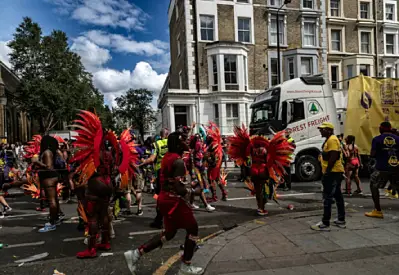
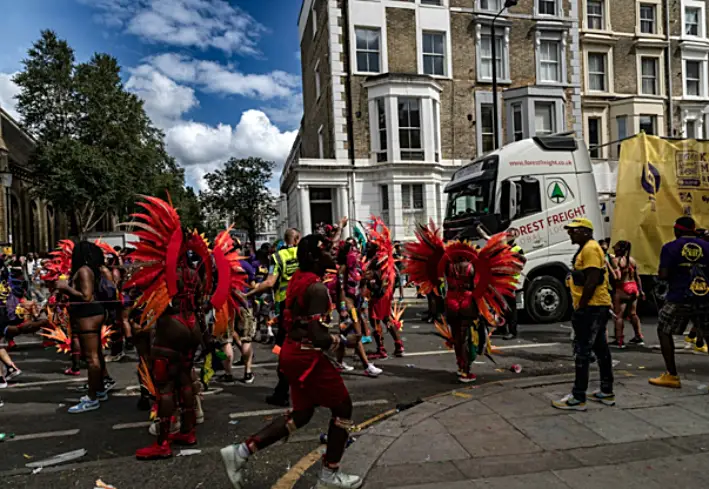
Every August Bank Holiday weekend, west London stops being London as you know it. The streets around Ladbroke Grove and Westbourne Park fill with sound systems the size of small buildings, dancers in feathers and sequins, and the smell of jerk chicken drifting over garden walls. This is Notting Hill Carnival — Europe’s largest street festival, and one of the best two days you can have in this city, provided you know what you’re walking into.
If you’ve never been, the scale can be genuinely disorienting. Millions of people descend on a few square miles of residential streets. There’s no ticket, no map you’re handed at the gate, no obvious “start here.” That’s part of the magic, but it’s also why so many first-timers spend half the day lost, hungry, or overwhelmed instead of having fun.
Here’s how to do it properly.
First, know what you’re actually going to
Carnival isn’t a festival that was built for tourists — it was built by a community, for a community, and everyone else is a welcome guest. It traces back to a Caribbean Carnival organised in 1959 by the journalist and activist Claudia Jones, held indoors at St Pancras Town Hall as a direct response to race riots that had shaken the area the year before. The outdoor event on Notting Hill’s streets followed in 1966, and by the 1970s it had grown into the parade of costumes, steel bands, and sound systems that defines it today.
That history matters once you’re there. This is a celebration of Caribbean culture, migration, and resilience, not a generic street party that happens to have good music. Support the vendors, appreciate the mas bands’ costumes, and remember you’re a guest in someone else’s celebration — and in someone else’s neighbourhood, since Carnival runs through residential streets where people actually live.
When it’s on, and how the two days differ
Notting Hill Carnival 2026 runs across the August Bank Holiday weekend, with the main events on Sunday 30 and Monday 31 August. The two days have distinctly different characters, and picking the right one matters more than almost anything else on this list.
Sunday is Family Day — a calmer, kid-friendly atmosphere with the children’s parade, and generally the easier day for a nervous first-timer. Monday is the big one: the main adults’ parade, the biggest sound systems, and by far the largest, densest crowds. If you want the full sensory-overload Carnival experience, go Monday. If you’d rather ease in, start with Sunday.
Many first-timers do both — a mellower Sunday to get their bearings, then the full spectacle on Monday.
Getting there and away
Leave the car at home entirely; roads throughout the area are closed, and several Tube and Overground stations near the site face closures or restrictions on both days. Check Transport for London’s journey planner on the day, since specific closures shift year to year.
Whatever route you take in, decide your route out before you arrive — trying to plan an exit strategy at 8pm, three drinks in, surrounded by 500,000 people, is not the moment. Avoid unlicensed minicabs touting for business near the site, particularly late at night.
What to actually wear
This is not the day for anything precious. Wear closed-toe shoes you can comfortably stand and dance in for eight-plus hours — trainers are the uniform for good reason, since broken glass and general street debris are a real hazard by the afternoon. Leave good jewellery, your nicest bag, and anything sentimental at home; crowded festival crowds are prime pickpocketing territory, and Carnival is no exception.
Dress for the actual forecast, not the one you’re hoping for — August in London can mean blazing sun or a sudden downpour, sometimes both in the same afternoon, so sunscreen and a compact rain layer both earn their place in your bag. If you’re near J’ouvert celebrations on Sunday morning, expect coloured paint and powder to be part of the fun, so wear something you won’t mourn if it gets stained.
Packing list: keep it light
The single best piece of advice from Carnival’s own organisers is to keep to the essentials. You genuinely don’t need much:
- A little cash (card readers slow to a crawl when every stall is swamped) plus a card as backup
- A phone, ideally with a portable charger, since signal gets patchy in dense crowds
- A refillable water bottle
- Sunscreen, and a hat if you burn easily
- Wet wipes and hand sanitiser — useful in ways you won’t appreciate until you need them
- A cross-body bag you can keep in front of you, zipped, at all times
That’s it. Anything valuable that isn’t on that list is better off left at home.
Handling the crowds without losing your mind (or your friends)
The single most useful thing you can do before you even leave the house is agree a meeting point with whoever you’re going with — something specific and easy to describe, not just “near the parade.” Phone signal becomes unreliable once the crowd density peaks, so don’t rely on being able to just call someone if you get separated.
Once you’re there, a few habits go a long way:
- Move with the crowd, not against it. Fighting upstream through a dense section is how people get hurt and tempers get short.
- Watch for crush points, particularly near the parade barriers, big sound systems, and Tube station entrances late in the day. If a space feels too tight, it’s fine to hang back and watch from the edges rather than push into the middle.
- Look out for signs of heat exhaustion in yourself and the people around you — in yourself, in friends, in strangers.
- If someone seems disoriented or unwell in the heat, get them somewhere cooler and find one of the first aid points; medical teams and ambulances are stationed throughout the route specifically for this.
- If you get separated from children or anyone who might struggle to find their way back, agree a meeting point in advance and take a same-day photo of what they’re wearing before you set off, so you can describe them accurately to a steward or officer if needed.
- Trust the stewards and police. They’re there in large numbers specifically to keep things moving safely, and they’re the right people to flag anything that feels off.
None of this is meant to scare you off — the overwhelming majority of the two million people who attend have an incredible, entirely trouble-free day. It’s simply worth a few minutes of preparation so a huge crowd never turns a great day sour.
The safety operation you won’t see (but is there)
Carnival’s scale means there’s a genuinely large safety operation running behind the scenes, and it’s worth knowing it’s there. The Met deploys around 7,000 officers a day over the weekend, alongside stewards, first aid teams, and medical response units stationed throughout the route — look for the interactive first aid map on the official Carnival site before you go, so you know roughly where the nearest point is if you or someone near you needs help.
In recent years the police have also used live facial recognition cameras on the approaches to Carnival, checking passers-by against watchlists for wanted or missing people — they’re positioned outside the Carnival boundary itself, before the crowds thicken. Following growing concern about crush risk as attendance has climbed toward two million, City Hall put an extra £4.66 million towards crowd safety and stewarding for the event’s 60th anniversary, on top of the existing multi-million-pound policing operation. Drones are banned for anyone other than official operators, and expect visible security at Tube stations and pinch points along the route as the day gets busier.
None of this is a reason to be anxious — it’s a reason to feel reassured. If something feels wrong, a genuinely large number of officers, stewards, and medics are within a short walk of you at any given point on the route.
The music: know your sound systems from your steel bands
Carnival’s music runs on what organisers call the five disciplines: masquerade, calypso, soca, steelpan, and sound systems — and the last of those is what most first-timers picture when they imagine Carnival. Static sound systems line the backstreets, each with its own devoted crowd, playing everything from classic reggae and dub to the latest soca and Afrobeats. Wandering between them, chasing whichever bassline pulls you in, is one of the purest Carnival pleasures there is.
Don’t skip the steel bands, though — the clatter and shimmer of a full steel orchestra is unlike anything else, and the National Panorama steel band competition on the Saturday before the main parade is worth catching if your trip allows for it. And don’t miss the parade itself: hours of elaborately costumed mas bands moving through the streets to live music, which is the event’s centrepiece and the best photo opportunity of the whole weekend.
Eating your way through it
Food is arguably as big a draw as the music. Stalls throughout the site sell Caribbean staples — jerk chicken, curry goat, rice and peas, patties, roti — cooked in the street on drum barbecues that have been fired up since dawn. Follow the smoke and the queues; the longest lines usually mean the best food.
Bring a bit of cash for this, since card machines can slow to a crawl when a stall is swamped and the queue is fifteen deep. And pace yourself with the drinks — if you’re going to have a few, do it responsibly, and never accept a drink from someone you don’t know or didn’t see poured.
A few things nobody tells first-timers
- Toilets exist, they’re just not obvious. Portable toilet blocks are dotted around the site — check the Carnival map in advance so you’re not searching mid-crisis. Some residents also open their homes for a small fee, which is a perfectly normal Carnival institution.
- The best viewing spots for the parade fill up early. If you want a good vantage point along the route rather than a spot in the general crush, get there well before the parade reaches your section.
- It’s genuinely fine to just wander. Unlike a ticketed festival with a lineup to plan around, Carnival rewards aimlessness — turning down a side street because the bass sounds interesting is a completely legitimate way to spend an afternoon.
- Ask before you photograph masqueraders closely, especially children. The costumes are spectacular and people are generally happy to be admired, but a quick “can I take your photo?” goes a long way.
Frequently asked questions
Is Notting Hill Carnival safe?
Yes — the overwhelming majority of the roughly two million people who attend each year have a completely trouble-free day. Around 7,000 Metropolitan Police officers are deployed each day of the weekend, alongside stewards, first aid teams, and medical response units stationed throughout the route, and City Hall put an extra £4.66 million towards crowd safety and stewarding for the 2025 event on top of the existing policing budget. The realistic risks are the same as at any huge outdoor crowd event — pickpocketing, crush points near barriers and Tube entrances, and heat exhaustion on a hot day — rather than anything specific to Carnival itself. Basic precautions cut that risk further: keep valuables to a minimum, agree a meeting point with your group in advance, stick to closed-toe shoes, and stay near the edges of a crowd if it feels too dense.
Is London safe?
Yes — London is generally regarded as one of the safer major world capitals, and the large majority of visitors experience no trouble at all. The city’s most common crimes against tourists are opportunistic and non-violent — pickpocketing, phone snatching, and street scams — concentrated in crowded tourist zones, transport hubs, and nightlife areas, particularly late at night; serious violent crime against visitors is comparatively rare. London is also heavily policed and extensively covered by CCTV, with a police service well practised at managing very large public events like Carnival, New Year’s Eve, and major sporting fixtures. As with any big city, ordinary precautions — staying aware of your surroundings, keeping bags zipped and in front of you, using licensed taxis or ride-share apps, and avoiding poorly lit or unfamiliar routes at night — go a long way toward keeping a visit trouble-free.
The bottom line
Notting Hill Carnival can feel like a lot to take in from the outside — the scale, the crowds, the sheer noise of it. But arrive with a plan for getting there and back, pack light, agree a meeting point, and treat it with the respect its history deserves, and what you’re left with is simply one of the best days London has to offer: incredible food, a parade unlike anything else in the country, and enough music to keep you dancing until your feet genuinely give out.
Go easy on yourself for the first hour or two while you find your bearings. By the afternoon, you won’t want to leave.
words Al Woods